



For decades, poverty was India’s permanent companion, surviving successive governments, Five-Year Plans, economic experiments and countless political promises.
It even became an election-winning slogan. In 1971, Indira Gandhi went to the electorate with two catchy words: Garibi Hatao (remove poverty).
It was an immensely effective political slogan. Unfortunately, poverty proved considerably more resilient than the slogan.
If I may ask, who exactly was expected to remove poverty? Was it some benevolent foreign government, an international agency or an outside entity that was supposed to come to India’s rescue?
Surely, that responsibility rested with the government elected by the people. Governments are not elected merely to make promises; they are expected to create the economic conditions in which people can improve their lives.
More than five decades after Indira Gandhi made poverty eradication a political rallying cry, India has achieved something that deserves recognition well beyond partisan considerations.
Numbers tell the story
According to the World Bank’s October 2026 Poverty and Equity Brief, an estimated 496 million Indians moved above the lower-middle-income poverty threshold of $4.20 (Rs398.44) a day between 2011-12 and 2023-24. The proportion of people living below this threshold fell from 57.7 per cent to 16.1 per cent.
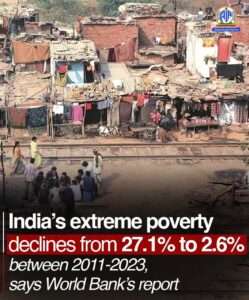
Even more striking is the decline in extreme poverty. Measured against the international poverty line of $3 (Rs284.91) a day, the proportion of Indians living in extreme poverty fell from 27.1 per cent to just 2.6 per cent.
These are not trivial statistical adjustments to be dismissed as government publicity. They represent a transformation in the circumstances of hundreds of millions of people.
Behind these numbers are families with better access to food, electricity, sanitation, housing, health, financial services and opportunities to earn a livelihood.
And this transformation has taken place predominantly during Narendra Modi’s tenure as prime minister.
Policies, not promises
The difference between making poverty an election slogan and actually addressing it lies in governance. Economic growth does not automatically translate into better living standards unless governments create mechanisms to ensure that its benefits reach ordinary citizens.
The Modi government has pursued a combination of economic reforms, infrastructure development, financial inclusion and targeted welfare programmes.
Jan Dhan accounts brought millions into the formal banking system. Direct Benefit Transfers reduced leakages in welfare distribution.
Ujjwala provided cooking gas connections to poor households, Swachh Bharat accelerated sanitation coverage, and the rural housing programme gave millions the prospect of a permanent home.
The expansion of electricity connections, roads, digital infrastructure, subsidised food distribution and access to basic services has also contributed to improving household welfare.
These initiatives did not operate in isolation. They were supported by economic growth, expanding consumption, employment opportunities and the increasing participation of women in economic activity.
The World Bank itself identifies rising consumption, employment growth, particularly among women, and expanded social transfers, including food subsidies, as important drivers of poverty reduction.
Credit, therefore, belongs not merely to Prime Minister Modi but also to the ministers, policymakers, bureaucrats and government departments responsible for translating policy into delivery.
The effectiveness of governance is ultimately measured not by the number of schemes announced but by their impact on people’s lives.
No room for complacency
None of this means that India has conquered poverty or that every Indian has an equal opportunity to prosper.
The World Bank has flagged persistent regional inequalities, youth unemployment and stagnant real earnings as significant challenges.
Employment generation, better wages, quality education, healthcare and improved skills remain pressing priorities.
Nor should poverty reduction be confused with the elimination of economic inequality. Millions who have crossed an international poverty threshold still have modest incomes and remain vulnerable to economic shocks.
But acknowledging unfinished business should not become an excuse to disregard what has been accomplished. Equally, recognising the achievements of the present government does not require pretending that every economic challenge has disappeared.
Results matter
India’s journey from the Garibi Hatao era to the remarkable poverty reduction recorded by the World Bank offers an important lesson in political accountability.
Poverty cannot be wished away through slogans, nor can it be eliminated by repeatedly announcing grand intentions. It requires sustained economic growth, sensible policies, institutional efficiency and a government determined to make development reach the last person in the queue.
Indira Gandhi gave India a memorable slogan. Narendra Modi’s government can point to measurable outcomes on a scale that deserves acknowledgement.
Ultimately, the electorate must judge governments not by the poetry of their promises but by the tangible difference they make to people’s lives. On that particular measure, India’s progress over the past decade is difficult to ignore.


