The Congress party appears to have discovered a new national obsession: demanding explanations for what the Indian armed forces may or may not have done during Operation Sindoor. Its latest target is former Chief of Defence Staff General Anil Chauhan, whose off-the-cuff observation about the possibility of a Bharatiya drone striking the Kiran Hills area in Pakistan has triggered demands for a probe. One has to ask: why is Congress so rattled? Instead of saluting the courage and professionalism of the armed forces, the party seems more interested in dissecting operational details that are, by their very nature, matters of national security. Surely, Congress leaders understand that military operations cannot be conducted with a running commentary for political parties, television studios or social media warriors. Operation Sindoor was launched after the horrific Pahalgam terror attack that killed 26 innocent people. Bharat’s response demonstrated that the old doctrine of absorbing Pakistan-sponsored terrorism and issuing ritual condemnations had ended. Indian forces struck terror infrastructure and military targets deep inside Pakistan, delivering a message that could hardly have been clearer: terrorism cannot be separated from the state machinery that sponsors, shelters or facilitates it. Most importantly, Bharat refused to be intimidated by Pakistan’s repeated nuclear blackmail. The message was unmistakable: nuclear weapons cannot provide a shield behind which terrorism can operate with impunity. And yet, while the country was standing behind its armed forces, sections of the Congress appeared more interested in questioning them. There is nothing wrong with legitimate scrutiny of government decisions. In a democracy, accountability matters. But there is a fundamental difference between demanding political accountability and casting suspicion on military action on the basis of an informal remark by a retired military commander. Turning an off-the-cuff observation into a political controversy risks revealing far more about the accusers than about the armed forces. If General Chauhan’s remark was imprecise, the military establishment can clarify it. If operational information was inadvertently disclosed, appropriate internal mechanisms can examine the matter. But converting every such statement into a political weapon against the government—and, by extension, against the credibility of Bharat’s military response—is irresponsible. Congress should also introspect about the increasingly shrill rhetoric coming from some of its own leaders. A party that once claimed to represent the entire nation cannot afford to sound as though it is constantly searching for constituencies to appease. Statements suggesting that a particular religious community is synonymous with Congress only deepen the impression that the party is retreating from national politics into identity-driven vote-bank calculations. Its political decline cannot be blamed on the armed forces, the Election Commission, the media or the Modi government.
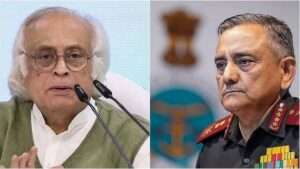
Congress has to look in the mirror. The demand for a probe into General Chauhan’s remarks is particularly curious when the larger strategic message of Operation Sindoor was that Bharat possesses the capability and political will to strike terrorist and military infrastructure wherever necessary. Pakistan’s nuclear threats did not paralyse New Delhi. That alone marked a decisive change in strategic signalling. Congress leaders are perfectly entitled to criticise Prime Minister Narendra Modi and his government. That is democracy. But national security is not an arena for reckless political point-scoring. The armed forces should not become collateral damage in an Opposition party’s desperate search for relevance. There is, however, one important constitutional correction to the argument being advanced by some: Article 19(1)(a), not Article 19(1)(c), protects freedom of speech and expression. Article 19(1)(c) concerns the right to form associations or unions. Restrictions on speech are governed by Article 19(2), while Article 19(4) deals with restrictions on the freedom of association. Therefore, the answer is not to casually threaten citizens or political parties with forfeiture of citizenship for speech. Such a step would itself be constitutionally problematic and dangerous to democracy. The better answer is to enforce existing laws firmly where speech crosses legally established boundaries, particularly where national security, incitement, or disclosure of legitimately protected information is involved. The Congress leadership should therefore do something simpler: restrain its loose cannons. Question the government. Attack Modi. Fight elections. Challenge policies. That is what an Opposition is supposed to do. But when Bharat’s soldiers are defending the nation, political parties should know where the Lakshman Rekha lies. The country expects political battles to be fought in Parliament and at the ballot box—not by undermining the morale, credibility or strategic autonomy of the Bharatiya armed forces. Bharat’s enemies need not be handed political ammunition from within.