


Gen Z really seems to be sandwiched between Millennials and Gen Alpha. How can a Baby Boomer like this writer write about these two generations by bypassing Gen X and Gen Y, also known as Millennials? But when there is a problem with a fruit, the researcher goes to its roots—and perhaps further down to the seed. This writer is at the root stage, where all the subsequent generations are asking him to comment on the “cockroaches” and their fight against the system, including the government.
Jantar Mantar, originally an astronomical observatory set up way back in 1724, 302 years ago, has undergone a remarkable metamorphosis. Today, the venue has become a familiar destination for protests, with the latest “cockroaches” gathering there and repeatedly demanding one man’s resignation.
Like cockroaches, which multiply rather quickly, the authorities perhaps did not foresee that their human counterparts could become equally persistent. If the CJI reportedly called the protesting youth “cockroaches”, one lady MP and a famous actress went a step further, describing them as people who belong to a gutter. There is, of course, a strong bonding between gutters and cockroaches: the latter find gutters an amenable place to thrive and multiply. Ironically, both subsequently changed their tone after facing instant backlash.
For nearly three weeks, this writer’s committed readers have been calling to ask why no piece had come from his end on these “cockroaches”—the Gen Z youth. Unless one hears from the horse’s mouth, nothing much can be said about them or the activities that have stirred the nation’s conscience.
This writer recently met a Gen Z girl, a meritorious student who had been studying in a boarding school and is now in a junior college attached to a hostel. Her otherwise small village near Bhongir, Tukkapur, gives no impression of what is happening in the country’s capital.
The first question posed to her was whether she knew that she belonged to Gen Z. Her answer was a simple “No”. Asked what she felt about the protests in Delhi and whether she believed things were moving in the right direction concerning paper leaks, she simply said she had no idea about the paper leak, the re-examination facility or the protest itself. She had no hesitation in admitting that she was completely unaware of this burning issue over which the country was protesting.
She is perhaps one among millions of unseen and unheard Gen Z youngsters who are tailor-made to do one thing: study, study and study. They remain largely cut off from the outside world, courtesy of a rote-driven education system that leaves little room for curiosity about what is happening beyond the classroom.
Back in Hyderabad, a couple of Intermediate students offered a very different perspective. They said they had worked hard and hoped for a lot, but after the paper leak, they had simply lost hope and were prepared not to take the re-examination. They launched a scathing attack on everyone responsible for the paper leak, from the chaprasi to the chairman, following the hierarchy all the way up.
They were, however, fully aware of the “cockroaches” and their protest and appeared excited about the minister’s resignation. When asked how they had benefited from it, their response was revealing: the minister’s resignation itself amounted to an admission of collective failure. The buck, they argued, stops with the minister—and he should go first.
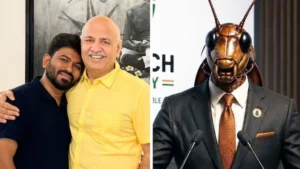
Politically speaking, the CJP appears to be a hotchpotch emergence of frustrated youth, ironically outsourcing its leadership to Boston, as though there were a serious dearth of local talent. Saurav Das, yes, seems to make more sense in his banter than the “imported” Dipke. Sceptics and cynics suspect these protests to be offshoots of the BJP and dub them “Anna Hazare Version 2.0”, though many reject the suspicion outright.
That the “cockroaches” have made themselves visible and are being taken seriously is undeniable. But the direction in which the movement is heading is less reassuring. It increasingly looks directionless. Political parties and leaders, meanwhile, are circling like vultures, eager to catch the political prey. So far, however, the “cockroaches” appear unwilling to fall into the trap.
Aged political leaders and ageing political parties are competing with each other to lure youngsters who are, ironically, fed up with precisely these old political formations. They cannot, therefore, arrogantly declare that Gen Z must necessarily be led only by Gen Z-aged leaders. Ironically, neither Dipke nor Saurav falls into that category to begin with.
Gen Z certainly needs the energy and impatience of youth. But it also needs the experience of Gen X, the knowledge of Millennials, the wisdom of Baby Boomers and even the futuristic imagination of Gen Alpha.
A blend of generations could perhaps help today’s youth understand the good, the bad and the ugly that have run through the experiences of earlier generations. Such a synthesis could help create an efficient, honest, hardworking and committed leadership team capable of taking the country forward.
Gen Z may need some hand-holding during its first few steps—not control, not political ownership, but guidance from Gen X, Millennials and Baby Boomers, along with the futuristic optimism represented by Gen Alpha.
Nobody wants a generation that started with a bang to end with a whimper. Gen Z could well become an important force in the larger challenge of leading India towards a brighter and more prosperous future.
At a time when democracy itself is going through many twists and turns, only time will tell whether the emerging generations, armed with high potential and intelligence, can make a meaningful dent in India’s political system—or merely become another instrument in the hands of those who have mastered the politics of protest.


