The Lok Sabha’s passage of the Micro, Small and Medium Enterprises Development (Amendment) Bill, 2026, on August 7 should have triggered a serious parliamentary debate. Instead, it passed amid Opposition protests and disruption, leaving a reform with potentially enormous consequences for Bharat’s small businesses inadequately discussed in the very institution meant to scrutinise it. This is not merely another amendment to an economic law. It addresses one of the most persistent problems confronting Bharat’s MSMEs: money earned but not received on time. According to figures cited in the Ministry of MSME’s annual report and the Economic Survey 2025-26, delayed payments to MSMEs have accumulated to an estimated ₹8.1 lakh crore. This is not capital that entrepreneurs are asking the Government to provide. It is money they have already earned by supplying goods and services but are waiting to collect. For a small enterprise operating on thin margins, a delayed invoice can mean delayed wages, deferred expansion, expensive borrowing and, ultimately, job losses. Large buyers can effectively use MSMEs as an interest-free credit line while the smaller supplier struggles to remain afloat. That is why this legislation matters. One of its important interventions is to enable States to establish multiple Micro and Small Enterprises Facilitation Councils (MSEFCs) instead of relying on a single overburdened mechanism. Existing councils have disposed of 53,911 cases involving ₹14,638.38 crore. That itself demonstrates both the demand for the mechanism and the enormous distance still to be covered. More councils can mean faster disposal—but only if States provide competent manpower, infrastructure and accountability. Merely multiplying institutions on paper will not solve the problem. The Bill also gives statutory permanence to the Udyam Registration Portal, strengthening the formal digital identity of MSMEs. This may sound bureaucratic, but it is important. A reliable common identity can help connect MSMEs with banks, TReDS platforms and payment-enforcement mechanisms, reducing the fragmentation that often hampers access to formal finance. Then comes the increasingly important TReDS platform, which enables MSMEs to discount invoices and receive money without waiting for buyers to pay. TReDS transaction volumes have reportedly risen dramatically—from about ₹40,000 crore in 2022-23 to ₹3.47 lakh crore in 2025-26.
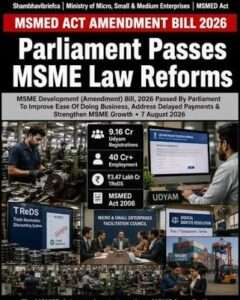
This is where the banking sector enters the picture. Delayed receivables force MSMEs to borrow working capital that they should never have needed in the first place. If payment discipline improves and invoice discounting expands, banks and NBFCs can finance more predictable receivables rather than merely extending increasingly expensive emergency credit. The larger economic implications are obvious. MSMEs account for roughly 31% of GDP, 36% of manufacturing output and 41% of exports, according to government estimates. They are also a major source of non-farm employment. An entrepreneur waiting months for payment does not think about expansion. He thinks about survival. He postpones hiring, machinery purchases and new orders. Unlocking working capital therefore has a direct bearing on production, employment and economic growth. But Parliament should have debated the weaknesses as vigorously as the potential. The delayed-payment protection remains principally focused on micro and small enterprises. Whether medium enterprises facing similar pressures receive adequate protection deserves closer examination. Likewise, creating more MSEFCs will achieve little if States cannot staff and operate them efficiently. And the ₹8.1 lakh crore figure should not be treated as a cheque waiting to be encashed. Recovering even a fraction of that amount will require enforcement, administrative capacity and time-bound dispute resolution. That is precisely why the Opposition’s disruption was so irresponsible. If there were shortcomings in the Bill, Parliament was the place to expose them. If there were safeguards needed, Parliament was the place to demand them. Walking out, protesting and allowing legislation to pass without meaningful debate does nothing for the very MSMEs the Opposition routinely claims to champion. India’s small entrepreneurs do not need political theatre. They need timely payments, cheaper working capital, enforceable contracts and institutions that work. The Bill points in the right direction. But legislation is only the beginning. The real test will be whether an MSME that has delivered today gets paid tomorrow—or is once again forced to wait months while its political champions make speeches about protecting it. MSMEs need cash flow, not crocodile tears.