



There comes a point in every political confrontation when rhetoric must give way to facts. The raging controversy over Chief Election Commissioner Gyanesh Kumar and the Congress-led Opposition’s street agitation has reached precisely that point. The Congress and its allies may continue shouting “vote chori”, demanding the CEC’s resignation and presenting themselves as champions of democracy. But democracy is not defended by slogans, street blockades or by dragging constitutional institutions into partisan battles. Democracy is strengthened by evidence, debate, institutional accountability and due process. The latest development should therefore command serious attention. Forty-two former eminent judges have now come out in an Open Letter in support of CEC Gyanesh Kumar and the Election Commission, expressing concern over attempts to undermine the credibility and independence of the constitutional poll body. Their intervention is significant because these are not political functionaries speaking for a party. They are people who have served in the judiciary and understand the constitutional architecture of the Republic. Their intervention also comes in the backdrop of the 272 eminent citizens who had defended the Election Commission in an Open Letter issued in November 2025. That letter was signed by 16 former judges, 123 retired bureaucrats, including 14 former ambassadors, and 133 retired armed-forces officers. They had criticised what they regarded as attempts to undermine constitutional institutions through unsubstantiated allegations against the Election Commission. The message from both interventions is unmistakable: questioning the Election Commission is legitimate; casually delegitimising it is not. The Opposition is perfectly entitled to scrutinise the functioning of the Commission. If there is credible evidence of wrongdoing, it should be placed before the appropriate constitutional and judicial forums. But there is a fundamental difference between raising questions and repeatedly declaring an institution guilty before the evidence has been established. The Supreme Court’s scrutiny of matters concerning the Election Commission and the Special Intensive Revision of electoral rolls reinforces precisely this constitutional route. The Court has sought responses from the concerned authorities. Yet judicial scrutiny cannot be equated with a judicial finding of guilt. The distinction is fundamental. The Opposition cannot have it both ways—demanding judicial examination on one hand while simultaneously declaring a constitutional authority guilty on the streets. More troubling is the manner in which the political confrontation has spilled onto the streets of New Delhi.
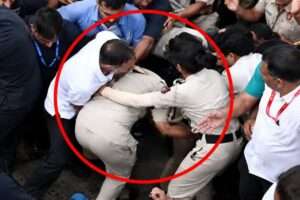
The events of October 7 were not hidden behind closed doors. The protests, confrontations with police, detention of Opposition leaders and subsequent video footage are available for public scrutiny. Delhi Police has also registered an FIR concerning the alleged unauthorised entry into Akashvani Bhawan during the protest. Video footage of the confrontation involving Rahul Gandhi and a woman police officer has further generated a political dispute. The Congress has contested the characterisation of the incident, maintaining that Gandhi was attempting to protect a party worker. The police position and the political explanation will ultimately have to be tested against the available evidence. And that is precisely why facts matter. Cameras may not by themselves establish the complete legal context of an incident. But they do make it considerably more difficult for political actors to rewrite what the public has actually seen. There is another uncomfortable historical lesson that the Congress cannot escape. The Emergency of 1975 remains one of independent Bharat’s darkest reminders of what happens when political power begins treating constitutional institutions as obstacles. The 39th and 42nd Constitutional Amendments were products of that turbulent period. The 42nd Amendment made sweeping changes to the constitutional framework. The Shah Bano episode offers another reminder of the tension that can arise between political expediency and judicial pronouncements. After the Supreme Court’s 1985 judgment, Parliament enacted the Muslim Women (Protection of Rights on Divorce) Act, 1986, during the Rajiv Gandhi government. History, therefore, does not permit any political party to claim a monopoly over constitutional morality. Rahul Gandhi cannot simultaneously hold up a pocket Constitution as a political symbol and expect the public to ignore video evidence when serious allegations arise from street confrontations. Nor can the Opposition claim exclusive ownership of democracy while bypassing the institutional mechanisms through which its allegations can actually be established. There is nothing undemocratic about questioning the Election Commission. There is, however, something deeply dangerous in attempting to destroy public confidence in a constitutional institution through relentless political rhetoric without first establishing the charges. Bharat is not a fragile democracy. Its institutions have survived wars, political upheavals, the Emergency, changes of government and intense electoral battles. They will survive this confrontation too. The intervention of the 42 former judges, coming after the earlier intervention of 272 eminent citizens, should serve as a warning against reducing constitutional institutions to political punching bags. Institutions can and must be criticised. Allegations can and must be investigated. But neither criticism nor allegation is a substitute for proof. The cameras are recording. The courts are watching. The people are judging. And facts do not need a political script.

