


N V Subash
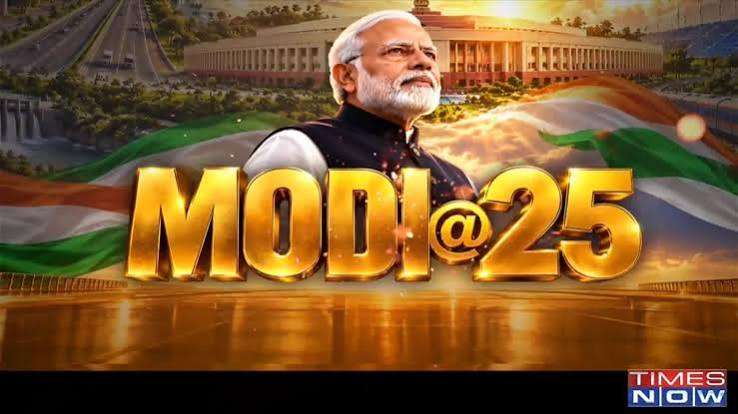
October 7, 2026, that’s today, marks a defining moment in Bharat’s democratic history. Prime Minister Narendra Modi completes 25 uninterrupted years as an elected head of government—a political journey that began in Gandhinagar on this day in 2001 and has since taken him to the centre of national and global affairs.
It is a record without parallel among Bharat’s elected heads of government. What began as the stewardship of a Gujarat emerging from the devastation of the Bhuj earthquake, recurring drought and administrative uncertainty has evolved into a quarter-century of continuous executive leadership. The Union Cabinet, in a resolution on October 6, described the milestone as 25 years of “unbroken leadership”.
For Modi, however, the journey has never been merely about longevity. It has been about converting political mandates into a governance philosophy built around Nation First, Citizen First.
From Gandhinagar to a National Blueprint
When Modi became Gujarat Chief Minister in 2001, the state faced enormous challenges. Reconstruction after the Bhuj earthquake became an early test of his administrative approach. Water security, electricity, agriculture, infrastructure and investment subsequently became central pillars of the Gujarat model.
The expansion of the Narmada canal network and thousands of check dams strengthened irrigation and water availability. Jyotigram Yojana transformed rural power supply, while the Vibrant Gujarat summits projected the state as an investment and manufacturing destination.
The larger significance of the Gujarat chapter was that it established Modi’s preference for measurable outcomes, infrastructure-led growth and direct engagement with citizens. His SWAGAT grievance-redressal initiative, for instance, later received the United Nations Public Service Award in 2010.
From Gujarat Model to Modi Model
The decisive transition came in 2014 when Modi moved to New Delhi after the BJP secured a majority on its own. Three successive Lok Sabha mandates later, his national tenure has become the defining political narrative of contemporary Bharat.
His governments have sought to combine welfare with infrastructure, technology with inclusion and economic growth with cultural confidence. Jan Dhan brought tens of crores into formal banking; UPI turned the mobile phone into an instrument of everyday commerce; Direct Benefit Transfer sought to reduce leakages; and schemes such as Ujjwala, Ayushman Bharat, PM Awas and Jal Jeevan Mission targeted basic dignity and access. By August 2026, PM Jan Dhan alone had crossed 59 crore accounts.
GST, Make in India, Digital India, the National Education Policy, the semiconductor push and large-scale infrastructure expansion have sought to alter the structural foundations of the economy. The IMF projects India’s 2026 nominal GDP at about $4.15 trillion, underlining the scale of the economy Modi now leads.
The transformation has not been confined to economics. Article 370, the Ram Mandir, the G20 presidency, the expansion of defence manufacturing and the assertion of Bharat’s voice in the Global South have collectively marked a period of considerable political and cultural change.
Kashi: The Personal Constituency
Perhaps nowhere is Modi’s development philosophy more visible at the constituency level than Varanasi, which he has represented in the Lok Sabha since 2014.
Kashi has witnessed extensive investments in roads, railways, sanitation, drinking water, tourism, heritage and urban infrastructure. The Kashi Vishwanath Dham redevelopment has given the ancient city a new public face, while major road and connectivity projects continue to reshape its infrastructure. In July 2026, the Union Cabinet approved two major elevated corridor projects for Varanasi involving a combined capital outlay of more than ₹25,000 crore.
A Quarter Century—and Still Counting
The extraordinary aspect of Modi’s 25-year journey is not simply that he has remained in power. It is that he has done so through repeated electoral contests, changing political circumstances, national crises and an evolving electorate.
From the earthquake-hit Gujarat of 2001 to an increasingly confident Bharat of 2026, Modi’s political journey mirrors a country undergoing profound change.
Supporters see him as the architect of a more assertive, aspirational and self-confident Bharat. Critics will continue to scrutinise his policies and methods, as they should in a democracy. But history will find it difficult to overlook the sheer scale and continuity of the political mandate behind his journey.
Twenty-five years after October 7, 2001, Narendra Modi stands not merely as one of Bharat’s tallest political figures, but as the longest continuously serving elected head of government in its history—a quarter century that has already become a defining chapter of independent Bharat. (The author is Telangana BJP state unit Chief Spokesperson and Media in-charge).


Superb review of Our PM Modi as CM & PM, Total 25 Years Tenure, Magnificent at a Stretch Performance Of 1/4 Century in the History Of Bharat .. I Think He Will be the First & Last Politician to have this Credits .. Hats Off to PM Modi, Lord Venkateshwera Swamy Bless Him With Best Of Health & The Best Days for Our Nation Bharath 🙏🙏💐💐🙏🙏