


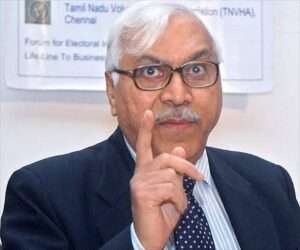
Former Chief Election Commissioner S.Y. Quraishi has suddenly discovered that the Election Commission needs to be lectured on electoral purity, constitutional propriety and democratic values. How convenient! Before preaching to the present Election Commission, perhaps Quraishi should spare a little time to revisit his own record as CEC and explain why standards that appear so sacrosanct today were not always applied with the same zeal during his tenure. Quraishi headed the Election Commission from July 2010 to June 2012, when the Congress-led UPA-II was in power. Nobody disputes his constitutional right to criticise the present ECI. But constitutional rights work both ways: the public has an equal right to examine the record of a former CEC who now presents himself as an uncompromising guardian of electoral democracy. And there is enough history to warrant that scrutiny. In 2020, when Quraishi criticised the Election Commission’s handling of alleged Model Code violations, the Commission itself hit back, accusing him of “selective amnesia”. It pointed out that during his tenure, none of the Model Code cases handled by the Commission resulted in an FIR being ordered, while only nine show-cause notices were issued. That response raises an obvious question: why should standards of electoral purity suddenly become more stringent when the occupant of the constitutional chair has changed? More importantly, Quraishi’s post-CEC career also deserves public examination. After leaving the Election Commission, he joined Smartmatic’s International Elections Advisory Council. This is not an allegation sourced from some anonymous social-media post. Smartmatic itself announced his appointment in 2015 and described the council as a body of eminent election professionals advising on election technology and electoral systems. There is nothing inherently improper about a retired election official advising a private election-technology company. But when that same former election commissioner subsequently becomes an outspoken critic of Bharat’s electoral machinery, questions about such associations are entirely legitimate. And the questions become even more interesting when Smartmatic’s corporate ecosystem is examined.
Smartmatic is part of SGO. Lord Mark Malloch-Brown, a prominent international political and development figure, served as SGO’s chairman before becoming president of the Open Society Foundations in 2020. SGO itself announced his move to OSF. Again, none of this establishes wrongdoing by Quraishi. Nor does it establish that his present criticism of the ECI has anything whatsoever to do with his past associations. But that is precisely why transparency is essential. Is Quraishi still associated with Smartmatic or any related organisation? What were the precise terms of his advisory role? Did he receive remuneration? Does he have any continuing professional or financial association with election-technology companies? And does he believe such associations should be disclosed whenever he comments publicly on Bharat’s electoral machinery? These are legitimate questions—not persecution. What is increasingly tiresome, however, is the phenomenon of retired bureaucrats and constitutional functionaries transforming themselves into instant crusaders against institutions they once headed or served. While in office, they speak the language of constitutional restraint. After retirement, some discover the freedom to make sweeping political interventions, often conveniently aligning with whichever political narrative happens to be fashionable. This is not confined to Quraishi. It is a larger malaise in Bharat’s public life. The bureaucracy is meant to serve the Constitution, not the government of the day. And after retirement, constitutional functionaries should not become political proxies for anyone. If an officer was genuinely independent while in office, that independence should remain visible in the record—not merely in post-retirement sermons. The Election Commission certainly deserves scrutiny. It must answer legitimate questions, explain its decisions and remain accountable to the people of Bharat. But accountability cannot be selectively demanded from one side. Those who question constitutional institutions must also be prepared to have their own records examined under the same unforgiving light. Quraishi is free to question the ECI. But he should not be surprised when the country asks him a few questions in return. And perhaps the most important one is this: Were the standards he is preaching today equally sacred when he himself occupied the chair? That is not a political vendetta. That is called accountability.

