

Shrikant Rao
The mid-September engineering summits at IAA Transportation 2026 in Hannover centered on a critical cross-continental reality: how the automotive and industrial supply chains are completely rethinking traditional component paradigms to match the future of electric movement. As electrified powertrains accelerate rotor speeds, thermal stresses, and high-frequency electrical loads, the technical focus has locked onto a component most drivers never see but on which modern electric drivetrains increasingly depend: the bearing.
For NBC Bearings, whose roots stretch back to Jaipur in 1946 under National Engineering Industries Ltd (NEI), part of the CK Birla Group, navigating this shift relies on a deliberately integrated cross-border model. By uniting their German technology hub, the Kinex manufacturing footprint in Slovakia, and their massive Indian R&D infrastructure, the company operates not as separate links in a traditional supply chain, but as a globally integrated engineering network.
I reached out to Andreas Knopf, Head of the Global Technology Centre at NBC Global (Germany) GmbH, through an extended e-mail exchange to explore how the Würzburg, Jaipur, and Slovak teams share application challenges, draw on regional academic talent, and co-engineer system-level solutions directly from the inception of a project.
Here is our full conversation:
The Global Network: Synergies Between Germany, Slovakia, and India
As Head of Group Engineering, can you describe the day-to-day workflow between Germany, Kinex Bearings in Slovakia and NBC’s R&D infrastructure in India?
I’d push back gently on the word “handover”—what we’ve built is a globally integrated engineering network, not a relay. Our German organization sits closest to many of our European customers, giving us direct visibility into application requirements, expectations, regulatory shifts, and emerging technology trends. Kinex in Slovakia adds an important European manufacturing and engineering footprint, while our Indian organization—home to NBC’s largest R&D centre—contributes substantial R&D depth, competency-based skills, resources, and manufacturing scale.
Every engagement starts the same way: with the customer’s application. Our German team works directly with the customer to understand the technical problem and shape it into a clear engineering requirement, ensuring genuine co-creation from the outset. From there, we draw on whichever capabilities across the group are best placed to deliver. This can span areas like application engineering and customer interface in Germany, product design, simulation and analysis, prototype development, materials expertise, manufacturing feasibility, testing, industrialization, and final customer qualification.
The principle that guides all of it is that engineering ownership doesn’t stop at a national border. Germany gives us customer proximity; Slovakia adds European engineering and manufacturing capability; and India brings a depth of scale, engineering resources, and manufacturing expertise that few competitors can match. Operating as one network lets us optimize for both technical quality and speed-to-market.
Accelerating R&D: Reducing Iterations for Automotive OEMs
How has having localized application engineering teams in Germany changed timelines for custom prototyping and commercial validation?
The real gain isn’t measured in days saved—it’s measured in fewer iterations between identifying a customer’s problem and delivering a technically validated solution. When our application engineers sit close to the customer, both physically and organizationally, we can embrace the requirement first-hand, stress-test assumptions early, and make engineering calls faster. The path from customer need to application analysis, concept design, simulation, testing, and validation becomes completely direct.
This matters enormously in eMobility, where development cycles are becoming more dynamic by the year, and customers rightly expect suppliers to move at the pace of their changing platform requirements. The GTC lets us combine local customer intimacy with NBC’s global engineering and manufacturing strength. Local engineering gives us speed and responsiveness, while our global infrastructure provides depth, scale, and competitiveness. Together, that creates a stronger value proposition for our European Tier-1 and OEM customers, and it genuinely differentiates NBC in the market.
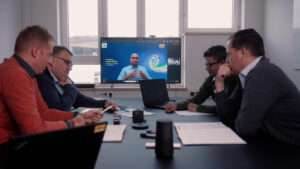
Engineering for E-Motors: Overcoming Electrical Erosion and NVH
What specific design and material breakthroughs has your Würzburg e-motors competence center achieved to address electrical erosion, extreme RPM and low-noise requirements?
The shift to electric powertrains changes the engineering brief fundamentally, and we’ve built our Würzburg competence centre around that reality. In conventional powertrains, bearing development is largely about load, speed, lubrication, temperature, contamination, and durability. Electric powertrains add a completely new layer—electrical current passage, electrical discharge damage, very high rotational speeds, thermal behaviour, and NVH. Our approach is to engineer the bearing as an integral part of the complete e-machine rather than a standalone component, because that is the only way to deliver real value to the customer’s system.
Electrical erosion is a prime example. In inverter-driven electric motors, electrical potential and high-frequency phenomena can drive current through the bearing. Under the wrong conditions, that produces electrical discharge machining effects on the rolling surfaces. Solving that requires us to co-engineer the bearing architecture, electrical insulation strategy, materials, surface engineering, lubrication, and sealing technology together, tailored to each customer’s specific application.
Higher rotor speeds raise the bar further on cage dynamics, lubrication, heat generation, stability, and overall bearing balance. NVH also matters more than ever. Electric vehicles are dramatically quieter than combustion-engine vehicles, meaning mechanical noise sources that used to go unnoticed are now front and centre for our customers.
Our competence-centre model lets us bring bearing design, tribology, materials, lubrication, manufacturing, and application engineering together around these challenges as one team. We are not chasing a bearing that merely survives higher RPM; we are engineering one that delivers reliable, efficient, quiet performance across the full operating envelope of the electric powertrain.
Strategic Footprint: Choosing Würzburg Over Schweinfurt
Schweinfurt is historically celebrated as the European centre of the bearing industry. What went into the strategic decision to establish NBC’s Global Technology Center in Würzburg instead? How has this choice helped NBC forge a distinct corporate identity and support talent retention?
At NBC, every location decision we make is ultimately a customer decision, and Würzburg was no exception. Schweinfurt’s legacy in bearing technology is undisputed, and it remains an integral part of the global bearing ecosystem. But as we looked at where we needed to be for the next phase of growth, it was clear we needed more than heritage. We needed a platform purpose-built around our customers’ future—one with its own identity, its own operating culture, and a mandate focused squarely on next-generation engineering.
Würzburg gives us exactly that, just 30 kilometres from Schweinfurt. We stay close to the deep technical talent and industrial ecosystem the region is known for, while building the Global Technology Center to augment a forward-facing NBC platform.
We were deliberate that this would never be a conventional sales or liaison office. We built the GTC to be a strategic arm of NBC’s global R&D organization. It serves as a European technical gateway, drawing on the scale of our largest R&D base in India, where our teams sit shoulder-to-shoulder with European customers to co-create solutions from the ground up. Our competence centres in eMobility, wheel-end, drivetrain, and manufacturing technology exist for one reason: to keep our engineers as close as possible to the problems our customers are actually trying to solve.
This also shapes how we attract and retain talent. Today’s engineers want to work at the edge of electrification, advanced materials, tribology, NVH, digital engineering, and smart manufacturing. By leveraging the multidisciplinary ecosystem in the Würzburg area, we give our people the chance to take on global technology challenges while remaining part of a large, connected international organization. This was never about competing with Schweinfurt’s heritage; it is about drawing on the strength of the wider region to build a distinct innovation hub aligned with where the technology is heading next.
Cultivating the Pipeline: Academic Collaboration with Technical University of Applied Sciences Würzburg-Schweinfurt (THWS)
Würzburg has a strong academic ecosystem, including the THWS. How actively does your facility collaborate with these institutions, and how critical is this regional talent pipeline?
No technology centre succeeds in isolation, and I say that to our teams often. Deep collaboration with the region’s academic and engineering ecosystem is core to how we operate. The Würzburg–Schweinfurt region carries a strong concentration of capability in mechanical engineering, mechatronics, materials, manufacturing, and automotive technology. Institutions like THWS stand out for their applied-engineering focus, which is exactly the orientation we need.
Our goal is simple: connect academic knowledge to real industrial problems to make our customers successful. Future bearing technology increasingly cuts across traditional mechanical-engineering boundaries. An e-motor bearing today can touch tribology, materials science, electrical effects, lubrication, thermal management, dynamics, acoustics, and digital monitoring all at once. That demands genuinely multidisciplinary talent.
Because of this, we don’t treat the regional academic ecosystem as simply a recruiting channel. We see it as a two-way technology pipeline where universities and research institutions bring emerging knowledge and talent, and we bring real application challenges, validation requirements, and manufacturing realities back to them. That exchange keeps our engineering team technically sharp and ensures our capabilities evolve in step with the industry.
The Validation Loop: Aligning Prototypes with European Standards
European automotive and industrial customers enforce demanding performance, safety and sustainability requirements. How does the GTC ensure that traditional design paradigms are adapted to these standards from the prototype phase?
Our philosophy here is straightforward: we validate the application, not just the component. A bearing can meet every catalogue specification and still underperform in a specific vehicle or machine. Therefore, our process starts by deeply understanding the customer’s complete application environment—including rotational speed, radial and axial loads, temperature, lubrication, contamination, duty cycle, electrical environment, expected life, and NVH requirements—before a single design parameter is fixed.
We then translate those system-level requirements into bearing-level design and validation criteria. By using digital engineering and simulation, we identify critical parameters early, followed by physical prototyping under representative operating conditions. This forms a continuous engineering loop that runs from customer requirements and application understanding, through concept design, simulation, and prototyping, to validation, manufacturing feedback, and final design refinement.
Manufacturing capability is built into that loop from day one, not bolted on at the end. A technically brilliant prototype means little if we can’t manufacture it consistently at the quality, volume, and cost our customer needs. This is exactly why the engineering team’s mandate runs beyond product development into manufacturing technology and industrialization. This tight integration of product, application, and manufacturing engineering working as one is what allows us to meet the exacting standards our European automotive and industrial customers rightly demand.
Paradigm Shift: Moving from Component Supplier to Technology Partner
Since the establishment of the GTC, what would you identify as its single greatest engineering or commercial achievement?
If you ask me to name one project or one customer win, I’d say that misses the bigger achievement. What I’m proudest of is the operational bridge we’ve built between NBC’s global capabilities and the European technology ecosystem, establishing Würzburg as a genuine strategic arm of our R&D organization.
When we established the GTC, our goal was to bring NBC closer to global customers and give ourselves the ability to respond to their technical requirements from within Europe itself. Since then, we’ve steadily built real competence across eMobility, wheel-end, drivetrain, and manufacturing-process development.
That has changed the character of our customer relationships. We now want to be in the room much earlier—when customers are still shaping their application architecture, performance requirements, and engineering challenges—because an engineering partner adds far more value when it helps design and optimize an application than when it simply supplies a component after the design is already locked.
So if I had to put the achievement in one sentence: the GTC has helped NBC evolve from being primarily a component supplier into a true technology and application-engineering partner for our global customers. That’s the foundation we’re building the next stage of growth on.
The Next Horizon: Smart Sensors, Digital Twins, and Beyond
Looking at the next three to five years, how do you see the German facility spearheading deeper digital integration, such as smart sensor bearings and digital twins, into NBC’s global product roadmap?
The next chapter of bearing technology will increasingly blend mechanical engineering with sensing, connectivity, simulation, and data analytics—and I see the Würzburg GTC playing a central role in shaping it. Historically, a bearing has been a highly engineered but largely passive mechanical component. The opportunity in front of us is to make bearings active contributors of information about the health and condition of the machine or vehicle they sit inside.
We are driving this forward by focusing on how condition monitoring, digital twins, and data-driven product development interact with one another. By embedding sensor-enabled capabilities, we can surface real-time speed, temperature, and vibration parameters to support predictive maintenance. We can then combine these laboratory results and field data into a living digital representation of bearing behavior, ultimately connecting design models and manufacturing data into one continuous engineering cycle.
The German GTC is well positioned to lead this because our proximity to customers keeps us close to the real application problems this technology needs to solve. We’re disciplined about one question above all: what information actually creates measurable value for the customer? A bearing that gives early warning of lubrication deterioration, abnormal vibration, or thermal drift becomes an asset to a customer’s broader digital management strategy. That is a far bigger opportunity than simply putting a sensor on a bearing for its own sake.
Our ambition is to bring mechanical engineering, materials science, tribology, electronics, data analytics, and manufacturing intelligence together into one coherent global technology roadmap, with the GTC and India working as two ends of the same strategic engine.
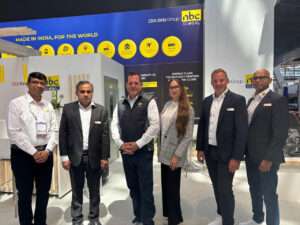
We took that story directly to the market during the recent IAA event in Hannover, giving customers and industry stakeholders a first-hand look at how our global engineering network is meeting the changing demands of mobility and industrial applications. For us, an event like IAA isn’t just a product showcase; it’s a demonstration of how NBC is evolving into a technology partner capable of standing with our customers from early application development through industrialization and global supply. That is exactly the role I see for the Würzburg GTC going forward.