



We have enough to worry about already. Global warming, erratic monsoons, rising temperatures, melting glaciers and governments dragging their feet on climate commitments.
Now comes another warning from the Arctic: the ground beneath our feet may have been storing a climate time bomb for thousands of years.
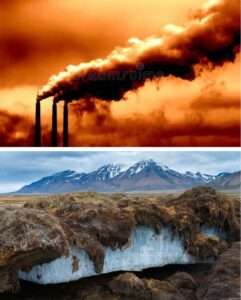
According to an AP report, the thawing permafrost in Alaska is releasing methane and carbon dioxide that have been locked in frozen ground for millennia. These are greenhouse gases that trap heat in the atmosphere.
As the Arctic warms rapidly, the frozen ground that once kept this organic matter preserved is beginning to release its contents. What was once buried in the distant past is becoming a problem for the present. Nature seems to be opening its own account books and humanity may not like to pay the price.
A problem we are helping to create
The irony is that we are not merely passive victims of this process. Our dependence on fossil fuels, relentless consumption and appetite for ever more energy are contributing to the warming that accelerates the thaw. The danger is that the resulting emissions could add to the warming that caused them in the first place.
Methane emissions from cattle add another dimension to the problem. As global demand for meat grows, so does the pressure of livestock production on the environment. Cattle release methane during digestion, making them a significant source of this greenhouse gas. We cannot blame the Arctic alone when our own consumption patterns are part of the story.
Of course, nobody expects the world to abandon its appetite for beef overnight. But must economic growth and personal consumption always come at the expense of the planet we intend to leave to our children and grandchildren?
October, and the air conditioner is still on
Closer home, we do not need a scientist to tell us that something is amiss. It is October, traditionally associated with the retreat of the monsoon and the arrival of autumn (Sharad-Hemant ritu) in parts of India, yet many of us still find it difficult to get through the day without an air conditioner.
If those who can afford air conditioning are struggling, imagine the plight of people who cannot. The poor have neither the luxury of escaping the heat nor the means to protect themselves from its consequences. They are often the least responsible for the emissions that contribute to climate change, yet among the first to suffer from it.
We blame El Nino for deficient monsoon rainfall, and with reason: this naturally occurring climate phenomenon can disrupt rainfall patterns over India.
But El Nino is not something humanity simply switches on at will, nor does it occur every year. Climate change can complicate the picture, but the two are not interchangeable explanations for every erratic monsoon.
Consumption continues to rise
Perhaps what we need is La Nina, the cooler counterpart of El Nino, to give us some relief. But even that would be no magic solution. A temporary shift in Pacific Ocean temperatures cannot reverse the long-term warming caused by greenhouse gas emissions.
Still, one is tempted to ask, with a touch of desperation: must we wait for the planet to turn into an inferno before we learn to respect it? At this rate, we might even begin wishing for an ice age.
The real tragedy is that we already know what is happening. Scientists issue warnings, international conferences produce declarations, and governments promise action. Yet consumption continues to rise, fossil fuels remain deeply entrenched and the interests of the present repeatedly trump the welfare of the future.
The carbon trapped beneath the Arctic may have taken millennia to accumulate. We could be releasing its contents into the atmosphere within a few generations.
Our descendants may well ask what we were thinking when the warnings were already there for everyone to see. What answer shall we give


Nagarjuna Rao’s “When the Frozen Past Threatens Our Future” is a thoughtful and scientifically grounded piece that effectively connects the phenomenon of Arctic permafrost thaw with the broader dynamics of climate change. The article explains the important positive feedback mechanism involved: warming accelerates permafrost degradation, which can release previously trapped methane and carbon dioxide, potentially contributing to further atmospheric warming.
What makes Nagarjuna Rao’s work particularly valuable is his ability to translate a complex Earth-system process into an accessible public argument without losing its scientific significance. His discussion also connects Arctic changes with fossil-fuel consumption, livestock methane emissions, changing monsoon behaviour and climate inequality, thereby presenting climate change as an interconnected socio-ecological system rather than an isolated environmental problem.
The article’s greatest strength lies in its systems-thinking approach. Nagarjuna Rao reminds the reader that processes operating over geological timescales can be rapidly altered by human activity, creating consequences that may extend across generations. It is therefore not merely a commentary on climate change, but a scientifically informed warning about feedback loops, cumulative environmental risk and intergenerational responsibility.
Overall, Nagarjuna Rao deserves appreciation for presenting a complex climate-science issue with clarity, scientific reasoning and a strong sense of human responsibility.