



In March 1890, a British lieutenant riding across Chinese Turkestan on a secret mission to track a killer was handed a bundle of brittle birch bark by a local digger. He paid for it, rolled it up, and sent it to Calcutta, unaware that he had stumbled upon what was then regarded as the oldest known Indian written manuscript. This roughly 1,500-year-old medical text had lain for centuries inside a ruined Buddhist stupa.
What began as a colonial manhunt for the murderer of a Scottish trader ended not with a dramatic arrest in the Karakoram, but with one of the most important manuscript discoveries in the history of Indian scholarship.
The killing that started it all
The story begins in April 1888, on the roof of the world.
Andrew Dalgleish, a Scottish trader and traveller, was camped with his party after crossing the Karakoram Pass, north of Kashmir. Inside his tent, he was shot by an Afghan named Dad Mahomed, a Kakar Pathan from Quetta who had once been a merchant but had fallen into debt and desperation. After the gunshot, Dalgleish was reportedly finished off with a sword.
The Government of India wanted the killer found. Lieutenant Hamilton Bower, a British Army officer, was sent on a confidential mission into Chinese Turkestan—present-day Xinjiang—to track Dad Mahomed.
A stranger, a dig and a bundle of bark
Bower’s pursuit took him far beyond the Karakoram, deep into the oasis towns along the old Silk Route. By early March 1890, he was near Kucha, in what is now northwestern China.
There, a local man who had previously worked in India approached Bower’s camp. He spoke of an “underground city” where he and a companion had been digging for treasure. They had found no gold, he said, but a book.
About an hour later, he returned carrying sheets of birch bark, protected between two wooden boards.
Bower bought the bundle on March 2 or 3, 1890, according to later scholarly reconstruction. He had no idea of its importance. He sent it to the Asiatic Society of Bengal in Calcutta, via Simla, along with a note describing the circumstances in which it had been found.
The bark had reportedly come from a ruined Buddhist stupa near the Ming-oi caves at Qumtura, roughly 15–20 kilometres west of Kucha, a site that once stood along the great caravan routes linking India, Central Asia and China.
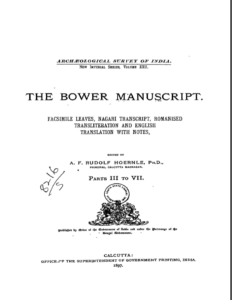
Calcutta’s scholar and the “oldest Indian book”
In Calcutta, the manuscript reached Augustus Frederic Rudolf Hoernle, a German-born Indologist associated with the Asiatic Society. He began studying it in February 1891 and presented his initial decipherment at the Society’s April meeting.
Hoernle recognised its extraordinary importance. It was then regarded as the oldest Indian written book known to scholarship—a collection of seven fragmentary Sanskrit treatises written in an early Gupta script, a later development of Brahmi, on birch bark.
Based on the palaeography, scholars placed the manuscript broadly in the 5th to early 6th century CE. The text itself contains no explicit date.
The manuscript, which came to be known as the Bower Manuscript after its finder, consists of about 51 birch-bark leaves. Rather than being a single work, it is a composite collection of seven separate texts.
A doctor’s handbook on the Silk Route
Three of the seven texts are medical.
One is a specialised treatise on garlic. Another is a formulary known as the Navanītaka—the Sanskrit word for “butter”—essentially a handbook of remedies and recipes. The remaining texts deal with divination, charms and protective practices, including remedies or protections associated with snakebite.
A name appearing in the manuscript is Yaśomitra. Hoernle regarded him as a possible patron of the manuscript or perhaps the person commemorated by the stupa in which it was deposited.
Then came another important clue.
Birch bark as a writing material was strongly associated with north-western India, while the birch species used for such manuscripts did not grow in Eastern Turkestan. The pages, therefore, had travelled—or the scribes who produced them had.
The discovery offered evidence of a north Indian scribal and intellectual tradition reaching deep into Central Asia. The manuscript may have been carried across the mountains and deserts by people moving along the Silk Route before eventually being deposited in a Buddhist monument.
A medical book had, in effect, travelled thousands of kilometres from the Indian cultural sphere before being sealed away for centuries.
The killer, the memorial and the manuscript’s journey
As for the man Bower had been sent to catch, the hunt did not end in a dramatic confrontation.
Dad Mahomed was arrested in Samarkand in 1890, far from the Karakoram tent where Dalgleish had been killed. He never faced trial in India and later died by suicide in prison.
Bower subsequently erected a small memorial at the place where Dalgleish was killed, marking the spot where the trader’s journey—and Bower’s pursuit—had taken a fatal turn.
The manuscript he had acquired almost incidentally followed a very different path.
From Calcutta, it eventually reached the Bodleian Library in Oxford, where it is preserved today in the university’s collections.
Why this matters?
The Bower Manuscript did far more than add an ancient text to a library shelf.
Its discovery transformed scholarship on the intellectual and cultural history of Central Asia. It provided an important window into the Buddhist civilisation that once flourished in Chinese Turkestan and offered evidence of the extraordinary reach of Sanskrit learning along the Silk Route.
It also demonstrated that Indian medical knowledge, recorded in Sanskrit and Indian scripts, had travelled far beyond the subcontinent.
For historians of medicine, the manuscript provides one of the earliest surviving physical windows into how remedies were recorded, how substances such as garlic were understood and used, and how practical medical knowledge coexisted with ritual practices and protective charms.
More broadly, it reveals a world in which ideas, languages, scripts and medical knowledge moved across mountains and deserts along the same networks that carried silk, spices, precious goods and religious traditions.
A hunt for a murderer, a gift to history
A British officer was hunting a murderer across some of the most forbidding terrain on earth.
What he inadvertently left for the world was not a courtroom drama, but a medical manuscript that had waited centuries inside a ruined Buddhist stupa.
The Bower Manuscript remains a remarkable counterpoint to the violence that led to its discovery: an Indian medical tradition preserved on fragile birch bark, carried into Central Asia, deposited in a Buddhist monument and eventually recovered almost by accident.
A murder set Hamilton Bower on the trail of a killer.
That trail led, unexpectedly, to one of the most remarkable surviving witnesses to India’s ancient medical and intellectual connections with Central Asia.



A Remarkable Investigation into the Hidden Continuity of Civilisation
The Murder Hunt That Unearthed India’s Oldest Written Book is an unusually compelling piece of investigative historical journalism. What begins as the pursuit of a murderer gradually becomes an inquiry into something far greater—the movement of knowledge, medicine, language and intellectual traditions across the ancient world. The article traces how Hamilton Bower’s 1890 investigation unexpectedly led to the discovery of the birch-bark manuscript that came to be known as the Bower Manuscript, a collection of Sanskrit texts dated palaeographically to roughly the fifth or early sixth century CE.
Its strongest feature is the scientific interconnection of apparently unrelated evidence. Geography, palaeography, manuscript material, archaeology and the history of medicine converge in the narrative. The fact that birch bark associated with north-western India was found in Central Asia raises an important historical inference: knowledge was not confined within modern political boundaries but travelled through human networks across the Karakoram and Silk Routes. The manuscript therefore becomes more than an ancient document—it becomes physical evidence of the transmission of ideas between India, Central Asia and China.
The investigative method is particularly significant because it follows evidence rather than beginning with a predetermined conclusion. A murder investigation leads to a geographical trail; the geographical trail leads to an archaeological find; the material leads to palaeographic analysis; and the manuscript finally opens a window into ancient medicine, Buddhism, Sanskrit scholarship and transcontinental exchange. This chain of discovery demonstrates how one historical clue can illuminate an entire civilisational network.
The deeper achievement of the article lies in its sense of discovery. It reminds us that history is not merely a chronology of kings, wars and political boundaries. It is also the history of human consciousness—how people carried ideas, remedies, scripts, beliefs and intellectual practices across mountains and deserts. The manuscript’s journey from the Indian cultural sphere into Central Asia and its eventual preservation in a Buddhist monument represents an extraordinary continuity of human curiosity and knowledge.
Scientifically, the article is strongest when it treats the manuscript as material evidence rather than legend. Its birch-bark medium, script, geographical provenance and textual contents provide independent lines of inquiry that can be examined through palaeography, archaeology, historical linguistics and the history of medicine. At the same time, some conclusions about the precise route and circumstances of transmission should appropriately remain hypotheses rather than absolute certainties—a distinction that strengthens, rather than weakens, the scholarly value of the investigation.
Overall, this is a fascinating example of investigative journalism becoming historical science. Its greatest merit is not simply that it tells the extraordinary story of the Bower Manuscript, but that it reveals how an accidental discovery can reconnect continents, disciplines and centuries. The article ultimately celebrates a rare human faculty: the consciousness to recognise that behind a fragment of ancient bark may lie an entire lost world of knowledge.