U Lakshman Rao
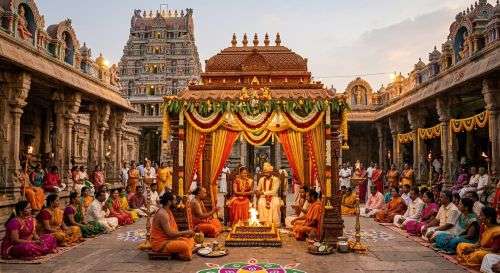
Marriage in the Hindu tradition is not merely a social agreement between two individuals; it is a solemn passage from one stage of life into another, sanctified by prayer, sacred fire, vows, family participation and the invocation of divine witness. Every ritual has a symbolic purpose, and the sequence in which the rites are performed represents a gradual movement from intention to commitment, from two families to one household, and ultimately from individual life to shared dharmic responsibility.
The Dharma Sindhu occupies an important place in the literature of Hindu ritual practice. It is a Sanskrit compendium dealing with Dharma, religious observances, vratas, samskaras, auspicious timings, purification rites, marriage procedures and numerous other aspects of traditional Hindu life. Modern descriptions of the work likewise identify it as a comprehensive reference dealing with samskaras and, specifically, a Vivaha Prakarana. It is traditionally associated with Kashinath Upadhyaya. Some bibliographical sources date the work differently, so a precise historical date such as 1809 should preferably be attributed to the particular edition or tradition being followed rather than stated as an uncontested fact.
Within the Telugu marriage tradition, the sequence of rites is especially elaborate. The following fifty-four observances may be understood not simply as a long list of ceremonies, but as a carefully constructed spiritual progression in which every stage prepares the couple for the next.
1. Kanyavaranam — Selection and acceptance of the bride.
Marriage begins with the conscious acceptance of the bride into the proposed marital relationship. It signifies that the union is not an impulsive arrangement but a considered decision involving the families and their responsibilities.
2. Pelli Choopulu — Formal meeting of the prospective bride and groom.
The meeting of the bride and groom is the human and social foundation upon which the sacred ceremony will later be built. It provides an opportunity for mutual recognition and acceptance.
3. Nischitartham — Engagement.
The engagement transforms intention into a formal commitment. Families publicly acknowledge the proposed union, thereby giving social and familial sanction to the forthcoming marriage.
4. Ankurarpanam — Sowing of auspicious seeds.
The sowing of seeds symbolises fertility, continuity and the beginning of a new life. A seed placed in the earth contains the promise of an entire future tree; similarly, marriage contains within itself the potential for family, responsibility and continuity.
5. Snatakam — Ceremonial bath and pre-marital observance of the groom.
The groom prepares himself for the transition from student life into the responsibilities of householdership. The ritual bath symbolises purification and readiness.
 6. Samavartanam — Completion of the student stage.
Samavartana marks the conclusion of the period of formal studentship. The groom symbolically returns from the discipline of learning to enter the duties of grihastha ashrama, the householder’s stage.
7. Kashi Yatra — The groom’s symbolic journey to Kashi.
The famous Kashi Yatra represents the groom’s symbolic choice between renunciation and worldly responsibility. The bride’s family persuades him to return from the imagined journey toward ascetic life and accept the sacred duties of marriage.
8. Mangala Snanalu — Auspicious ceremonial baths.
The ceremonial baths signify physical and spiritual purification before entering the central marriage rites. They prepare the participants to approach the sacred proceedings with cleanliness and auspiciousness.
9. Edurukolu — Ceremonial reception of the groom.
The groom is welcomed with honour by the bride’s family. Hospitality becomes a sacred expression of respect, transforming the arrival of an individual into the arrival of a future member of the family.
10. Varapuja — Worship of the groom.
The groom is ceremonially honoured as the person who is about to assume the responsibilities of a husband. The worship is not merely personal adulation but recognition of the sacred duty he is undertaking. (to be concluded)
11. Gauri Puja — Worship of Goddess Gauri by the bride.
The bride invokes Gauri, the divine embodiment of auspicious married life, strength and feminine grace. Through this prayer she seeks blessings for harmony, longevity and fulfilment in married life.
12. Punyahavachanam — Purification and invocation of auspiciousness.
This rite sanctifies the ceremonial environment and invokes purity and auspiciousness. It establishes the spiritual atmosphere in which the subsequent rites are to be performed.
13. Vighneshwara Puja — Worship of Lord Ganesha.
Every important undertaking traditionally begins with the invocation of Ganesha, the remover of obstacles. The prayer expresses the hope that the marriage may proceed without impediment.
14. Raksha Bandhanam — Protective sacred thread.
The sacred thread is associated with protection and spiritual safeguarding. It reminds the participants that the marriage is undertaken under divine protection and moral responsibility. (to be concluded)