



How many controversies must Meta stumble into before sovereign nations begin treating it as a geopolitical actor rather than just another social media company?
The temporary restriction of Prime Minister Narendra Modi’s video may have been dismissed by Meta as an “inadvertent technical error.” But India has every reason to ask a far more fundamental question: Can a foreign technology giant, answerable to nobody except its shareholders, be trusted with shaping political discourse in the world’s largest democracy?
This is no longer about one video.
It is about power.
Meta today influences elections, governments, public opinion, businesses, media narratives and even national security conversations across continents. No unelected corporation in history has exercised such enormous influence over democratic societies. The latest incident involving Prime Minister Modi merely exposes a deeper problem—Meta’s opaque algorithms have become powerful enough to decide what billions of people see, what they don’t see and, increasingly, what they are allowed to believe.
Bharat’s Parliamentary Standing Committee was therefore absolutely justified in summoning Meta’s leadership and demanding accountability. Reports even suggest that the committee expects a personal apology from CEO Mark Zuckerberg and has questioned whether the company should continue enjoying intermediary protections if such lapses continue.
The company may call it a glitch.
Democracies call it a systemic failure.
Meta’s global record inspires little confidence.
Remember Cambridge Analytica? Tens of millions of Facebook users had their personal data harvested to allegedly influence electoral outcomes across countries. That scandal permanently altered how the world viewed Meta—not as a neutral platform, but as a corporation incapable of safeguarding democratic processes.
Remember Myanmar? United Nations investigators concluded that Facebook had played a significant role in spreading hate speech against the Rohingya community, with its algorithms amplifying dangerous content faster than the company could—or would—control it.
Remember the United States? Mark Zuckerberg has spent years shuttling between Capitol Hill hearings, facing angry lawmakers from both Republican and Democratic parties over election interference, misinformation, political bias, child safety, privacy violations and algorithmic manipulation. Rarely does one find America’s bitterly divided political establishment united. Yet Meta managed precisely that.
The European Union has repeatedly investigated and penalised Big Tech—including Meta—over privacy practices, competition issues and compliance with digital regulations. Australia forced Meta to negotiate compensation with news publishers after Facebook attempted to block news content altogether. Time and again, governments across the democratic world have reached the same conclusion: Meta cannot simply be trusted to regulate itself.
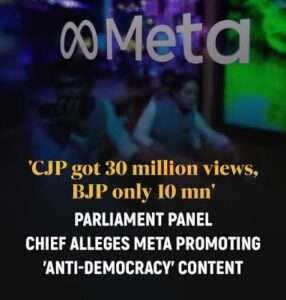
Bharat should not imagine it is facing an isolated incident.
It is facing a repeat offender.
The Modi video controversy is merely the latest chapter in a long global history of algorithmic opacity, selective moderation, weak accountability and repeated apologies after the damage is already done.
Meta frequently invokes “community standards”. But who writes these standards? Who audits the algorithms? Who decides what constitutes misinformation? Who determines whether the communication of an elected Prime Minister reaches citizens or disappears from their screens? Certainly not the voters of Bharat.
No private corporation should possess such unchecked influence over a sovereign democracy.
Equally worrying is the selective outrage displayed by sections of Bharat’s political class. They have no hesitation in accusing the Government of “intimidating” Meta merely because Parliament demands answers. Since when did asking questions of one of the world’s richest corporations become an assault on free speech? Accountability strengthens democracy; corporate immunity weakens it.
Freedom of expression is sacred.
Freedom for digital monopolies to manipulate narratives is not.
Bharat has every constitutional right to insist that every intermediary operating within its jurisdiction obey Bharatiya law, respect Bhatiyas institutions and remain fully transparent about its content moderation practices. Parliament’s scrutiny is not an attack on Meta; it is an assertion of Bharat’s digital sovereignty.
The question, therefore, is no longer whether Meta committed an error.
The question is whether Bharat should continue depending on a foreign platform that has repeatedly found itself at the centre of global controversies involving elections, privacy breaches, hate speech, misinformation, child safety and algorithmic bias.
Bharat is no digital novice. It has built Aadhaar, UPI, DigiLocker, ONDC and one of the world’s most sophisticated digital public infrastructures. It possesses the talent, innovation and market size to develop globally competitive indigenous social media platforms that operate within Bharat’s constitutional framework instead of being governed by opaque algorithms designed thousands of miles away.
Those who argue that Meta is “too big to regulate” misunderstand Bharat’s strength.
Meta needs Bharat far more than Bharat needs Meta.
The Government has rightly chosen to summon the company’s global executives and demand answers. But accountability cannot stop at explanations and apologies. If repeated violations continue, if transparency remains elusive and if Bharat’s laws are treated as optional, New Delhi should not hesitate to invoke the strongest remedies available under law—including suspension of intermediary protections or, if circumstances ultimately warrant, prohibiting platforms that repeatedly undermine India’s legal and constitutional framework.
Every sovereign nation has a duty to defend its democracy.
Bharat should be no exception.


