For years, a section of the Western media seemed almost incapable of writing about Narendra Modi or his government without seasoning the story with predictable doses of cynicism, criticism and, at times, outright disdain. Bharat’s economic rise was questioned, its democratic credentials were repeatedly put under the microscope and virtually every policy decision of the Modi government was examined through a distinctly Western ideological lens. That is why the latest assessment from The New York Times is rather revealing. In a report published on August 29, the newspaper observes that Prime Minister Narendra Modi has visited at least 20 countries since August 2025, using these engagements to expand Bharat’s network of strategic and economic partnerships. More importantly, it notes that these are not merely ceremonial visits involving handshakes, photo opportunities and carefully drafted communiqués. Many have involved what the newspaper describes as businesslike, closed-door discussions aimed at securing concrete outcomes for Bharat. Now, that is quite a departure from the familiar Western-media narrative. The interesting part is not that The New York Times suddenly discovered Modi. It is that even a publication that has often been sharply critical of his government is being forced to acknowledge the effectiveness of Bharat’s increasingly pragmatic diplomacy. And the results are difficult to dismiss. According to the NYT account, Modi’s diplomatic outreach has produced tangible gains ranging from submarine technology cooperation with Germany and easier student access to France to lower duties on Scotch whisky from Britain. Japan and Australia, too, have emerged as increasingly important partners. One may chuckle at the Scotch whisky reference, but the larger point is serious. Diplomacy is ultimately about converting relationships into national advantage. A country does not strengthen itself merely by collecting flattering joint statements. It does so by securing technology, investment, market access, defence cooperation, energy security, mobility for its students and opportunities for its businesses. That is precisely where Modi’s foreign policy has become consequential.
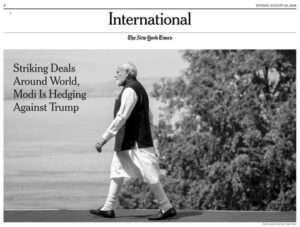
The newspaper’s central observation is that Bharat is spreading its bets in an increasingly unpredictable world. That is not weakness. It is strategic maturity. For decades, Bharat’s foreign policy was often constrained by the need to balance one major power against another. Today, New Delhi appears far more comfortable talking simultaneously to Washington, Moscow, Paris, Berlin, Tokyo, Canberra, London and countries across the Gulf, Central Asia and the wider Global South. And there is another striking feature: Bharat is increasingly being approached by others. The NYT notes that more than a dozen heads of state have visited Bharat during the period under review. That matters. Countries do not send their leaders halfway around the world merely because New Delhi is an interesting tourist destination. They come because Bharat’s market, strategic weight, technology ambitions, defence capabilities and geopolitical importance increasingly demand attention. This is perhaps the biggest change in the international perception of Bharat. The old caricature of Bharat as a hesitant developing country waiting for Western approval is becoming harder to sustain. Bharat is now negotiating simultaneously for technology from one country, trade concessions from another, defence cooperation from a third and strategic partnerships with several others. And this is happening while the global order itself is being shaken by the unpredictability of the Trump era. The irony is delicious. Some sections of Western media spent years explaining to Bharat how it should conduct its democracy, economy and foreign policy. Now one of their own most influential newspapers is effectively documenting how Bharat is building room to manoeuvre precisely because the world has become less predictable. Modi’s foreign policy is not about choosing between America, Russia, Europe, Japan or the Global South. It is about ensuring that Bharat has enough relationships, options and leverage that nobody can dictate its choices. That is the real story. Amazing, but true: Bharat is no longer asking the world where it belongs. Increasingly, the world is figuring out how to position itself around Bharat.