



अथ व्यवस्थितान् दृष्ट्वा धार्तराष्ट्रान् कपिध्वजः। प्रवृत्ते शस्त्रसम्पाते धनुरुद्यम्य पाण्डवः॥ हृषीकेशं तदा वाक्यमिदमाह महीपते॥
Having witnessed the Kaurava army, the sons of Dhritarashtra, arrayed in disciplined formation and prepared for the inevitable confrontation, Arjuna, whose chariot bore the emblem of Hanuman, raised his mighty Gandiva bow and addressed Lord Krishna, O King Dhritarashtra.
This moment marks a significant transition in the unfolding drama of the Mahabharata. The great war of Kurukshetra had reached its decisive threshold. Both armies had assembled in formidable formations, their warriors equipped with weapons, their commanders prepared to execute their military strategies, and their conches had already proclaimed the commencement of hostilities. The atmosphere was charged with anticipation, apprehension and an unmistakable sense of historical inevitability. The confrontation between the Pandavas and the Kauravas was no longer a political dispute or a diplomatic disagreement; it had become an unavoidable struggle in which the destiny of an entire civilisation appeared to be at stake.
The expression Kapidhwaja carries considerable significance. Arjuna’s chariot bore the image of Hanuman upon its banner, symbolising extraordinary strength, courage, devotion and unwavering commitment to righteousness. Hanuman, the celebrated embodiment of selfless service in the Ramayana, represented the highest virtues of discipline, humility and divine allegiance. His presence upon Arjuna’s banner was not merely an ornamental distinction or a military identification mark. It connected two great streams of India’s Itihasic tradition, bringing together the ideals of the Ramayana and the moral struggle of the Mahabharata. The banner thus represented more than the identity of a warrior; it symbolised the spiritual and ethical foundation upon which his struggle was undertaken.
In ancient systems of warfare, distinguished warriors and military commanders carried distinctive emblems upon their chariots and standards. These symbols enabled soldiers to recognise prominent combatants amidst the confusion of the battlefield. The identification of warriors was essential because the established conventions of chivalrous warfare generally expected combatants of comparable standing and ability to confront one another. Such identification also served a strategic purpose, allowing commanders to assess the position of important adversaries and organise their military responses accordingly. The tradition of identifying military ranks and formations through distinctive insignia has continued in different forms in modern warfare, where flags, insignia, uniforms and other identifying symbols distinguish military units and commanding officers.
Arjuna’s banner, therefore, was an expression of both personal identity and martial distinction. It announced the presence of one of the greatest archers of his age. Yet, the deeper significance of the emblem lay in its association with Hanuman, whose life demonstrated that extraordinary physical strength becomes meaningful only when guided by righteousness and devotion. Arjuna possessed unparalleled military skill, but the presence of Hanuman upon his flag also suggested that courage alone was insufficient. Strength required a higher purpose, and victory acquired moral legitimacy only when it served Dharma.
The raising of Gandiva is equally significant. Arjuna did not enter the battlefield as an ordinary soldier responding to an immediate command. He was the foremost warrior of the Pandava forces, a master of archery trained under exceptional teachers and entrusted with an indispensable responsibility in the impending conflict. Gandiva was not simply a weapon; it represented his martial identity, years of discipline, extraordinary accomplishments and his commitment to the cause for which the Pandavas had struggled. Its elevation indicated his preparedness to discharge the responsibility that had brought him to Kurukshetra.
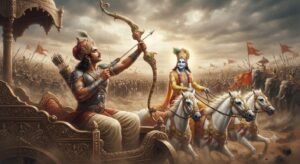
Nevertheless, the distinction between readiness for battle and the actual commencement of violence must be carefully understood. The armies had taken their positions, the conches had sounded, and the warriors were prepared. Yet the decisive exchange of weapons had not begun. It was precisely at this critical juncture that Arjuna raised his bow and addressed Krishna. The narrative deliberately captures the final instant before action, when the consequences of every decision were still suspended between intention and execution.
From a military perspective, Arjuna’s conduct appeared entirely consistent with that of a warrior determined to fulfil his obligations. He had accepted the challenge, prepared himself for combat and stood ready to confront the Kaurava forces. His actions conveyed confidence, determination and a sense of urgency. He had not come to the battlefield to negotiate another settlement or reconsider the political history that had led to the confrontation. The prolonged injustice suffered by the Pandavas, the humiliation of Draupadi, the repeated attempts to deprive them of their rightful inheritance and the failure of diplomatic efforts had brought the conflict to this decisive stage.
Yet, the Mahabharata does not present this moment merely as the beginning of a military campaign. Its philosophical significance is considerably greater. The epic places a highly accomplished warrior at the intersection of personal duty, family attachment, moral responsibility and the demands of justice. Arjuna’s outward preparedness conceals the profound psychological and ethical crisis that is about to emerge. The man who has raised Gandiva in readiness for battle will soon question the very purpose of fighting.
This contrast constitutes one of the most remarkable narrative devices in the Bhagavad Gita. The battlefield becomes a setting in which the external conflict between two armies gradually transforms into an internal conflict within an individual. The first concerns kingdoms, political authority, justice and the restoration of Dharma; the second concerns conscience, attachment, grief, responsibility and the nature of righteous action. Through Arjuna, the Mahabharata establishes that even the most accomplished human being may encounter uncertainty when confronted with decisions carrying immense moral consequences.
Krishna’s position is particularly significant in this context. He is Arjuna’s charioteer, but his role transcends the ordinary responsibilities of a charioteer. He is the guide who will lead Arjuna from confusion towards clarity, from emotional disturbance towards discrimination, and from attachment towards an understanding of Dharma. The relationship between the warrior and his divine guide provides the foundation for the philosophical revelation that follows.
The opening description also reveals the deliberate contrast between external preparedness and internal understanding. A warrior may possess weapons, military knowledge, courage and strategic intelligence, but these qualities alone do not guarantee the wisdom required to distinguish right action from wrong action. Physical strength can overcome an adversary, but intellectual discrimination is necessary to overcome confusion within oneself. The Gita begins its profound teaching precisely at the point where the limitations of worldly accomplishment become apparent.
Arjuna’s raised Gandiva consequently acquires a deeper symbolic meaning. It represents the human capacity to act, while Krishna’s forthcoming instruction represents the wisdom required to direct that action. The bow signifies preparedness; the divine teaching signifies discernment. Between the two lies the essential question of human existence: whether an individual acts under the influence of personal emotions and attachments or in accordance with a higher understanding of duty and righteousness.
The Mahabharata thus transforms the eve of battle into an eternal philosophical inquiry. Kurukshetra is not merely a geographical location where two armies confront each other. It becomes a representation of the moral battlefield within every human being, where competing obligations, desires, fears and convictions demand resolution. The external war provides the circumstances; the internal struggle reveals the deeper purpose of the Gita.
At this decisive moment, Arjuna stands prepared with Gandiva, Hanuman’s emblem fluttering above his chariot, and Krishna seated beside him. The warrior believes that he is about to undertake a familiar military responsibility. Little does the immediate narrative suggest that his impending questions will lead to one of humanity’s most enduring philosophical discourses. The raising of the bow precedes the questioning of its purpose, and the readiness to fight precedes the discovery of the true meaning of action.
It is this extraordinary transition that gives the passage its timeless importance. The Bhagavad Gita does not begin with an abstract philosophical proposition. It begins with a human being confronting an immediate and overwhelming reality. Through that experience, it gradually unfolds universal truths concerning duty, wisdom, self-knowledge, disciplined action and the relationship between the individual and the Supreme.
Thus, the moment Arjuna raises Gandiva is not simply the prelude to the Mahabharata war. It is the threshold of a spiritual revelation in which the eternal conflict between ignorance and knowledge, attachment and detachment, confusion and wisdom, and individual desire and universal Dharma is brought into focus. The battlefield awaits the first arrow, but the destiny of the human mind awaits Krishna’s first instruction.

