MS Sparsha
There are some Indians whose names are written in history books. And then there are those whose inventions quietly shape our lives every single day, even though hardly anyone knows who they are.
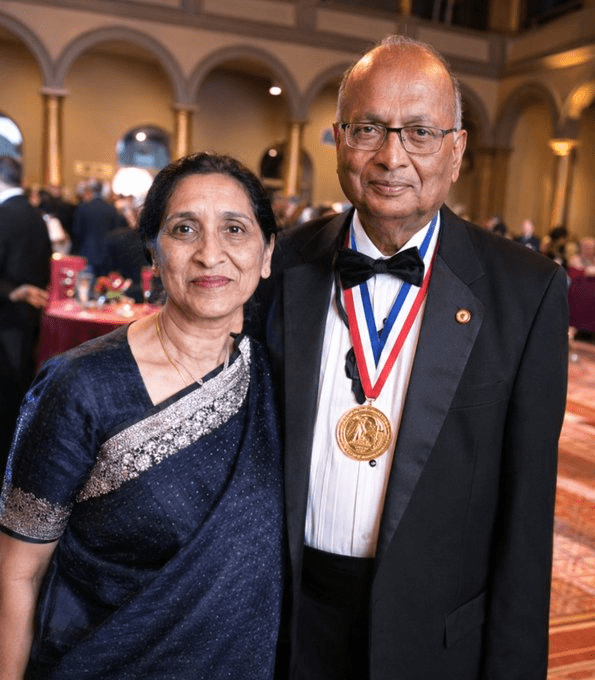
Dr Arogyaswami Paulraj belongs firmly to the second category.
Born in Pollachi, Tamil Nadu, Paulraj joined the Indian Navy as a teenager and served the country for nearly three decades. But his extraordinary journey began with a problem India could not solve—and a technology the world would not sell to it.
The 1971 India-Pakistan war exposed a serious weakness in the Indian Navy’s underwater warfare capabilities. INS Khukri was sunk by a Pakistani submarine, and India’s sonar systems had failed to detect the submarine in time. The Navy urgently needed better sonar technology.
India tried to buy it.
The answer from countries possessing advanced technology was essentially: No.
That refusal could have ended the story. Instead, it changed the course of Indian technological history.
The Indian Navy turned to one of its own officers and asked him to build what India could not buy.
That officer was Arogyaswami Paulraj.
The Navy had recognised his potential early and sent him to IIT Delhi for a master’s degree. Encouraged by his professors, he went on to complete a doctorate. After the 1971 war, he was entrusted with the formidable challenge of developing an indigenous sonar system.
There was no foreign technology to copy, no imported equipment to fall back on and no shortcut.
Paulraj and his team built it from the ground up.
The result was APSOH—Advanced Panoramic Sonar Hull-mounted. It entered service with the Indian Navy in 1983 and became a landmark achievement in India’s indigenous defence technology. It was not merely a substitute for imported equipment; it was a sophisticated system regarded among the finest of its kind.
But Paulraj’s story did not end with sonar.
He went on to help establish national research capabilities in computing, artificial intelligence and military electronics. India honoured him with the Padma Bhushan.
Then came perhaps the most remarkable chapter.
After leaving the Navy, Paulraj went to Stanford University in the United States as a postdoctoral researcher. In other words, a decorated Indian scientist who had already made his mark in defence technology was willing to begin again as a researcher.
While conducting experiments with wireless communications, he noticed something unusual. Signals that should have interfered with one another could, under the right conditions, be separated and exploited.
He pursued the observation.
The breakthrough became known as MIMO—Multiple Input, Multiple Output.
In simple terms, instead of relying on a single antenna to transmit and another to receive, MIMO uses multiple antennas simultaneously. Rather than allowing multiple signals to interfere with one another, it makes them work together, dramatically increasing the amount of information that can be transmitted.
That idea became fundamental to modern wireless communications.
Your Wi-Fi router uses it.
Your smartphone uses it.
The technologies behind 4G and 5G depend heavily on it.
The man who helped make that possible was an Indian naval officer who had once been told, in effect, that India could not buy the technology it needed.
Paulraj went on to found companies based on his inventions, with companies including Intel and Broadcom acquiring ventures associated with his work. He holds around 80 patents and has received some of the world’s most prestigious honours, including the Marconi Prize, the IEEE Alexander Graham Bell Medal and the Faraday Medal. He has also been inducted into the United States National Inventors Hall of Fame.
Think about that for a moment.
A technology pioneered by an Indian who first solved a critical problem for India’s Navy now sits quietly inside billions of devices across the world.
Yet how many Indians know his name?
This is precisely why stories such as Paulraj’s must be told.
India’s technological rise was not created overnight. It was built by scientists, engineers, soldiers, researchers and innovators who refused to accept that the country must forever depend on others for advanced technology.
The 1971 war exposed a weakness.
Foreign powers refused to fill it.
An Indian officer accepted the challenge.
He built the sonar.
Decades later, he helped transform wireless communication.
That is not merely the story of an inventor. It is the story of Atmanirbhar Bharat before the phrase became a national aspiration.
The next time your Wi-Fi connects instantly, or your smartphone downloads data in seconds, spare a thought for the Indian whose pioneering work helped make that possible.
Dr Arogyaswami Paulraj may be an unsung hero of Bharat—but the world is quite literally connected through an idea that came from him.