

Chidambaram is no ordinary politician. As a former Union Minister and a legal luminary, he is fully aware that the idea of simultaneous elections is neither alien to Bharat’s Constitution nor an unprecedented experiment. The first four Lok Sabha elections—in 1952, 1957, 1962 and 1967—were held alongside State Assembly elections. The real question, therefore, is not whether “One Nation, One Election” is constitutional in principle, but why Bharat abandoned a system that once worked. And if Chidambaram wants to identify who helped break that cycle, he cannot conveniently look away from his own Congress party. The synchronised election cycle did not collapse because Bharatiyas rejected it. It was progressively disrupted by premature dissolutions and the misuse of constitutional provisions. The most notorious early example was the dismissal of the democratically elected Communist government in Kerala in 1959 under Article 356 by the Congress government at the Centre. That episode has itself been described in official educational material as a controversial and widely cited instance of the misuse of emergency powers. The late 1960s brought further instability, with defections and premature collapses of governments and Assemblies, while the Lok Sabha itself was dissolved prematurely in 1970, resulting in the 1971 general election. Thus, the original simultaneous cycle gradually fractured. This history matters because the Congress cannot now present the consequences of a system it helped disrupt as an argument against restoring synchronisation. Chidambaram’s principal objection—that aligning Assembly tenures with the Lok Sabha could involve shortening or extending the democratic mandate—is not without constitutional merit. A government that loses its majority must be allowed to fall, and a fresh election may become unavoidable. State legislatures are also constitutionally significant institutions, not subordinate appendages of Parliament. But identifying a possible constitutional complication is not the same as proving that the entire idea is wrong. That is where the Congress argument becomes intellectually unconvincing. If there are difficult situations—such as a hung Assembly, collapse of a coalition or a government losing its majority—the answer should be to devise constitutional safeguards, not to preserve a system in which the country is effectively pushed into election mode every few months.
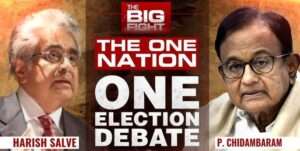
Bharat is today a nation of 1.4 billion people pursuing ambitious development goals. Infrastructure projects, industrial investments, employment programmes, education reforms, defence modernisation and long-term economic policies require continuity and administrative concentration. Yet governments and political parties are perpetually preparing for the next election. Elections are the essence of democracy, but permanent electioneering is not the essence of governance. Every election brings the Model Code of Conduct, restrictions on announcements and administrative decisions, diversion of government machinery, enormous expenditure, mobilisation of security forces and months of political campaigning. When one State finishes voting, another enters campaign mode. National parties continuously shift political and organisational resources from governance to electoral management. That is hardly the environment in which a developing nation can pursue a 10-, 15- or 25-year national development vision. One Nation, One Election is therefore not about eliminating elections. It is about concentrating them into a predictable electoral cycle so that the remaining years can be devoted overwhelmingly to governance and development. The current constitutional proposal itself envisages simultaneous elections while providing for mechanisms to deal with premature dissolution, including elections for the unexpired portion of a term. The larger question is simple: Should Bharat remain permanently in election mode, or should it create a system that gives governments sufficient uninterrupted time to govern? Chidambaram is entitled to raise constitutional objections. Indeed, those objections deserve serious examination. But opposing the very idea of reform while ignoring the historical role of Congress in dismantling the original electoral synchronisation is hardly persuasive. The Congress should first answer why Bharat had simultaneous elections for four consecutive cycles and why that arrangement eventually collapsed. Bharat cannot remain trapped forever in the politics of the next election. At some point, the nation must choose between perpetual campaigning and sustained development. One Nation, One Election deserves that debate—not the politics of selective historical amnesia.