Lakshmanrao Upadhyayula
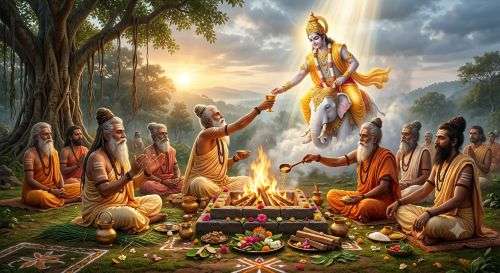
In the sacred assemblies of the Vedic seers, when the dawn spread its first rays across the silent horizon and the altar fire rose toward the heavens, the venerable sage Śaunaka Gṛtsamada lifted his voice in the stately cadence of the Jagatī metre to invoke Brahmanaspati, the Lord of the Sacred Word. In the vision of the Ṛgveda, Brahmanaspati is not merely a deity presiding over ritual utterance; he is the sovereign intelligence hidden within sound itself, the divine principle that transforms thought into truth, prayer into power, and disciplined speech into creative force. He is the guardian of mantra, the revealer of wisdom, and the spiritual architect who opens the pathways through which human aspiration ascends and divine grace descends.
The patrons who honoured Brahmanaspati first kindled Agni, the visible symbol of aspiration and inner illumination. In Vedic thought, fire is both physical and metaphysical. Scientifically, fire converts matter into energy, releasing light and heat; spiritually, it represents the transformation of human limitations into higher consciousness. When the sacrificers offered clarified butter and sacred oblations into Agni, they were enacting a profound psychological truth: every noble effort requires the surrender of selfish impulses into the refining flame of disciplined awareness. Through hymns, offerings, and unwavering devotion, they became self-sufficient, for the greatest wealth is the capacity to draw strength from the inexhaustible source within.
Whoever befriends Brahmanaspati allies with the very principle of order, wisdom, and articulate intelligence. Such a person gains a life-force so abundant that his vitality surpasses even the continuity represented by his own descendants. Longevity in the Vedic sense is not merely the extension of years; it is the preservation of meaningful existence, where one’s influence, insight, and virtue endure across generations. The friend of Brahmanaspati leaves behind not only sons, but a living legacy of wisdom.
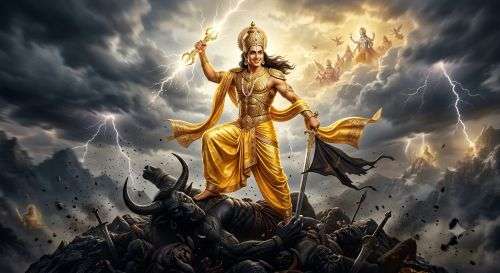
The hymn prays that the patron, supported by courageous sons, may overcome the bold offspring of his enemies. On the outer plane, this reflects the struggle for protection and prosperity; inwardly, it symbolises the victory of disciplined faculties over the rebellious tendencies of the mind. The courageous sons represent the powers of discrimination, restraint, and noble action born from spiritual practice. When these inner forces mature, they conquer fear, confusion, and destructive impulses. Thus the Vedic battle is also a psychological conquest in which the illumined intellect triumphs over the armies of ignorance.
The patron becomes renowned for his wealth of cows. In Vedic symbolism, cows are not merely animals of material prosperity; they represent rays of knowledge, nourishing thoughts, and sustaining resources. Just as cows yield milk to nourish the body, enlightened ideas nourish the intellect and spirit. A person rich in “cows” is one whose mind overflows with insight, generosity, and practical wisdom. Such abundance supports both worldly success and spiritual progress.
The hymn further praises the patron as one of keen and penetrating observation. This is a remarkable testimony to the scientific temperament embedded in Vedic culture. True spirituality does not reject inquiry; it refines perception. The disciplined mind becomes capable of seeing beneath appearances, recognising patterns, and discerning subtle relationships. Brahmanaspati, as Lord of sacred speech, grants the clarity by which thought becomes precise, language becomes truthful, and observation becomes transformative knowledge.
The one who draws near to Brahmanaspati is blessed with children and grandchildren, signifying continuity, fertility, and enduring influence. In a deeper sense, children represent the ideas, actions, and institutions that carry one’s values into the future. Grandchildren symbolise the long-term consequences of a life aligned with truth. The Vedic sages understood that the most authentic immortality lies in transmitting wisdom that continues to bear fruit long after one’s earthly journey has ended.
The hymn compares the devotee to rivers bursting their banks and to a powerful ox overcoming rival bulls. These images reveal the irresistible momentum of awakened energy. A river constrained by its boundaries gathers force until it reshapes the landscape; likewise, the human spirit, when empowered by truth, transcends limitations and creates new possibilities. The victorious ox symbolises concentrated vitality, grounded strength, and unwavering determination. The friend of Brahmanaspati does not depend solely upon external support; he rises through the power generated by inner alignment.
Just as the flame of fire cannot be extinguished while fuel remains, the devotee of Brahmanaspati cannot be exhausted by any adversary, however formidable. This metaphor reflects a profound psychological principle: resilience arises when one’s motivation is rooted in meaning rather than circumstance. A purpose-driven mind renews itself continuously, drawing energy from conviction, faith, and disciplined thought. External opposition may test such a person, but cannot consume the source of his strength.
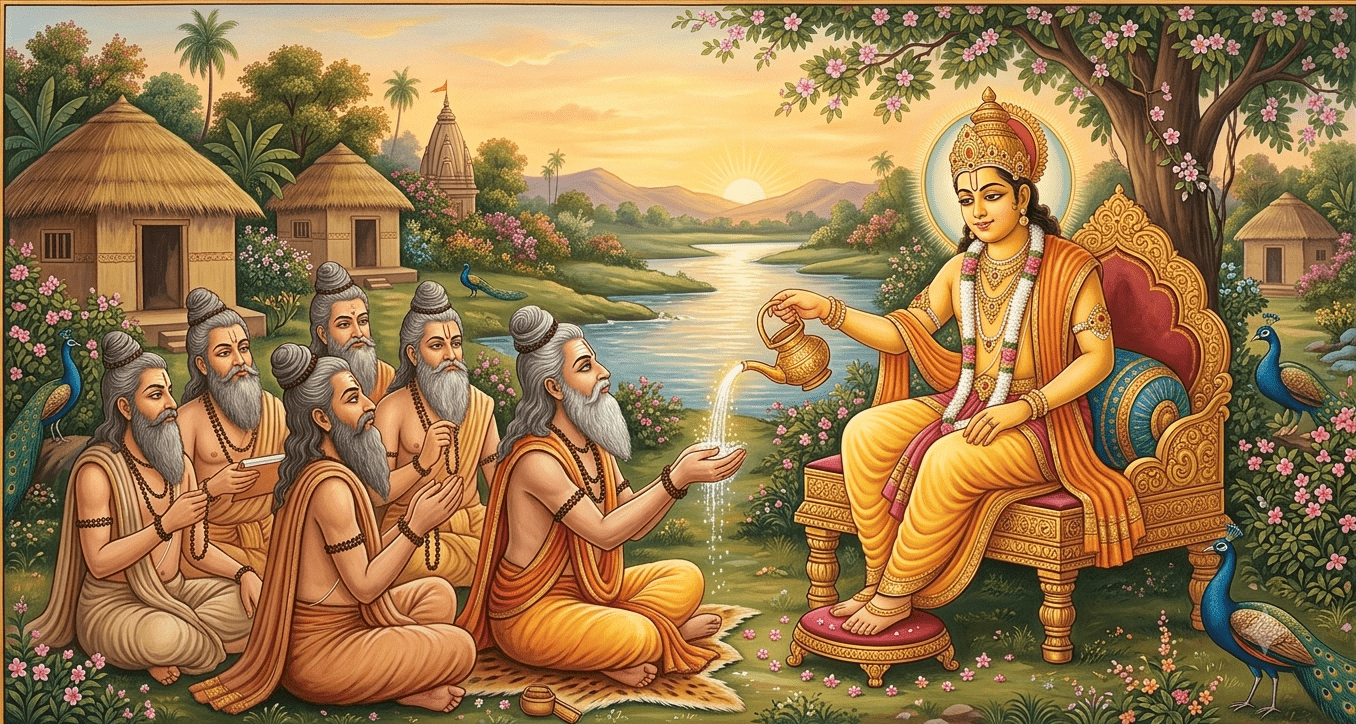
The hymn declares that streams of pure waters descend from heaven upon the friend of Brahmanaspati. Water in Vedic symbolism signifies inspiration, emotional purification, and the flow of life-giving knowledge. Scientifically, water sustains every biological process; spiritually, it represents the descent of clarity and grace into the human heart. When the mind is attuned to truth, refreshing insights arise spontaneously, washing away mental fatigue and nourishing creativity.
Even the servants of such a patron are honoured above others and receive wealth before the rest. This image illustrates the radiating effect of noble leadership. When an individual lives in harmony with truth, everyone associated with him benefits from the order, generosity, and prosperity he generates. Modern psychology confirms this principle: the emotional and ethical state of a leader shapes the environment around him, influencing the confidence, productivity, and well-being of the entire community.
The strength of the friend of Brahmanaspati is described as unrestrainable. This does not refer to aggression, but to the unstoppable force of integrated character. When thought, speech, and action are aligned, human energy is no longer dissipated by contradiction. Such coherence produces extraordinary effectiveness. The individual becomes like a well-directed current—calm, focused, and capable of overcoming obstacles without wasteful struggle.
The hymn concludes with the majestic image of all rivers flowing toward the patron who is a friend of Brahmanaspati. This signifies that opportunities, resources, and blessings naturally converge upon the one who lives in accordance with cosmic law. Rivers always seek the ocean, and in the same way, all forms of abundance are drawn toward integrity, wisdom, and devotion. Such a person enjoys comfort, auspiciousness, and wealth, not as accidental rewards, but as the natural consequences of living in harmony with truth.
Thus the prayer of Śaunaka Gṛtsamada reveals a timeless Vedic doctrine: sacred speech, disciplined thought, and reverence for divine intelligence transform human life from struggle into mastery. Brahmanaspati is the power that turns words into reality, insight into prosperity, and devotion into enduring strength. The one who befriends this divine principle becomes luminous like fire, abundant like rivers, steadfast like the victorious bull, and fertile like the earth nourished by heaven. In every age, this hymn proclaims that the greatest wealth belongs to those whose speech is truthful, whose minds are clear, and whose hearts are aligned with the eternal order of the universe.