



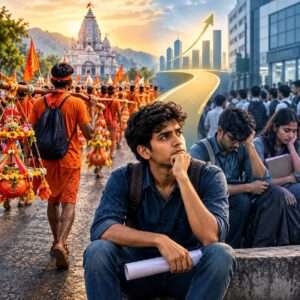
Every year during the holy month of Shravan, the streets of North India are filled with saffron as millions of Kanwariyas participate in the Kanwar Yatra. They walk hundreds of kilometers carrying sacred Ganga water from pilgrimage sites like Haridwar and Gangotri to offer it to Lord Shiva. This is a remarkable example of devotion, discipline, tolerance, and collective faith. These pilgrims comprise a significant number of young people. Their enthusiasm and physical strength are a testament to the immense energy of India’s youth. However, a major question arises with these young pilgrims: how many of them look for jobs during the rest of the year and try to build a stable future?
This isn’t an insult to religious faith. Rather, it’s a way to raise awareness about one of India’s most pressing socio-economic issues. Faith nourishes the mind, and employment provides dignity, security, and purpose. Asking young people to choose between the two isn’t the nation’s problem. Rather, the problem is cultivating an environment where faith and opportunity coexist harmoniously.
India has a large youth population. This demographic dividend is seen as a strength of the country. Every year, millions of young people graduate from schools, colleges, and universities with hopes and dreams of gainful employment. They prepare for competitive exams, apply for numerous jobs, and await recruitment notifications. A large number of people have degrees but either do not have jobs or work part-time. This is not just an economic problem, but can also have psychological and social implications. Unemployment can undermine self-confidence, delay economic independence, increase pressure on families, and in some cases, lead to despair and frustration.
The Kanwar Yatra is associated with this generation, one of the youngest. These people come from villages, towns, and cities. They include students, children of farmers, daily wage laborers, young professionals, and unemployed graduates. Their participation in the pilgrimage symbolizes their faith and culture. Therefore, to say that unemployment motivates people to engage in religious activities or that religious pilgrimages cause unemployment would be simplistic and unfair. These assumptions are inaccurate because they do not take into account the complexity of social behavior and economic realities.
However, this presents an interesting paradox. The determination and perseverance displayed by young people walking hundreds of kilometers under challenging conditions is exemplary, and they also possess the discipline, endurance, and commitment essential for the development of any nation. If equal opportunities are available in the areas of education, innovation, entrepreneurship, manufacturing, scientific research, and employment, this vast human resource could be one of the biggest drivers for India’s economy.
Not only are there not enough jobs available, but there’s also a huge gap between what’s taught in schools and what workers expect. Even for graduates with the necessary skills, employment opportunities are often limited, and industries face a shortage of skilled workers. This contradiction reflects the mismatch between human resource needs and the education system. Therefore, schools must focus on skills, critical thinking, digital literacy, and industry-oriented training, not just academic knowledge.
The central and state governments have launched numerous initiatives and policies to promote skill development, self-employment, the startup ecosystem, manufacturing, and entrepreneurship. These efforts have resulted in new opportunities for many young people. However, given India’s large youth population, much remains to be done. Policies alone are not enough to address this problem.
But society also has a duty. In many families, getting a government job remains the primary criterion for success. In the modern economy, many alternatives to government employment exist, and all should be considered. New sectors of the economy are creating jobs, especially entrepreneurship, digital services, renewable energy, agribusiness, tourism, creative industries, and technology-based companies. Teens should be encouraged to consider these opportunities, not just “normal” ones.
The media also plays a crucial role in shaping public discourse. Reporting on the Kanwar Yatra is typically done either in terms of its religious grandeur or in the context of specific issues. Social issues related to youth participation are rarely addressed. Instead of sidelining the idea of faith and action, public appeals should focus on the fact that the commitment and dedication displayed by these organizations or pilgrimages can be channeled into social work, environmental protection, disaster relief, blood donation drives, and nation-building initiatives.
In Indian civilization, karma and spirituality have never been in opposition to each other. Rather, it has been a celebration of the balance between purity and duty. Meditation, discipline, simplicity, and inner strength are all symbolized by Lord Shiva. His teachings remind devotees that spiritual growth always accompanies responsible action.
Governments cannot solve the problem of unemployment. Industries must invest and create employment opportunities. School curricula need to be restructured to suit changing market needs. Business and society must recognize and value human resource skills. Most importantly, young people must embrace lifelong learning and adapt to constantly changing technologies. New job opportunities are emerging in the fields of artificial intelligence, renewable energy, advanced manufacturing, digital commerce, biotechnology, and green industries. Preparing young people for these sectors is crucial for India’s future competitiveness.
It is not possible for India to choose between faith and development; the question is how to integrate them. Faith provides individuals with emotional strength and moral guidance. Work provides individuals with independence and dignity, and gives them self-respect and the confidence to fulfill their role in society. Overall, they become responsible and empowered citizens.
India’s demographic dividend will only be realized if the country’s youth are provided with quality education, skills, employment opportunities, and dignified livelihoods. The Kanwar Yatra is a testament to the power of India’s youth, as they are showing immense enthusiasm for this event. The challenge for policymakers, educators, industry, and society is to ensure that this energy is harnessed for innovation, productivity, and national development.
So this isn’t about the Kanwar Yatra. It’s about the future of a young Indian who wants to earn a respectable living while preserving cultural traditions. He shouldn’t be burdened with the burden of living for a livelihood and the sacred waters of faith. A truly mature India will be one where both these aspirations are fulfilled: where devotion satisfies the soul and where meaningful employment empowers lives.


