



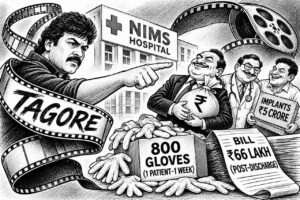
Remember Tagore, the 2003 Chiranjeevi blockbuster in which the megastar takes on a corrupt medical establishment exploiting patients and their families?
The film may have been fiction, but the findings emerging from the Anti-Corruption Bureau’s surprise inspections at Hyderabad’s Nizam’s Institute of Medical Sciences (NIMS) make one wonder whether its scriptwriters had a crystal ball.
Only this time, the story is not playing out on a cinema screen. It is unfolding in a government hospital, and the alleged beneficiaries are not merely private medical operators but those handling public money meant for the poor under Telangana’s Aarogyasri scheme.
A curious consumption pattern
Eight hundred surgical gloves for one patient in a single week! That’s what hospital records reportedly showed during the ACB inspection.
Let us do some elementary maths. Eight hundred gloves mean 400 pairs, or approximately 57 pairs a day. That is one pair every 25 minutes, round the clock, for seven consecutive days.
Was the patient undergoing surgery every half-hour? Or was there an unusually large number of hands attending to this one unfortunate individual? Perhaps the hospital could enlighten us on this rather extraordinary consumption pattern.
If the gloves were actually used, someone must have been working overtime. If they weren’t, someone was certainly making a killing out of them.
Bills that refused to die
The gloves are only the tip of the iceberg. The ACB reportedly found billing entries worth approximately Rs 66 lakh processed after patients had been discharged during July, August and September.
In some instances, bills were allegedly processed as late as three months after a patient’s death.
Now, that is a long billing cycle. Apparently, discharge from hospital does not necessarily mean discharge from the billing department. And death, it seems, is no guarantee that the bills will stop coming.
One wonders whether the patients were expected to return from the grave to verify the consumables allegedly used on them.
Questionable supply chain
The ACB also found vendors storing implants and other medical consignments worth approximately Rs 5 crore in cupboards near five operation theatres and in OT sub-stores, without authorisation.
Doctors and nursing staff were allegedly taking implants directly from vendors without raising indents through the hospital’s main store. Utility certificates were subsequently issued and forwarded with vendor invoices for billing.
According to the ACB, this procedure left considerable scope for collusion, including the possibility of certifying and billing implants that may never have been used.
What a convenient arrangement! The supplier keeps the stock, the hospital staff certifies its use, and the government eventually picks up the tab.
If the allegations are established, it would be a remarkably well-oiled supply chain – except that the supply chain appears to have bypassed the very safeguards designed to protect public money.
Canteens, contracts and a cosy nexus
The ACB’s findings reportedly extend beyond medical consumables and implants to manpower contracts, security services, hospital canteens, medical shops and tender procedures.
Expired food items, unhygienic conditions, missing records and alleged irregularities in awarding contracts paint an equally disturbing picture.
A hospital is supposed to be a place where patients put their trust in doctors and administrators. At a government institution, that trust carries an additional responsibility: public money must be spent honestly and transparently.
Chiranjeevi’s Tagore took on precisely the kind of medical exploitation that audiences found outrageous. The film was entertainment, but its underlying message was serious.
What makes the NIMS revelations particularly disturbing is that the alleged irregularities concern a public healthcare institution and a scheme intended to protect economically vulnerable patients.
The need for accountability
Perhaps the ACB’s findings will finally bring accountability to those responsible, if the allegations are substantiated. Surprise inspections should not end with seized files and press notes.
They must lead to a thorough investigation, recovery of public money wherever fraud is established, and prosecution of those found guilty.
The poor come to government hospitals seeking treatment, not to finance a racket involving gloves, implants and bills that apparently refuse to die.
In Tagore, Chiranjeevi delivered justice in cinematic fashion. In real life, we don’t need another megastar to play vigilante. We need an uncompromising investigation, institutional accountability and punishment for the guilty.
And if someone is planning a sequel to Tagore, NIMS seems to have already supplied the script – complete with 800 gloves, Rs 5 crore worth of implants and bills that outlive their patients.

