Lakshmanrao Upadhyayula
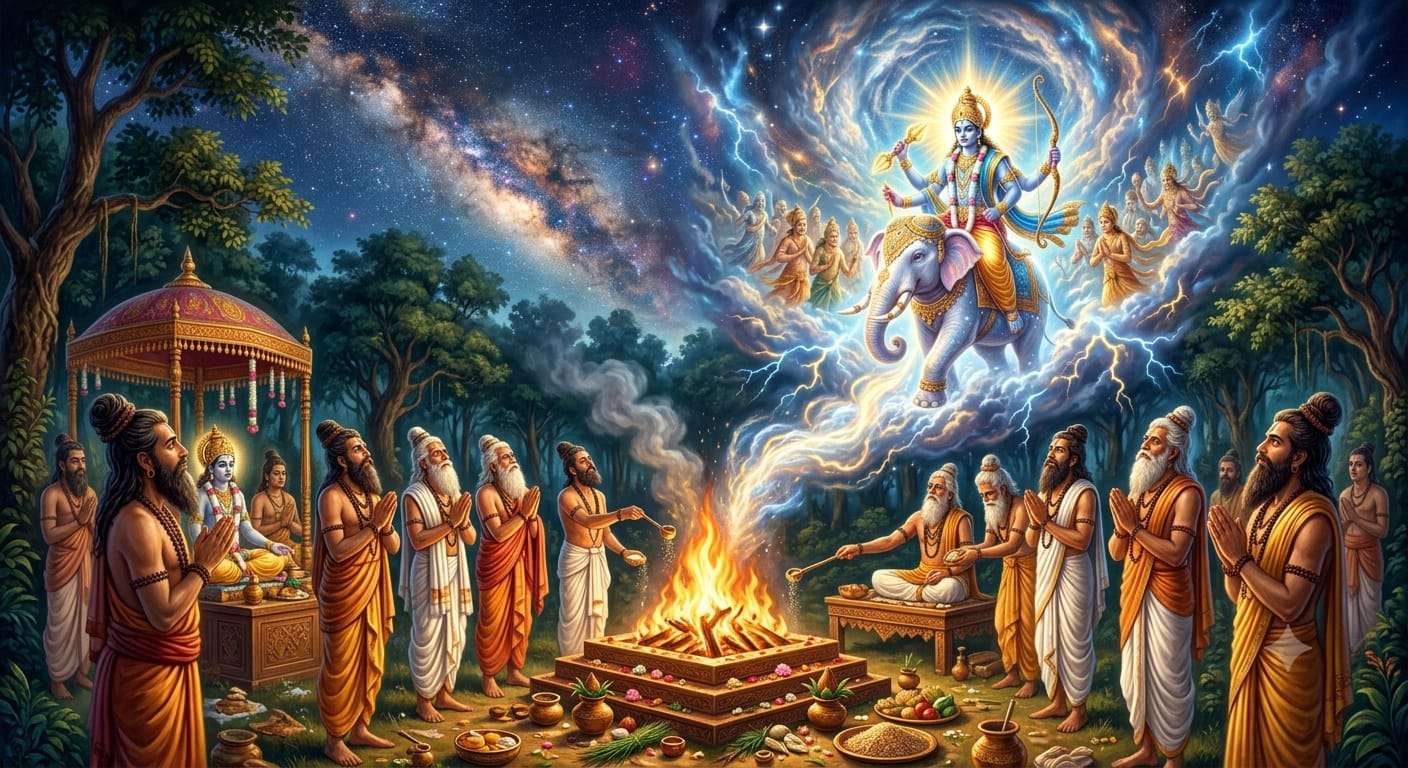
In the sacred tradition of the Rigvedic seers, the illustrious sage Vishwamitra raised his voice in profound devotion, invoking Agni through the divine Gayatri Chandas. His prayer was not merely a ritual recitation but a cosmic dialogue that united the visible and invisible dimensions of existence. Agni, the radiant intermediary between humanity and the celestial realms, was praised as the sacred messenger who carries offerings to the gods and returns their blessings to the worshippers. Through the power of mantra, the sage invoked the deities presiding over the seasons, the months, the fortnights, the sacrificial implements, and the divine powers who receive oblations, seeking their benevolent presence for the welfare and prosperity of the yajamana, the patron of the sacrifice.
The Vedic vision regarded time itself as sacred. The seasons, months, and fortnights were not merely divisions of the calendar but living manifestations of cosmic order. As the ritual unfolded, these divine powers were invoked to harmonize earthly life with the rhythms of the universe. Through their blessings, the patron of the sacrifice was expected to receive prosperity, longevity, wisdom, and spiritual elevation. The yajna thus became a grand synthesis of human effort and cosmic cooperation, reflecting the Vedic understanding that all existence functions through interconnected laws.
The sages extolled Agni as the brilliant, praiseworthy, swift, and affluent lord of sacred rites. He was celebrated through meticulously arranged Vedic hymns whose grammatical precision reflected the discipline and intellectual rigor of the Vedic tradition. Every syllable, accent, and intonation carried significance, demonstrating an advanced appreciation of linguistic science. The hymns were designed not only to express devotion but also to preserve the vibrational integrity believed to sustain harmony between the human and divine worlds.
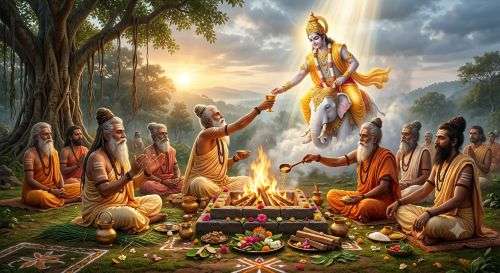
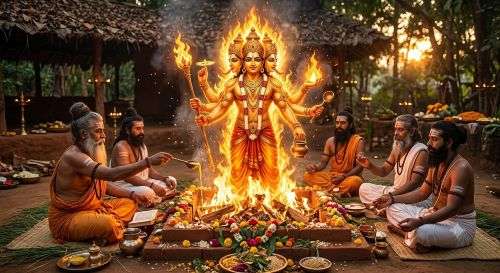
Before the sacred fire, the priests prepared purified oblations and reverently placed them upon the consecrated altar. They invoked Agni with humility, praying that through his purifying power they might be freed from sins and their lingering effects. The blazing flames of Agni, described poetically as his radiant hair, illuminated the sacrificial ground. His fire symbolized both physical purification and inner transformation, consuming impurities while awakening spiritual insight within the hearts of devotees.
Agni was revered as the eternal purifier, worthy of worship by gods and humans alike. The sages sought from him the fulfillment of righteous desires and the attainment of noble aspirations. They praised him as resplendent, immortal, and radiant, the sanctifier of clarified butter and the perfect recipient of sacrificial offerings. Every oblation poured into the sacred fire was regarded as a symbolic act of surrender, whereby material substances were transformed into subtle energies and conveyed to the divine realms through Agni’s agency.
The Ritvijas, the learned officiating priests, approached Agni with sacred ladles in their hands and hymns upon their lips. They sought refuge in his divine presence, offering oblations with devotion and precision. Their chants resonated throughout the sacrificial enclosure, creating an atmosphere of sanctity and spiritual concentration. The ritual was not viewed as a mechanical performance but as a profound collaboration between knowledge, devotion, and disciplined action aimed at pleasing the divine powers and securing their grace.
The Vedic seers recognized Agni as the producer and sustainer of sacred fire, perpetual in his existence and inexhaustible in his radiance. He inspired individuals toward righteous action and sacred duties. As the supreme knower of yajnas, Agni possessed complete understanding of every ritual principle and stood foremost among all divine intelligences associated with sacrifice. His wisdom encompassed both visible and invisible dimensions, making him the guardian of sacred knowledge and ritual order.
Agni was praised as wise, vigilant, and unwaveringly attentive to every aspect of the sacrifice. Strong in all respects, he was carefully established at the proper place within the sanctified precincts of the yajna. This careful placement reflected the scientific temperament of Vedic ritualism, where every detail—from the orientation of the altar to the arrangement of offerings—was governed by precise principles. Such practices reveal an ancient culture deeply committed to observation, measurement, order, and systematic understanding of natural and spiritual phenomena.
The Vedic hymns further celebrate Agni as the bestower of boons through sacred rites and as the divine presence dwelling within the elemental foundations of creation. Mythologically, Agni is connected with Ila, the daughter of Daksha Prajapati, symbolizing the union of cosmic order and sacrificial energy. Through this sacred association, Agni becomes both a cosmic force and a familial presence within the divine genealogy, reflecting the Vedic tendency to express profound metaphysical truths through symbolic narratives.
The sages addressed Agni as the acquirer of strength, adorned with majestic light and ever delighted by sincere offerings. They prayed that he would grant blessings according to the merits and aspirations of the worshippers. Through his luminous presence, the sacrificers sought physical well-being, material prosperity, intellectual growth, and spiritual fulfillment. Agni’s benevolence was understood as a force that nourished every dimension of human life.
The intelligent devotees recognized Agni as the ruler of the universe and the inspirer of waters, whose energies sustain life throughout the world. They nourished him with offerings of food and clarified butter, enabling his flames to rise brilliantly toward the heavens. This reciprocal relationship between humans and the divine reflected the Vedic principle of mutual sustenance, wherein offerings made with devotion contribute to the maintenance of cosmic harmony and ecological balance.
The luminous Agni, described as the grandson of nourishment, shone magnificently across the expanse of space. The sages praised him through sacred hymns, acknowledging his omniscience and all-pervading presence. Their chants revealed a sophisticated spiritual philosophy in which the same fire that burns upon the altar also exists within the sun, within lightning, and within the vital energies sustaining life itself. Such insights reveal an early attempt to understand the unity underlying diverse natural phenomena.
Agni was worshipped as the venerable, visible, and accessible deity who dispels darkness and fulfills the worthy desires of devotees. His flames symbolized the triumph of knowledge over ignorance, order over chaos, and illumination over obscurity. As the fire blazed upon the altar, it became a living metaphor for the awakening of consciousness and the ascent of the human spirit toward higher realms of understanding.
The worshipper finally addressed Agni with profound reverence, offering sacred oblations into his blazing form. He prayed for nourishing rains, abundant harvests, and the flourishing of life upon earth. As clarified butter enriched the flames, Agni grew ever more luminous and expansive, symbolizing the growth of wisdom, virtue, and spiritual realization. Thus, the Vedic sacrifice emerged as both a sacred act of devotion and a disciplined exploration of cosmic principles, harmoniously uniting spirituality, scientific observation, environmental awareness, and profound philosophical insight within a single transformative vision of existence.