



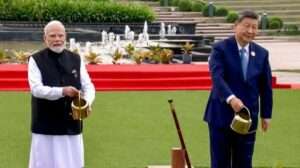
High-sounding platitudes have been invoked by both Xi Jinping and Modi in the statements issued after the bi-lateral meeting on the sidelines of the BRICS Summit. The two leaders expressed commitment to a fair, reasonable, and mutually acceptable resolution of the boundary question proceeding from the political perspective of their overall bilateral relations and the long-term interests of the two peoples.
China is committed to “a fair, reasonable, and mutually acceptable resolution of the boundary question”; and “addresses each other’s economic and trade concerns in a balanced way and promotes the sound and steady development of economic and trade relations”.
“China and India have different national realities. We should draw on each other’s strengths, support each other, help each other succeed, and develop together. In the face of the changing and turbulent international landscape, the world’s two most populous countries and important members of the Global South shoulder important responsibilities,” China quoted Xi.
“Calibrate the direction with an objective and rational strategic perception. China and India are partners rather than rivals, and development opportunities rather than threats to each other. This is a strategic judgment made based on the development stage and international environment of the two countries, and one that conforms to the common interests of the two countries and the two peoples.”
“Help each other succeed in the spirit of win-win cooperation. Both sides should focus on development as the greatest common denominator, and strengthen friendly exchanges and mutually beneficial cooperation. A “Wake-up call” for jingoistic rhetoric by all types of opposition “hawks” and critics!
“Remove irritants with the political wisdom of mutual respect and mutual understanding. The two sides should stay committed to advancing bilateral relations and resolving the boundary question, seek parallel, mutually reinforcing progress, and maintain peace and tranquillity in the border areas,” the statement said on the border issue.
“Contribute to a better world with open and inclusive multilateral coordination. The two sides should support each other’s BRICS chairship, strengthen coordination in the United Nations, the Shanghai Cooperation Organization, and the G20, work together to address global challenges, and unequivocally uphold international fairness and justice,” it said.
“India always views its relations with China from a strategic and long-term perspective. It hopes to be a partner, not a rival, of China, and regards each other’s development as an opportunity, not a challenge.”
“India has an independent foreign policy, and developing relations with China is not affected by any third party,” it quoted Modi telling Xi, alluding to India’s ties with the US.
“India’s policy and position on issues relating to Taiwan and Tibet remain unchanged, and it will not allow any force to engage in anti-China activities on its territory,” the Chinese statement said.
Having entered NEFA way back in 1961 and fought the War in 1962, commanded a unit in East Sikkim astride Chola Pass in 1982 and carried reconnaissance of Bomdilla, Tawang and Bumla during the Sumdorong Clash in 1987-1988, and with detailed insights into various historical events, I cannot but help but entreating both Xi Jinping and Modi (as strong leaders of both nations) to exercise their political will to resolve the border dispute with utmost expedition instead of leaving it to trigger crisis escalation in posterity.
Let me recall that India is to be blamed for squandering opportunities to resolve the border disputes.
Ipso facto, Deng Xiaoping revived the proposal, which originally mirrored an offer made by Chinese Premier Zhou Enlai in 1960, on multiple occasions. Deng Xiaoping’s proposed “package deal” was based on a territorial swap and maintaining the status quo with both nations making concessions based on the lines of actual control (My battalion – 2 Madras – gave fire-power demonstration in Ambala).
The proposal was essentially a west-for-east swap aimed at legitimizing the existing territorial control of both nations. In the Eastern Sector: China would drop its claims and accept Indian sovereignty over the McMahon Line (Arunachal Pradesh). Deng even suggested renaming it a neutral “India-China line”. In the Western Sector: India would drop its claims and recognize Chinese sovereignty over Aksai Chin, an area China occupied and heavily consolidated in the lead-up to and during the 1962 war. Deng proposed that both sides could make minor territorial concessions or adjustments on both wings to finalize a clean border line.
Deng presented to Atal Bihari Vajpayee during his historic visit to Beijing, the first senior Indian visit since the 1962 war. India indicated it was not ready for such an agreement. Re-publicized by Deng in an interview with the Indian defense journal Vikrant and repeated to G. Parthasarathi, chairman of India’s Policy Planning Committee during 1980 and 1982. Deng discussed the issue during Prime Minister Rajiv Gandhi’s landmark visit to China in 1988. According to Chinese diplomatic recollections, Deng pushed for the settlement, but the Indian side did not formally accept the swap.
Xi Jinping must pragmatically renew Deng’s “Package Deal” all over again, which is a “Win-Win Situation” to both nations.
Unhesitatingly, Modi must exercise political will to accept the “Package Deal” by appealing to “We the People” of India as the best option from a long term strategic context.
Let me outline and review the Sino-Indian border disputes. 4 states viz., Himachal Pradesh, Uttarakhand, Sikkim and Arunachal Pradesh and UT of Ladakh share a border with China. And, the Sino-Indian border is generally divided into three sectors namely: Western sector, Middle sector, and Eastern sector.
The details of the current disputed areas include: 1) 1963 – Trans-Karakoram Tract (Shaksgam) – Ladakh (Leh district); 2) Demchok sector Ladakh (Leh district); 3) Chumur (2 separate noncontiguous Chumur North & Chumur South subsectors) Ladakh (Leh district): 4) Shipki La Himachal Pradesh (Kinnaur district); 5) Kaurik Himachal Pradesh (Lahaul and Spiti district; 6) Sang-Nelang-Pulam Sumda, Uttarakhand (Uttarkashi district); 7) Barahoti Uttarakhand (Chamoli district); and 8) Arunachal Pradesh.
In the Western sector, there is an inherited territorial dispute over Aksai Chin. India claims it as part of erstwhile Kashmir, while China claims it is part of Xinjiang. As per information available in the public domain, the total area presently under China’s occupation of China is nearly 40,000 sq.kms out of which Aksai Chin alone constitutes 37,244 square km. Add to the above data, the ongoing dispute in Depsang Valley/Plain, the Gogra patrolling points following the Galwan Clash in 2020, and the Pangong Tso Lake stand-off, among others.
In the Middle Sector, India shares about a 625 km long boundary with China, which runs along the watershed from Ladakh to Nepal with Himachal Pradesh and Uttarakhand touching this border. China claims the Kaurik region of Lahaul & Spiti districts as part of its Tibet province and the Tashigang-Shipki La region of Kinnaur district is also claimed by China as its own part of its Tibet province.
In the Eastern Sector, India shares a 1,140 km long boundary with China. The McMahon Line denotes the border. China considers the McMahon Line illegal and unacceptable, claiming that Tibetan representatives who had signed the 1914 Convention held in Shimla which delineated the McMahon Line on the map were not have the right to do so. Even Taiwan (Republic of China) considers it illegal.
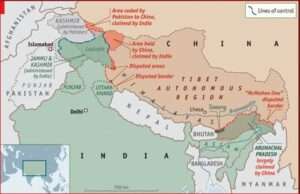
Sino-India border disputes are complex historical issues. India’s claim to the area is largely based on the “Johnson Line” in Ladakh and the MacMohan Line in Arunachal Pradesh. PRC (People’s Republic of China) and ROC (Republic of China – Taiwan) contest both India’s claims.
PRC-ROC and India have never agreed on the course of their shared border, a boundary inherited from the British colonial era that passes through many remote and largely uninhabited stretches of the Himalayas. The first border dispute occurred in the middle sector in 1954 when India occupied several posts. In 1958 China’s ambassador to India at the time sent two memos to the Foreign Ministry of India calling for an immediate withdrawal of Indian troops from the disputed areas and the resumption of negotiations. Next, the Sino-Indian military clashed at Longju in August 1959. The dispute flared into war in 1962, which resulted in a resounding Chinese victory and the loss of territory for India. Also, the artillery duel in Natu La, Sikkim in 1967.
Add to it the military standoff at the Sumdorong Chu Valley in Arunachal Pradesh in 1987. From the late 1980s until the mid-2010s, the border remained relatively peaceful, and the two sides engaged in sporadic talks to reduce tensions. The two countries hoped to set aside the boundary dispute and focus on other areas of their relationship.
China began taking provocative actions along the LAC, leading to two dustups, in 2013 and 2014, and a lengthy standoff in the summer of 2017 in Doklam, where the borders between Bhutan, China, and India converge and where China had tried to build a road. The completion of that road would have given Beijing a commanding military position in the area, allowing China’s People’s Liberation Army to overlook a stretch of India known as the Chicken’s Neck—a corridor connecting India’s northeastern states to the rest of the country. Fortunately, none of these engagements resulted in loss of life.
That changed in June 2020 in the Galwan River valley in Ladakh, in the western sector of the border, where 20 Indian troops and at least four Chinese soldiers were killed in a hand-to-hand brawl. The clash followed a major Chinese military buildup in the spring of 2020 of 30,000 troops with tanks and artillery at five different locations along the LAC, including in areas India regularly patrolled. Beijing also later deployed fighter and bomber aircraft, rocket forces, and air defense radars at several points along the disputed border.
The Chinese and Indian militaries have since pulled back forces from the most contentious positions and established temporary buffer zones, but both sides retain large numbers of soldiers along the tense frontier. A border clash that took place near Tawang, in the eastern Indian state of Arunachal Pradesh, in December 2022 was a reminder that, although recent attention has been focused on Ladakh, many other flash points along the 2,100-mile LAC could erupt into crisis at any moment.
Following the disengagement of troops along the LAC in eastern Ladakh in November 2024, the two countries have taken incremental steps to stabilise ties: resumption of direct flights, easing of visa restrictions, revival of the Kailash Mansarovar pilgrimage and easing of curbs on Chinese investments. However, no breakthrough on border disputes has been made through negotiations yet.
Despite military clashes, bilateral negotiations on border issues continue even till date, starting with Chou En Lai’s offer in late 1960’s, Deng’s offer in 1980s to Rajiv Gandhi, India’s formal acceptance of the Chinese claims on Tibet, and the opening of the Nathu-La for trade as well as the start of meetings between special representatives on the Boundary Issue during Vajpayee’s visit to China in late June 2003.
I dare challenge political and media pundits laying claims to recapture Aksai Chin through political and military means. They may drumbeat to expose Modi for surrendering territory; but they cannot in their wildest dreams, regain territory from China. Instead, they may open the window of opportunity to China to capture a better part of Arunachal Pradesh areas which were paying taxes to Tibet rulers.
To sum up, Deng’s “Package Proposal” is a “Win-Win” outcome for both nations. As strong and pragmatic leaders, if Xi Jinping and Modi fail to resolve the border disputes expeditiously over one that sounds good in theory but is impossible to execute, then woe be to enduring peace among partners. Instead, conflict escalation could erupt along the 2,100-mile disputed border at any time. Such a conflict will contradict the national security interests of both nations. The sky will be the limit if both strong leaders opt for a ‘give-and-take’ policy in the best interests of both the powerful economies in Asia.

