Lakshmanrao Upadhayula
In the sacred hymns of the Ṛgveda, the illustrious sage Vishvamitra raises his inspired voice in praise of Agni Vaiśvānara, the Universal Fire who pervades all worlds and all beings. These mantras are composed in the majestic Jagatī metre, whose expansive rhythm mirrors the vast movement of the cosmos itself. Viśvāmitra offers these hymns with minds purified and words refined, just as clarified butter is purified before being poured into the sacrificial flame. Such well-measured chants are not merely poetic utterances; they are luminous vibrations that awaken joy, harmony, and divine consciousness in the hearts of the worshippers.
Vaiśvānara Agni is the divine power who makes every yajña fruitful. He is the sacred mediator between mortals and the gods, carrying offerings from the visible world into the unseen realms. As fire transforms physical substances into subtle essences, so Agni translates human devotion into spiritual merit. In scientific terms, he represents the principle of transformation—matter becoming energy, intention becoming action, and action becoming spiritual evolution. Thus, the Vedic seers perceived in Agni both a deity and a universal law governing all processes of conversion and ascent.
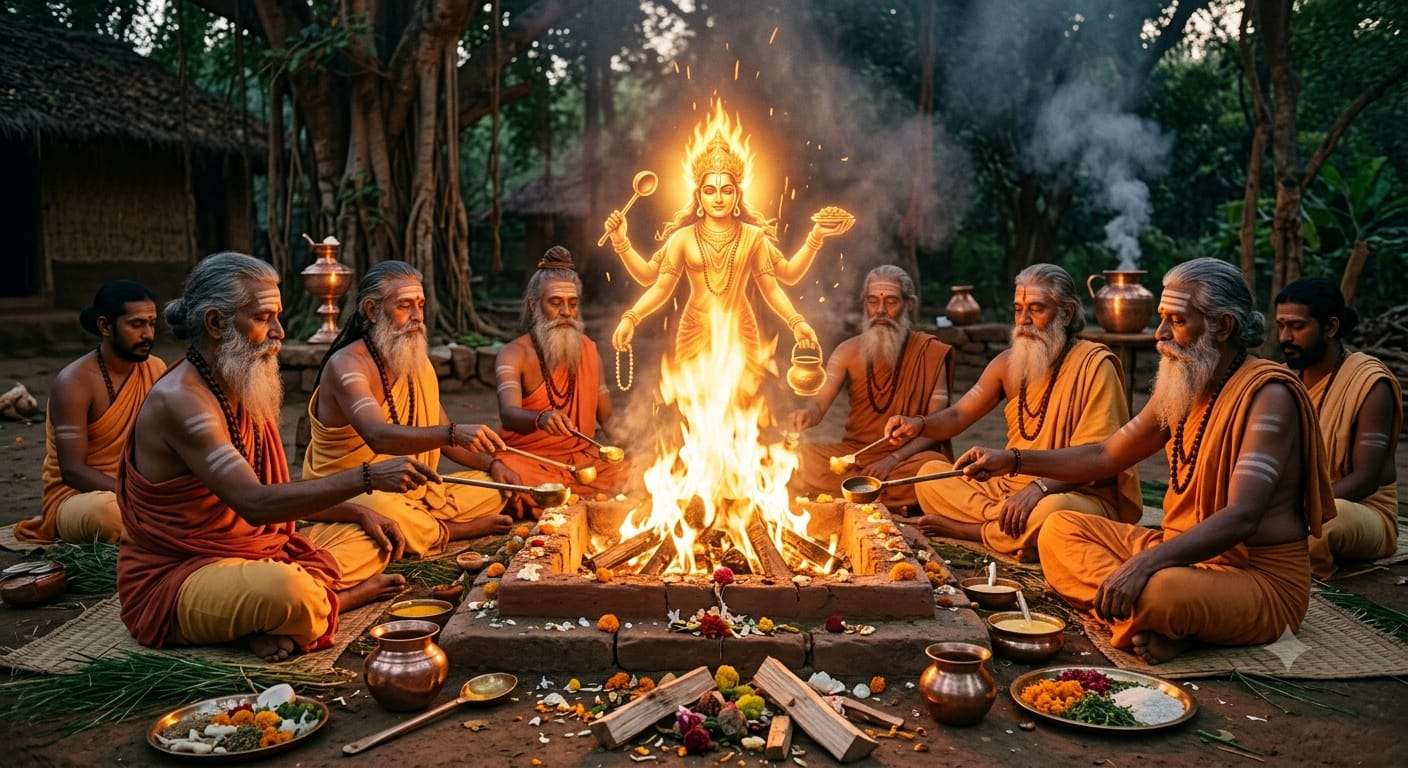
Just as a curious observer salutes a splendid chariot before understanding its destination, so ordinary men and learned priests alike approach Agni with reverence. The household fire, known as Gārhapatya, the ritual offering fire, Āhavanīya, and the southern fire, Dakṣiṇāgni, are all manifestations of this one cosmic energy. Carefully kindled, purified, and sustained, these sacred fires become living altars through which the gods are invited to descend and bless the sacrifice.
Agni is the immortal carrier of oblations. Though ever ancient, he is untouched by decay and remains eternally youthful. He nourishes all beings without violence, sustaining life through warmth, digestion, and illumination. His flames are likened to a mighty bow whose arrows are rays of light piercing the darkness of ignorance. At his birth, he illumines both earth and heaven, revealing the hidden unity of the material and spiritual worlds.
To his divine parents—Heaven and Earth—Agni is a beloved son. To humanity, he is an honoured guest seated upon the sacred altar. The wise gods, perceiving the sufferings of beings, manifested Agni in the holy precincts of sacrifice so that those burdened by sorrow might be uplifted. As a weary traveller seeks the strength of a noble horse, and as the hungry seek food, so the aspirant turns to Agni, the self-luminous and inexhaustible source of spiritual nourishment.
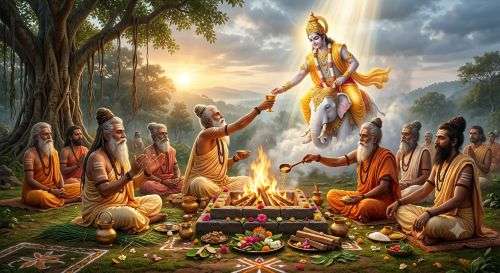
The descendants of the venerable Bhrigu, masters of sacred fire, adored Agni as the heavenly power of aspiration and intelligence. He is supremely brilliant, the friend of all the gods, the destroyer of grief, and the officiating priest who performs the sacrifice on behalf of the patron. Seeking his grace, the priests spread the sacred kuśa grass, lift the wooden ladle, and invoke him with devotion. Their actions reflect the scientific precision of Vedic ritual, in which every gesture, sound, and offering is aligned with cosmic order.
Agni, radiant and all-seeing, summons the gods to the sacrificial ground. The patrons, eager to serve him, prepare seats of holy grass and consecrate the yajña hall with purity and care. Their worship is an act of cooperation with the universe itself. In return, Agni bestows prosperity, food, strength, and spiritual wealth upon those who honour him with sincerity.
Agni worships Heaven and Earth and sanctifies the vast mid-region of the sky. Newly born through the friction of the arani sticks, he is lovingly tended by the sacrificer like an infant. Yet this seemingly small flame is omnipresent, containing within itself the power that nourishes the worlds. The Vedic vision here reveals a profound scientific intuition: immense energy can arise from subtle beginnings, and a spark can become the source of universal sustenance.
Seated among the gods, Agni serves as the donor and distributor of offerings. He is the auspicious conductor of the yajña and the benevolent guardian of every household. Great sacrificers honour him as the first and most essential guest, knowing that without Agni no communion with the divine is possible. Even the immortal gods themselves desired him, for he alone unites heaven, atmosphere, and earth.
The gods fashioned Agni in three cosmic forms: as terrestrial fire upon the earth, as lightning in the atmosphere, and as the sun in the heavens. Of these three, the earthly fire was installed among mortals as the universal ruler and visible deity. The other two were placed in the sky and the celestial realm. This threefold conception reveals an extraordinary scientific insight, recognizing the same energy principle manifesting as combustion, electricity, and solar radiation.
Those who seek wealth and success sharpen Agni like a sword, refining their inner will and intelligence. Agni extends through higher and lower worlds and moves through all planes of existence. He holds the universe within himself, just as energy underlies every structure and process in nature. In the human body, he shines as digestive fire, transforming food into life and consciousness.
As Vaiśvānara, Agni is ever newly born. He grants noble desires and roars like a lion through all regions. In every being he flourishes as the power of metabolism, vitality, and aspiration. Free from decay and death, he bestows beautiful and beneficial gifts upon the devoted patron. Thus, the Vedic seers recognized the same sacred fire in the altar, in the sun, and within the human organism.
Venerable to priests and sages, Vaiśvānara is compared to the primordial Puruṣa moving through the vastness of space. He is the ancient seer who sustains the universe and enriches those who worship him. He invigorates body, mind, and spirit, leading the aspirant from limitation to fullness.
Travelling the path of the gods in the form of the sun, Vaiśvānara illumines all worlds. The celestial beings, mighty and wise, brought this divine fire from heaven and established it among mortals through the agency of Vāyu, the life-breath. This symbolism reflects the intimate relationship between oxygen, breath, and combustion—an observation of remarkable scientific sophistication encoded within sacred imagery.
Agni is the god of manifold paths, adorned with golden rays and resplendent light. The worshipper turns to him for abundance, knowledge, and protection. He moves toward the sacrificial hall as omniscient consciousness, bearing the banner of heaven. Dwelling within the solar orb, he possesses inexhaustible stores of nourishment and stands as the greatest among luminous powers.
Pure, straight, and ever-vigilant, Agni invites the gods and beholds the entire universe. His splendour appears in countless colours, visible in every flame and every sunrise. He is the creator of auspiciousness for humanity, the bestower of prosperity, and the revealer of truth. To such a radiant deity the devotee offers heartfelt prayer, seeking both material well-being and the supreme wealth of spiritual illumination.
The hymns of Viśvāmitra to Vaiśvānara Agni reveal the profound unity of devotion, cosmology, and scientific insight. Fire is not merely a physical phenomenon but a universal principle of transformation, intelligence, and divine presence. In the sacrificial altar, in the brilliance of the sun, in the lightning of the heavens, and in the digestive warmth within every living being, Agni shines as the eternal mediator between matter and spirit. To contemplate Vaiśvānara is to recognise that the same sacred energy sustaining the universe also burns within the human heart as the light of consciousness itself.