



The intense heatwaves plaguing Indian cities are no longer merely a meteorological phenomenon but an issue of climate justice. Heatwaves are often considered transient climate events, but their unequal impacts are deeply intertwined with inequalities in housing, income, employment, access to water and electricity, and the ability to escape the intense heat. The wealthy can take refuge in air-conditioned buildings, while millions of urban poor must endure the intense heat of the day to get to work, school, and home. The recent heatwave in Delhi, with surface temperatures in the beautiful city reaching over 54 degrees Celsius, reflects this unequal reality.
Unlike other parts of the world, climate change is impacting urban design and development, causing Indian cities to become hotter. Global warming is increasing the frequency, duration, and intensity of extreme heatwaves. However, at the local level, urbanization can further exacerbate temperatures through the urban heat island (UHI) effect. During the day, concrete, asphalt, and other built surfaces absorb heat from the sun and release it slowly, leading to warmer neighborhoods after nightfall. Unplanned and rapid urban growth has replaced natural cooling zones with heat-trapping infrastructure.
The lack of vegetation further worsens the situation. Trees and green spaces regulate temperatures and provide shade through transpiration. They are one of the most effective natural barriers to heat, but they are gradually disappearing, especially in high-rise buildings and poorer areas. Dense building populations can also restrict airflow, causing hot air to accumulate between buildings.
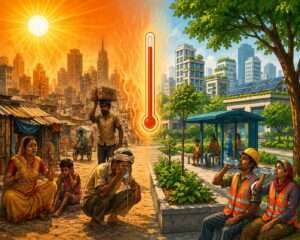
The injustice of urban heat affects people unequally, and their ability to adapt is also unequal. Poor people often live in informal settlements or poorly constructed homes with poor ventilation, limited insulation, and tin roofs. During the hottest hours of the day, these homes can be much hotter than the outside temperature. Experiencing heat in crowded rooms, where electricity is erratic and there is no ability to use air conditioners or fans for long periods of time, is particularly dangerous. For many families, home becomes their only refuge.
Another aspect of insecurity is occupation. Many workers in the informal sector, such as street vendors, construction workers, sanitation workers, delivery personnel, traffic police, domestic workers, etc., cannot avoid working during the hottest hours of the day. Unlike formal employees, many of these workers are paid based on attendance, productivity, and/or sales. Taking leave for health reasons can result in lost income. Heat also leads to reduced productivity, reduced customer footfall, wastage of perishable goods, and physical fatigue. As a result, this heat can lead to a vicious cycle of reduced income and increased expenses for water, electricity, and healthcare.
Its health effects are also not uniform. Symptoms of prolonged high temperatures include dehydration, headaches, dizziness, weakness, and insomnia. The elderly, the already frail, and young children are more vulnerable. However, poor people living in urban areas are less likely to have access to quality medical care, clean water, and cooling. Poor sleep at night can also have long-term effects, as it can lead to deterioration in physical and mental health, especially in hot climates where homes lack adequate cooling, are crowded, and cannot be closed at night. Heat-related vulnerability is not just a matter of the highest temperature recorded at a weather station; it can also include the duration of heat exposure and the availability of resources to mitigate the effects of heat.
Indian cities need to move beyond typical heatwave strategies and adopt a heatwave-resilient and socially inclusive approach to urban planning. While this is an important first step, disaster management plans must incorporate the results of neighborhood-level risk mapping, rather than simply city-wide average values. Ward-level maps should highlight informal settlements, areas with low tree density, heat-storage surfaces, and locations where outdoor workers or populations have limited access to water and health services. The risk assessment approach by the National Disaster Management Authority provides a valuable foundation, but its implementation must be closely integrated with the urban planning process.
The construction of affordable housing projects should be the foundation of urban heat-resistance. Reflective roofs, cool roofs, improved building insulation, shaded windows, improved building ventilation, and the use of energy-efficient building materials are all passive cooling options that can regulate internal temperatures and reduce air conditioning energy consumption. For example, under the right conditions, cool roofs can reduce internal temperatures by approximately 2-5 degrees Celsius. Therefore, governments should prioritize installing them in slums, underprivileged areas, and public institutions such as schools, hospitals, Anganwadi centers, and other public institutions.
Green and blue infrastructure should also be viewed as integral city services, not just additional amenities. Increasing tree density, greening streets, protecting parks, and restoring lakes and water bodies can cool the local climate, improve air quality, and enhance public health. But these measures must be fairly distributed. If affluent areas are given parks where they are not needed, it would be unfair to give concrete and asphalt to low-income areas.
Cities should also provide accessible cooling centers, ventilated public spaces, and drinking water points in vulnerable areas. Special attention should be paid to bus stops, markets, labor centers, and construction areas. Such facilities should be available during heatwave warnings and made readily available, free of charge. Early warning systems should also be disseminated in local languages and through the informal sector and marginalized communities.
Heat resilience must be incorporated into urban master plans, building codes, and infrastructure investments. Climate-sensitive buildings should be encouraged to incorporate orientation, shading, ventilation, and the use of heat-reducing materials based on ECBC principles. Heat impact assessments should be used in addition to regular environmental assessments for new roads, housing projects, and commercial developments.
Outdoor workers need protection too! Occupational heat standards in India need to be strengthened, along with mandatory rest breaks, shaded workspaces, drinking water, and flexible working hours during extreme heat.
In conclusion, extreme heat exposes inequalities in urban structure and access to resources. A 45-degree Celsius day may be the same for a wealthy person and a street vendor, but their experiences are completely different. To make cities resilient to climate change, it is essential to address issues such as housing, livelihoods, public health, labor rights, and social security, in addition to reducing temperatures. Heat-risk mapping for each ward, climate-resilient housing, cool roofs, green infrastructure, cooling shelters, and occupational safety measures should be at the center of urban governance. Instead of focusing on the urban poor, we must focus on making India’s cities cooler, safer, fairer, and more just.

