



The fearful twilight of evening spread a heavy veil of helplessness and sorrow over the Pandava camp. Dharmaraja beheld his army trembling with anxiety and despair. Their condition resembled that of a cow trapped in deep mire, struggling helplessly to free itself yet sinking deeper with every effort. Observing the exhaustion and fear of his warriors, he resolved to bring the day’s conflict to an end and ordered the army to withdraw. The humiliation suffered by Arjuna, Krishna, and the other mighty heroes at the hands of Bhishma gnawed at his heart. With a mind weighed down by grief and discouragement, Dharmaraja returned to his camp while the Pandava forces slowly dispersed to their respective stations.
The Kaurava army too was commanded to retire for the day. Sanjaya narrated the scene to King Dhritarashtra, saying that the king’s sons gathered around Bhishma with reverence, saluted him respectfully, and praised his valor in words suited to his noble temperament. Their joy shone openly upon their faces as they celebrated the triumph of the day and later returned contentedly to their quarters.
The terrible events of the ninth day deeply weakened the spirit of Dharmaraja. That night, with sorrow silently enclosed within his heart, he approached Krishna in secrecy, accompanied by his brothers. Desiring guidance for the course that lay ahead, he spoke with deep anguish. He said that Bhishma had intensified his assault that day and had shattered their armies like a raging forest fire consuming all living beings in its path. Krishna himself had witnessed the fierce heroism displayed by the grandsire upon the battlefield. Among the Pandava warriors, Dharmaraja confessed, not a single one seemed capable of confronting Bhishma or enduring the overwhelming force of his might. He lamented that he had failed to estimate the devastating power of Bhishma before the war began.
With a heart burdened by grief, Dharmaraja reflected upon the terrible cost of war. What value, he asked, was a kingdom stripped of kin and friends who had fallen upon the battlefield? A kingdom without people was no kingdom at all; it resembled a desolate forest devoid of life. He declared that he had no desire to rule such a barren realm. Instead, he wished to retire to the forest with his brothers, to live a life of penance and worship, free from the burdens of royal ambition. The blame for the war, he admitted, would rest upon him alone, for his reckless gambling had already brought countless hardships upon his brothers. Though he could still see his beloved companions alive, he could not bear the thought of offering them as sacrificial victims to Bhishma’s arrows. Therefore, he implored Krishna to discover a way to alter the course of the war without violating the sacred principles of righteousness.
Hearing these words of sorrow, Krishna gently consoled him. He reminded Dharmaraja that he was a man bound by the sanctity of his word, and once he had taken an oath, he could not withdraw from it under any circumstances. The Pandava brothers were powerful and capable warriors, and their strength would not permit them to fall into disgrace. Krishna assured him that, with wise counsel and determined effort, the kingdom and prosperity that were rightfully theirs would certainly be restored. He also revealed that Arjuna had once restrained him from killing Bhishma himself, and had prevented him from breaking his vow of not taking up arms in the war. Yet, Krishna said, Arjuna was his beloved friend, the husband of his sister, and also his devoted disciple. For Arjuna’s sake, he was prepared to do anything. Their bond was built upon mutual affection and deep loyalty, each honoring the word of the other without hesitation.
Dharmaraja then questioned Krishna with concern. Krishna had earlier promised to assist them without personally engaging in combat; how then could he violate that vow at such a critical moment? Fate, Dharmaraja admitted, had cornered him with unbearable anxiety. He also revealed that he had once spoken with Bhishma, who had declared that he would fight on the side of the Kauravas yet would always wish well for the sons of Pandu. Bhishma had even suggested that he might one day guide them toward the means of obtaining their rightful kingdom.
With renewed sorrow, Dharmaraja spoke again. After their father Pandu had passed away, it was Bhishma who had lovingly protected and nurtured them like his own children. Their affection for the grandsire was profound and sincere. Even to conceive the thought of bringing about his death felt like a grievous sin. Yet the duty of a king was fierce and unyielding, and the code of royalty often demanded ruthless decisions. Perceiving the unspoken desire within Dharmaraja’s heart to meet Bhishma, Krishna approved the thought. He advised that since Bhishma had declared his goodwill toward them, it would be wise to approach him directly and seek his counsel. If asked sincerely, the grandsire himself might reveal the means by which he could be defeated.
Krishna therefore proposed that they should visit Bhishma that very night in secrecy, without the knowledge of others. They would approach him humbly, salute him with reverence, and request both his blessing and the knowledge that would ensure their welfare. Such was the nobility of Bhishma’s character that he would surely disclose even the secret of his own death if asked with sincerity. Following his guidance thereafter would enable them to proceed toward victory.
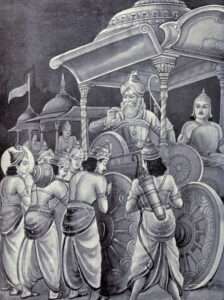
Accordingly, Krishna, Dharmaraja, and the other Pandava brothers set out quietly, wearing simple garments and ornaments without any sign of royal display. In silence they reached Bhishma’s camp and approached him with humility, bowing down to touch his feet with deep devotion. Bhishma received them with affection, calling each of them by name and inquiring kindly about their well-being. Surprised by their unexpected visit, he asked the purpose of their arrival and invited them to request whatever they desired, assuring them that, however difficult it might be, he would gladly fulfill it with love and blessings.
Dharmaraja, standing before him with a bowed head and a face clouded with sorrow, respectfully spoke. He requested Bhishma to show them the path by which they might regain their kingdom and also the means by which the war might end with the least possible destruction to their army. Bhishma answered with calm honesty. As long as he continued to fight upon the battlefield, he declared, the destruction of the Pandava forces was inevitable and their victory impossible. Only by conquering him could they hope for success.
Hearing these words, Dharmaraja addressed the grandsire with deep reverence. He compared Bhishma to the mighty Lord Shiva himself, who, bearing the trident and the hidden third eye, descends to the world for divine sport. If Bhishma stood upon the battlefield with such power, how could any warrior hope to confront him? Therefore they had come seeking his compassion and guidance to learn the way by which he might be overcome.
Bhishma acknowledged the truth of Dharmaraja’s words. As long as he held a bow in his hands, he said, even the gods themselves could not defeat him. Yet since the Pandavas had come to him with faith and respect, it was his duty to remove their doubts and guide them toward a path acceptable to all. There was no greater act of virtue for him than to satisfy their request. He then revealed the conditions under which he would refuse to fight. He would never raise his weapons against one who was unarmed, who had cast aside his armor, who had lowered his flag, who had fallen helpless upon the ground, or who was a woman. He would also not attack anyone who had once been a woman or bore a woman’s name, nor one whose turban had fallen or who stood without family protection.
Bhishma further explained that he had taken a solemn vow never to fight a person who had been born a woman and later became a man through divine grace. Such a person, he said, already stood within the Pandava ranks: Shikhandi, the child of Drupada. In a former birth Shikhandi had been a woman, and thus Bhishma would never raise his weapons against him. If Shikhandi were placed before him in battle, Bhishma would lay down his arms and cease fighting. At that moment Arjuna could strike freely with his arrows. Once Bhishma fell, defeating the remaining Kaurava forces would become far easier. Declaring this strategy with sincerity, Bhishma urged them to act according to his instruction.
After receiving his blessing, the Pandavas respectfully took leave and returned quietly to their camp. As they walked back, Arjuna spoke to Krishna with deep concern. Bhishma, he said, was a noble soul who seemed ready to ascend to heaven. Yet fate demanded that he should be slain through a stratagem. Arjuna’s heart trembled at the thought. Bhishma was wise, virtuous, and compassionate, an elder revered by all people. In childhood, when Arjuna had played innocently in the dust, the grandsire would lovingly lift him in his arms and speak affectionately of his father Pandu with tears in his eyes. Remembering such moments, Arjuna felt unwilling to destroy such a venerable soul through deception. Krishna listened attentively, carefully weighing the turmoil within Arjuna’s heart and the grave necessity that destiny had placed before them.

