Upadhyayula Lakshman Rao
In the sacred vision of the seer Deerghatama, the hymn to Agni unfolds not merely as praise, but as a profound contemplation of existence itself, where the physical, intellectual, and cosmic realms converge into a single luminous principle. The brilliance of the Sun, radiant and life-sustaining, is understood as a manifestation of strength, and that very radiance is mirrored within every living being as consciousness. Agni, in this vision, is not confined to flame alone; he is the awakening of intellect, the force that enables thought to reach its purpose, and the subtle power that lends balance and clarity to speech, action, and intention. Thus, Agni becomes the unseen organizer of the universe, harmonizing the visible and invisible processes that sustain life.
As the source of nourishment, Agni is intimately bound with food, growth, and the sacred cycle of offering and receiving. In the ritual space, he consumes oblations, transforming them into subtle energies that ascend toward the divine, while in the body he becomes the digestive fire that sustains physical existence. This duality reflects an early scientific intuition—an understanding that transformation of matter into energy is central to life. The sages perceived that nourishment is not merely consumption but a sacred exchange governed by universal law, where Agni stands as the mediator between the material and the spiritual.
The hymn further reveals the threefold manifestation of Agni, each embodying a layer of cosmic function. The terrestrial fire, visible and immediate, sustains ritual and daily life; the electric fire, subtle and dynamic, courses through the unseen realms, serving the seven worlds with its invisible energy; and the solar fire, vast and all-encompassing, governs the cycles of rain, light, and time itself. In this triadic understanding, one perceives an early attempt to grasp the diversity of energy forms—heat, electricity, and solar radiation—woven into a unified principle. The ten directions become his domain, signifying the omnipresence of energy in all spatial dimensions.
From the earliest times, the wise have sought refuge in Agni, preserving the sanctity of offerings and maintaining the continuity of sacred knowledge. The friction of the Aranis, the wooden sticks that give birth to fire, symbolizes both physical ignition and intellectual awakening, suggesting that effort and discipline are required to kindle both flame and wisdom. Agni, though born of humble origins, rises ever youthful, consuming impurities and transforming them into light. His growth, from a fragile spark hidden within fuel to a blazing force that devours obstacles, mirrors the evolution of knowledge itself—beginning in obscurity and culminating in illumination.
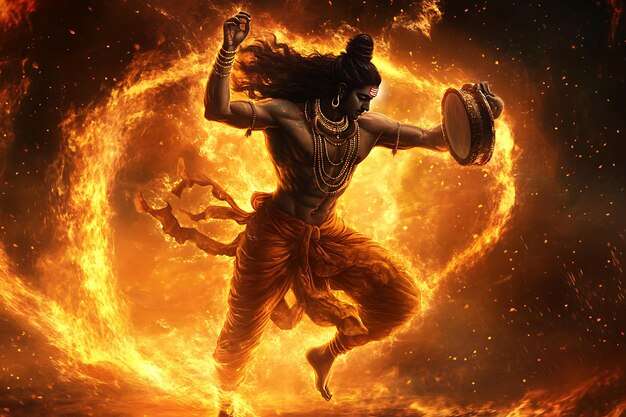
Strengthened by Vayu, Agni expands, just as energy intensifies through interaction with movement and air. The imagery of flames devouring forests and moving through smoke captures a keen observation of natural processes, while also symbolizing the relentless advance of transformation. The sages perceived in this not destruction alone, but renewal—the clearing away of the old to make space for the new. Agni’s movement through soot and flame reflects a dynamic understanding of matter changing states, an insight that resonates with the scientific temper embedded within Vedic thought.
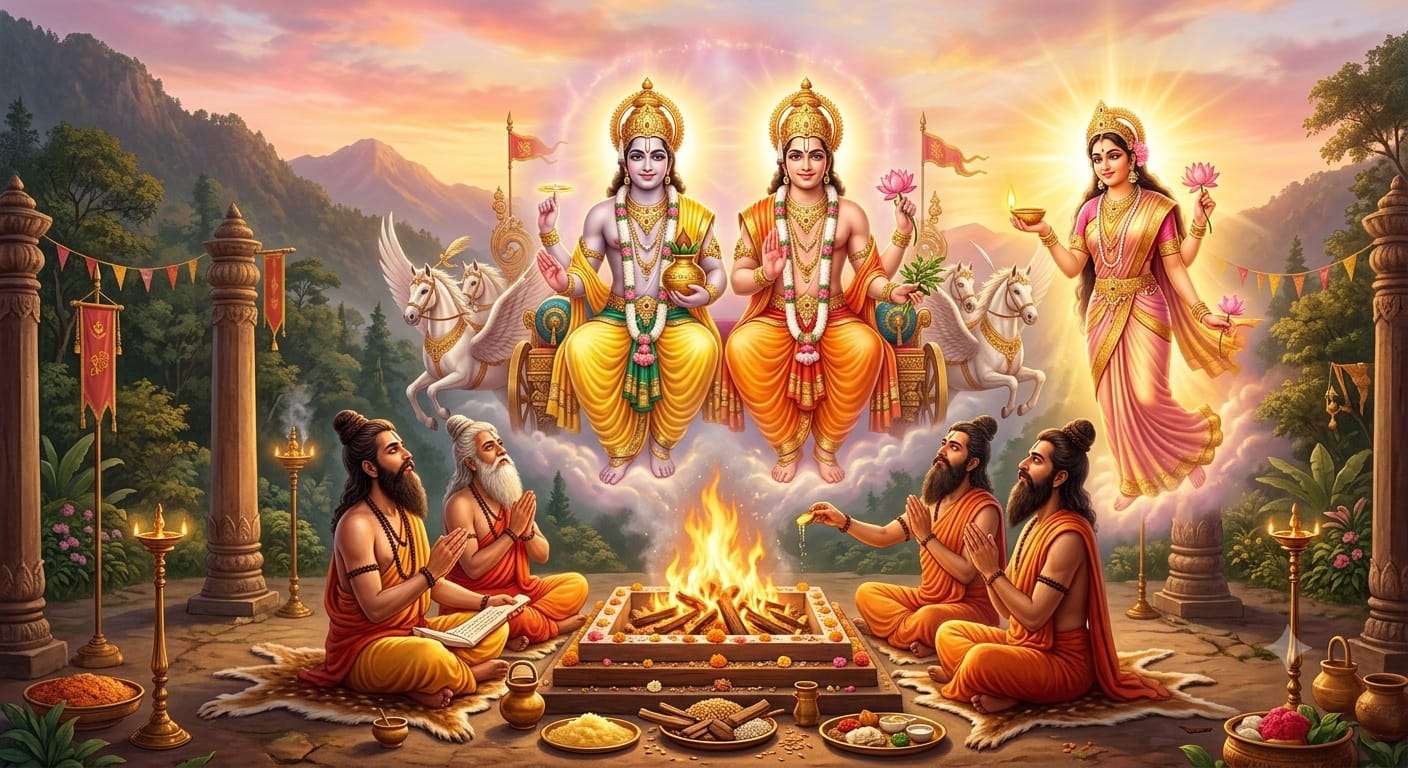
In the cosmic order, Agni becomes the priest, the messenger, and the monarch. He invites the celestial hosts and carries offerings to the gods, establishing a connection between the human and the divine. Deities such as Varuna, Mitra, and Aryaman are invoked alongside him, each representing aspects of universal order—law, harmony, and generosity. Agni’s presence ensures that these principles are not abstract ideals but active forces within the cosmos. Like a chariot bound and guided through space, he sustains motion and direction, illuminating paths while leaving behind a trail of transformation.
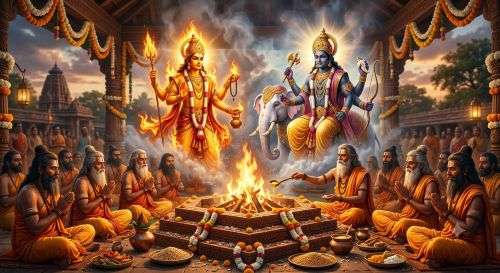
The hymn captures the awe inspired by Agni’s brilliance, a force both creative and fearsome. To birds and beasts, he appears as a warrior; to the devotee, he is a benefactor. This dual nature reflects a deep understanding of energy as both constructive and destructive, depending on its application. Yet, within the ritual, Agni is approached with reverence and discipline, ensuring that his power is aligned with order and purpose. The priests, through measured chants, seek to harmonize with this force, their voices rising like clouds resonating under the Sun, echoing the rhythm of nature itself.
Ultimately, Agni stands as the eternal mediator of existence—youthful, radiant, and inexhaustible. He bestows wealth, vitality, and progeny, symbolizing the continuity of life and knowledge. As the carrier of offerings, he bridges the earthly and the celestial, guiding the soul toward higher realms. The aspiration expressed in the hymn is not merely for material prosperity, but for alignment with the cosmic order, where the individual becomes attuned to the universal rhythm. In this synthesis of spirituality and observation, the hymn reveals a worldview that is at once poetic and analytical, where devotion coexists with inquiry, and where the flame of Agni illuminates both the altar and the intellect.