
Every new government inherits an economy. Yet political arguments about economic performance often begin by comparing where one government left the country with where another eventually took it—without asking the most basic question: what was the starting line?
That question becomes particularly relevant when comparing the economic inheritances of Manmohan Singh in 2004 and Narendra Modi in 2014.
A comparison of 16 key macroeconomic indicators at the point of transition—covering growth, inflation, fiscal position, current account, foreign-exchange buffers, banking health, public debt and the global economic environment—offers a revealing picture. On this comparison, 14 of the 16 parameters were more favourable in 2004 than in 2014.
That does not automatically make Atal Bihari Vajpayee a better economic manager than Manmohan Singh, nor does it diminish the economic achievements of the UPA years. It does, however, establish an important fact: Manmohan Singh inherited a considerably more comfortable macroeconomic starting position from Vajpayee than Narendra Modi inherited from Singh.
Consider the external sector. In 2004, India had a current-account surplus of around 2.3 per cent of GDP. By 2014, the country was running a current-account deficit of around 1.7 per cent of GDP. Foreign-exchange reserves provided roughly 14 months of import cover in 2004, compared with about eight months in 2014. RBI data similarly show the substantial difference in the external buffers available at the two points of transition.
The banking sector presents an even more consequential difference.
In 2014, the reported gross non-performing asset ratio of scheduled commercial banks was around 4 per cent. But the subsequent Reserve Bank of India Asset Quality Review exposed how seriously stressed bank balance sheets had become, particularly because a substantial amount of troubled corporate lending had been inadequately recognised. The clean-up that followed eventually revealed the full magnitude of the bad-loan problem.
This is important because the Modi government did not inherit merely a statistical problem. It inherited a banking system carrying the accumulated consequences of aggressive corporate lending during the preceding boom years. The subsequent clean-up—through recognition of bad loans, recapitalisation, the Insolvency and Bankruptcy Code and recoveries—came at a considerable fiscal and economic cost.
The global environment also matters. The early 2000s offered India relatively favourable conditions, including strong global growth, abundant international liquidity and relatively benign commodity conditions. By 2014, India faced a much more difficult combination of global volatility, tighter financial conditions and the after-effects of the global financial crisis.
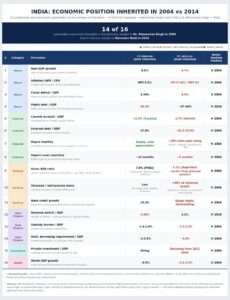
There were, of course, parameters where 2014 looked better. Public debt relative to GDP was lower, while the revenue deficit position was marginally more favourable. And no serious comparison can pretend that governments have complete control over global oil prices, international interest rates, capital flows or geopolitical shocks.
That is precisely why the argument should not be reduced to “Vajpayee was better than Manmohan” or “Modi is better than Manmohan.”
The real issue is the starting point.
Manmohan Singh deserves credit for the growth achieved during his tenure, particularly in its first phase. But he also handed over an economy in 2014 that was dealing with high inflation, fiscal pressures, a stressed banking sector, a weakened investment cycle and a vulnerable external position. The 2013 taper-tantrum episode had already demonstrated how exposed India had become to global capital-flow shocks.
Modi, therefore, did not receive the same economic inheritance that Singh received in 2004.
This distinction is frequently lost in political debates. Economic performance should be judged on both inheritance and delivery. A government taking over a healthy economy cannot be assessed in exactly the same manner as one taking over an economy requiring stabilisation and structural repair.
The larger lesson is simple: before judging the race, establish the starting line.
The numbers suggest that the starting line in 2004 was substantially stronger than the one in 2014. That does not settle the entire debate over who governed India’s economy better. But it certainly changes the terms of the debate—and makes simplistic comparisons between the Manmohan Singh and Narendra Modi eras difficult to sustain.