



The radiant crown that adorned Arjuna’s head was no ordinary ornament fashioned by celestial hands. It possessed a lineage as illustrious as the warrior who wore it. In ancient times, Lord Brahma, delighted by the severe austerities of Indra, the sovereign of the heavens, bestowed this resplendent crown upon him as a symbol of divine authority and unconquerable sovereignty. It shone with supernatural brilliance, spread glory wherever its wearer stood, struck terror into hostile hearts, and drove away demons, spirits, and every unholy being that dared approach its radiance.
In the fullness of time, when Arjuna ascended to the celestial realm, Indra, recognizing in his son the embodiment of heroic excellence and unblemished righteousness, placed this sacred crown upon his head before the assembled hosts of heaven. It was not merely a royal decoration but a heavenly acknowledgment of Arjuna’s unparalleled valour. This honour followed his astounding conquest of the formidable Nivatakavachas, the invincible demons who dwelt beneath the sea. These dreadful warriors had long defied even the might of Indra, yet Arjuna subdued them with irresistible prowess. The celestial assembly rejoiced, and the crown became the visible seal of his immortal fame.
Sanjaya, recounting the terrible events of Kurukshetra to the blind King Dhritarashtra, described the sorrowful moment when that glorious crown met its destined fall. Just as the blazing sun illumines the world throughout the day before descending into the western ocean and disappearing from sight, so too the celestial crown of Kiriti fell from Arjuna’s head upon the battlefield. It had been scorched and shattered by the venomous power of the serpent missile. Bereft of his crown, Arjuna resembled a lofty dark mountain whose majestic summit had been torn away. Yet he calmly wrapped a spotless white turban around his head, and his serene countenance shone like the full moon rising in tranquil splendour across the night sky.
The serpent weapon that struck the crown had been released by Karna, yet its hidden origin reached back to an ancient episode. Krishna reminded Arjuna that during the burning of the Khandava forest, Takshaka’s wife had been slain by Arjuna’s arrows while attempting to escape with her son. That surviving serpent was Ashwasena, who had cherished vengeance through the passing years. Assuming the form of the dreadful Nagastra, he entered Karna’s arrow with but one purpose—to end Arjuna’s life. Though the missile destroyed the celestial crown, its fury remained unsatisfied, and Ashwatthama prepared to strike again.
Arjuna, swift in perception and unwavering in resolve, answered the threat with astonishing mastery. His arrows shattered the serpent missile before it could renew its deadly assault. Without pause he pierced Karna repeatedly, sending ten, twelve, and then countless shafts into his adversary. At last he loosed a mighty blazing arrow whose fiery energy drank Karna’s blood as though it were sweet nectar before passing through his powerful frame.
The grievous wound only inflamed Karna’s indomitable spirit. Like a serpent struck by a staff, he hissed in furious wrath, realizing that even the invincible Nagastra had failed to destroy his rival. His disappointment transformed into relentless aggression. Twelve arrows sped toward Krishna, while ninety-nine razor-edged shafts flew against Arjuna. His thunderous roar echoed across the battlefield, filling the Kaurava ranks with renewed confidence as they witnessed their great champion still standing amidst overwhelming peril.
Arjuna answered with equal magnificence. His arrows tore apart Karna’s glittering armour and severed the celestial earrings that had long distinguished him. Blood streamed from Karna’s head and ears, staining his radiant form crimson. Yet neither warrior slackened his assault. Karna covered Arjuna with torrents of arrows, while Arjuna broke every advancing missile and answered with hundreds more. Karna’s body glowed red with blood, resembling a magnificent mountain rich with minerals from whose slopes crimson streams flowed beneath the golden light of the setting sun.
The duel rose to a sublime height where human strength seemed joined by divine power. Arjuna’s arrows enveloped Karna’s chariot, banner, horses, and charioteer beneath an unbroken canopy of steel. Karna, though grievously wounded, stood resplendent in heroic endurance. Even King Shalya, who guided his chariot, marvelled at the splendour of his courage. He appeared like the evening sun, its crimson rays spreading gloriously across the western mountains, refusing to surrender its brilliance before the coming night.
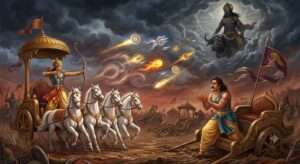
At that solemn hour, an unseen voice belonging to Yama, the Lord of Justice, resounded across the battlefield, audible to both armies. The decree of destiny had arrived. The curse the offended Brahmin pronounced and Parashurama’s terrible words had reached their appointed fulfilment. Karna’s chariot wheel slowly sank into the earth. Simultaneously, the sacred mantras of the Bhargava weapon vanished from his memory. The strength of his celestial weapons deserted him, and his chariot became helplessly trapped.
Standing amidst overwhelming adversity, Karna raised his hands in anguish and lamented before fate itself. He questioned whether righteousness truly protected those who upheld it. He reflected upon his lifelong adherence to generosity, honour, and courage, wondering why Dharma now seemed silent in his darkest hour. Yet his grief clouded his understanding, for he remembered only the virtues he had practised and overlooked the grievous injustices he had willingly embraced. Even as he uttered these words, Arjuna’s arrows continued to strike him, increasing both his pain and his fierce determination.
Though afflicted by destiny, Karna’s heroic spirit remained unconquered. Before the astonished gaze of gods and warriors alike, he once more showered Krishna and Arjuna with a fierce storm of arrows. Summoning the mighty Brahmastra, he released its immeasurable power. Arjuna immediately answered with the Indrastra, yet the Brahmastra consumed its brilliance. Observing this, Krishna spoke earnestly to Arjuna, questioning why the divine weapon had yielded before Karna’s missile. Instantly understanding the gravity of the moment, Arjuna invoked his own Brahmastra, whose sacred energy neutralized Karna’s celestial weapon and restored the balance of the contest.
The conflict continued with astonishing speed. Karna severed the string of the Gandiva bow, believing he had gained a decisive advantage. Yet before his eyes could perceive it, Arjuna restrung the immortal bow with effortless mastery and resumed his relentless assault. Krishna, smiling at the unequal contest, reminded Arjuna that none equalled his mastery in archery. His strength, skill, precision, and divine concentration formed a perfect union. What exhausted other warriors remained for him merely an effortless display of celestial discipline. Krishna urged him to cast aside every hesitation and accomplish the destiny ordained by time itself.
Karna prepared to release yet another deadly serpent arrow toward Arjuna. But before the missile could leave the bowstring, the cursed wheel sank deeper into the earth with a thunderous crash, arresting both his movement and his confidence. Forced to descend from his immobilized chariot, Karna appealed to Arjuna for a pause in accordance with the traditional code of righteous warfare.
Thus Sanjaya narrated to King Dhritarashtra one of the most intense and tragic moments of the Mahabharata. It was a spectacle where unmatched heroism, inexorable destiny, forgotten curses, divine intervention, and the irreversible march of time converged upon a single battlefield. The fall of Arjuna’s celestial crown and the sinking of Karna’s chariot wheel became enduring symbols that even the mightiest warriors cannot escape the eternal law by which destiny, justice, and the consequences of one’s deeds ultimately prevail.

