Lakshmanrao Upadhyayula
The sage Vamadeva invokes the divine presence of Agni through the sacred metres of Asti, Ati Jagati, Druti, and Tristubh found in the hymns of the Rigveda. These metres are not merely poetic forms but rhythmic structures that harmonize the human mind with cosmic vibrations. Agni is praised as the radiant Lord whose brilliance illuminates every realm of existence and whose movements are swift, purposeful, and unfailing. The gods themselves inspire him for the divine battle against ignorance, while devoted patrons invoke him through sacred hymns. Agni remains eternal, ever-youthful, and unmatched in wisdom. The gods established him as the divine messenger who reaches the sacred centre of every yajna performed by humanity, carrying offerings from the earthly realm to the celestial world while uniting heaven and earth in one uninterrupted current of sacred energy.
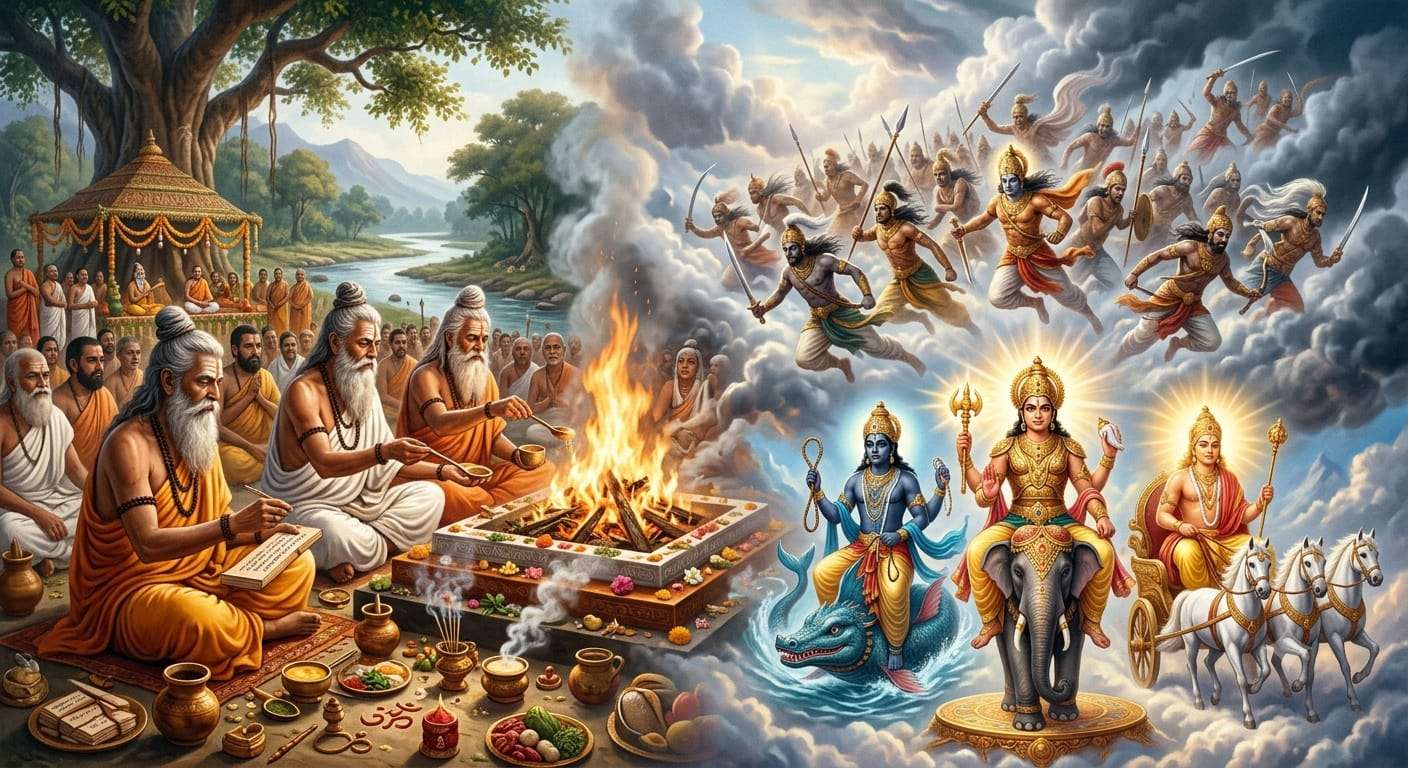
Agni is closely associated with Varuna, who is described as his divine brother. Varuna governs the cosmic waters, moral order, and universal law. Every offering placed into the sacred fire ultimately reaches the divine through Agni, while Varuna sanctifies creation through the life-giving gift of water. This profound relationship between fire and water reveals one of the deepest scientific observations of the Vedic seers: life is sustained through the harmonious balance of opposing yet complementary forces. Fire transforms, while water preserves. Together they symbolize purification, nourishment, and the continuity of existence. Therefore the sage prays that Agni may graciously bring Varuna before the assembled priests so that divine grace, forgiveness, and abundance may descend upon the yajna.
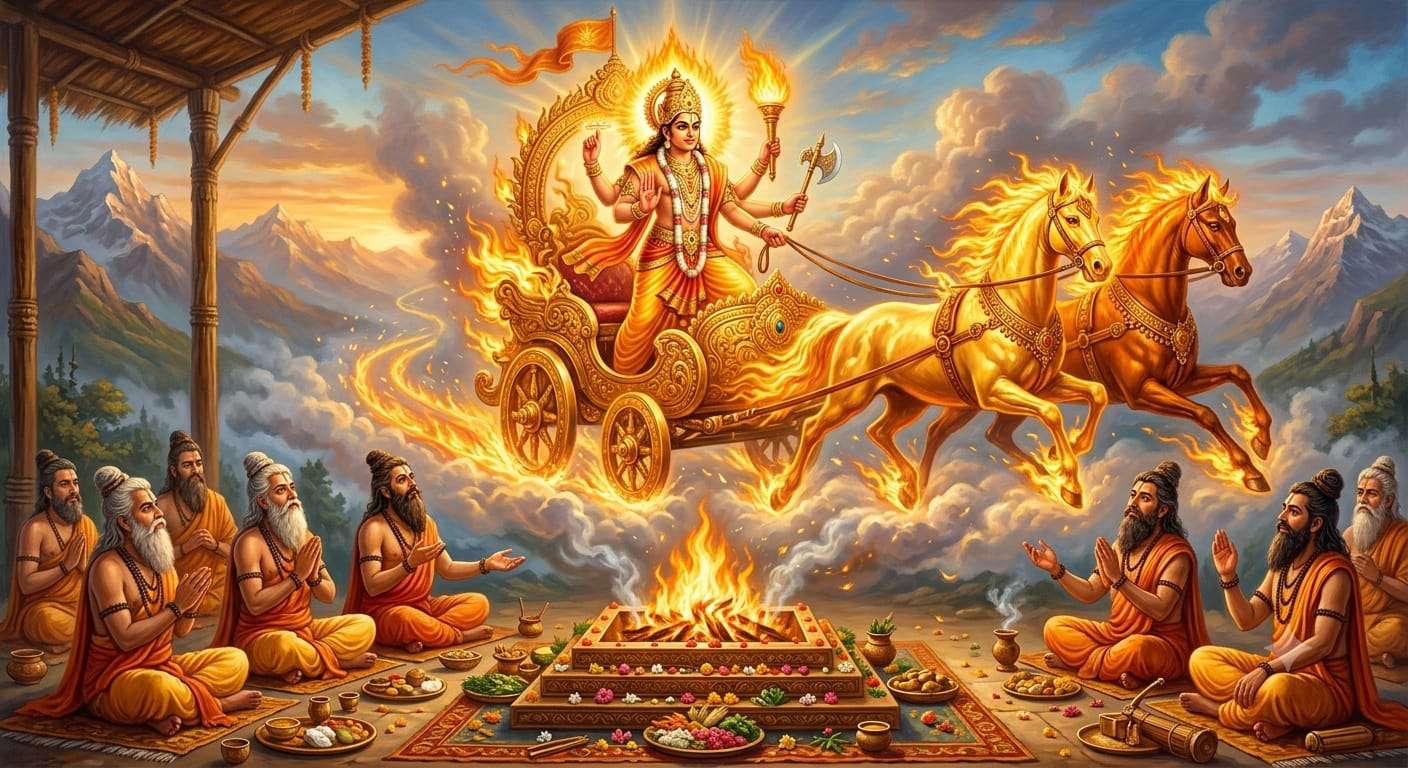
The twin horses yoked to Agni’s golden chariot symbolize the harmonious movement of energy and intelligence. Their swift journey reflects the disciplined progress of life guided by righteousness. The rapidly turning wheels signify the ceaseless motion of time and the orderly functioning of the universe. Agni is invoked to bring Varuna and the Maruts to receive the sacred oblations with delight. Through this divine communion, blessings are sought not only for the present generation but also for sons, grandsons, and all future descendants, affirming that righteous actions performed today become the inheritance of tomorrow.
The seer acknowledges that Agni alone understands the complete path leading humanity through the four sacred aims of life—Dharma, Artha, Kama, and Moksha. These are not isolated pursuits but successive stages of human fulfilment. Dharma establishes righteousness, Artha provides lawful prosperity, Kama grants disciplined enjoyment, and Moksha culminates in eternal liberation. Agni is therefore invoked to soften the anger of Varuna, purify every sin, remove all moral imperfections, and establish divine harmony within human life. As the supreme priest among gods, Agni performs every sacrifice flawlessly and leads sincere seekers toward spiritual perfection.
The sacred fire is invited to dwell among the worshippers as their nearest kinsman and constant protector. The hymns pray that diseases associated with impurity and imbalance, symbolically attributed to the displeasure of Varuna, may be destroyed through Agni’s purifying power. The yajna becomes both an outward ritual and an inward transformation, cleansing the body, mind, and spirit. Agni rewards every sincere patron according to the purity of intention, making every sacred hall a place where divine blessings descend upon those who perform righteous actions with unwavering faith.
The cows are lovingly described as the luminous wealth of humanity. Their pure milk, enriched through sacred preparation, becomes a worthy offering that nourishes both the gods and the worshippers. Beyond material sustenance, the cow represents abundance, compassion, ecological harmony, and selfless giving. The Vedic vision recognizes the intimate relationship between humans, animals, nature, and divinity. Agni delights in offerings prepared with purity rather than extravagance, revealing that sincere devotion possesses greater value than external display.
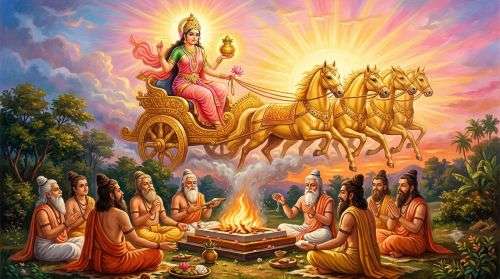
Agni manifests in three glorious and interconnected forms: terrestrial fire, atmospheric energy associated with Vayu, and the radiant brilliance of Surya. These three expressions illustrate a remarkable scientific insight into the continuous transformation of energy throughout the cosmos. Fire upon earth, dynamic forces within the atmosphere, and solar radiance in the heavens together sustain all biological and ecological processes. The Vedic sages perceived these manifestations not as separate entities but as one eternal principle operating through different dimensions of creation. Agni shines in the vast heavens through his own inherent brilliance, observing the entire universe while sustaining life through luminous energy.
Agni serves simultaneously as messenger, inviter, and honoured guest in every yajna. His golden chariot reflects purity, while his brilliant flames symbolize knowledge that dispels ignorance. Mounted upon radiant red horses, he moves ceaselessly toward every sacred altar where sincere devotion is offered. Like a generous household that continually provides nourishment to all who enter, Agni becomes the welcoming presence of every ritual. He knows the hearts of those who perform sacrifices and responds according to their sincerity rather than their outward status or material wealth.
The Adhvaryu priests ceremonially establish Agni upon the northern altar, where he becomes the living centre of every sacred rite. He dwells in the homes of patrons as the bestower of prosperity, wisdom, protection, and spiritual fulfilment. Agni shows no distinction between rich and poor, for divine grace is bestowed according to righteousness alone. The precious jewel associated with Agni symbolizes inner illumination, divine knowledge, and the inexhaustible wealth of spiritual realization. The priests worship this radiant treasure, praying that its blessings may flow into every deserving life.
Though immortal and eternal, Agni continually manifests wherever sacred duties are faithfully performed. The gods appointed him as the universal priest of all yajnas. He is poetically described as the father of heaven because his luminous power sustains celestial order. The Adhvaryu priests anoint him with reverence, recognizing him as the visible embodiment of divine truth. Agni stands supreme among sacred powers because he transforms ordinary offerings into eternal spiritual merit.
The mysterious descriptions of Agni being hidden within the body, dwelling in clouds as subtle smoke, and flourishing in the vastness of space reveal profound layers of Vedic insight. Fire exists not only in visible flames but also within digestion, metabolism, lightning, atmospheric processes, and solar radiation. The sages observed that water arises from clouds through cycles involving heat and evaporation, demonstrating an early understanding of natural processes integrated into sacred symbolism. Thus Agni becomes the invisible force sustaining both the physical universe and the inner consciousness of living beings.
The ever-youthful and radiant Agni is praised by seven priests whose hymns awaken divine awareness. Their chants preserve the sacred knowledge transmitted through generations of enlightened seers. The seven priests also symbolize the disciplined faculties of human consciousness working together in harmony to realize divine truth. Through sacred recitation, Agni becomes fully manifest within both ritual and the awakened heart.
The ancient ancestors gathered before Agni to perform yajnas and welcomed the arrival of Ushas, whose radiant light dispelled darkness. Their faithful service to Agni strengthened both intellect and spirit. Empowered by divine wisdom, they discovered the cows hidden within caves concealed by ignorance and darkness. This symbolic recovery represents the restoration of knowledge, prosperity, and spiritual enlightenment after overcoming the obstacles that obscure truth.
The noble Angirasas broke open the mountain strongholds where the stolen cows had been concealed by the deceitful Pani. Their victory signifies the triumph of wisdom over greed, light over darkness, and righteousness over falsehood. Through disciplined meditation, unwavering vows, and profound intelligence, they generated the sacred flame of knowledge and conducted yajnas with complete devotion. They composed twenty-seven sacred metres, enriching the Vedic tradition with refined expressions of divine truth. Their spiritual perseverance established an enduring model of scholarship, contemplation, and sacred responsibility.
As Ushas arose with the brilliance of Surya, darkness dissolved before the advancing light. The dawn became a daily reminder that ignorance can never permanently overcome truth. The ascending Sun observes every action of humanity, witnessing both virtue and error without partiality. This imagery reflects the Vedic understanding that the universe itself bears witness to human conduct and that every deed produces corresponding consequences according to the eternal law of Ṛta.
Finally, Agni is praised as the pure, radiant sustainer of the universe and the eternal inviter of all the gods. The patrons preserve sacred Soma and carefully prepare every offering not for personal gain but as expressions of gratitude and reverence. Agni remains the noble guest of humanity, carrying every oblation to the divine realms while returning blessings of peace, prosperity, health, wisdom, and spiritual awakening. The hymn concludes with unwavering faith that those who meditate upon Agni with sincerity shall receive the true fruits of their devotion, for the eternal flame continues to unite the visible and invisible worlds in one sacred order of everlasting harmony.