MS Shanker
When a few hundred protesters become a national movement, has journalism mistaken a street for a country?
A WhatsApp post making the rounds raises an uncomfortable question about Indian journalism: Has a small stretch of road in New Delhi acquired the extraordinary power to speak for 1.4 billion Indians? Or has a section of the media simply decided that whatever happens within camera range is what the nation must be thinking?
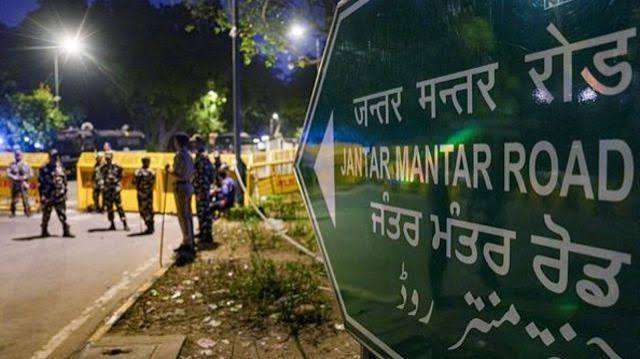
The post describes Jantar Mantar as a stretch roughly 200 metres long and 15 metres wide, questioning how a protest site occupying such limited space can become the supposed barometer of national sentiment. Its arithmetic may invite scrutiny, but its central argument deserves something rarer than a television debate: serious consideration.
Welcome to the curious world of prime-time journalism, where 500 people holding placards can trigger breathless declarations that “the nation is boiling,” while millions going about their daily lives apparently fail to qualify as news.
A protest breaks out in Delhi, and the television ticker announces that “people are on the streets.” Which people? How many? From where? Representing whom? Such inconvenient questions can wait. The camera has found a crowd, the studio has assembled its shouting panel, and democracy has conveniently supplied the evening’s entertainment.
Meanwhile, Bharat has more than 700 districts and over 700,000 villages. Its citizens live across vastly different social, economic and cultural realities. Farmers, workers, entrepreneurs, students, women, small traders and countless others have concerns that rarely fit into the neat choreography of a televised confrontation.
But why travel to a village to understand rural distress when a familiar road in the capital offers ready-made visuals, instant outrage and a convenient backdrop for political theatre?
The problem is not that Jantar Mantar receives coverage. Peaceful protest is a legitimate democratic expression, and those who gather there have every right to be heard. Nor does a small crowd necessarily mean a small grievance. Sometimes a handful of people can expose a serious injustice that deserves national attention.
The real problem begins when coverage quietly transforms into representation: when a gathering is presented not merely as a protest, but as proof of the nation’s mood, without evidence that it speaks for the nation at all.
Apparently, geographical proximity to Parliament has acquired the same magical properties as electoral legitimacy. Stand near the seat of power, find a camera, raise a slogan, and—presto! —you are suddenly the voice of India. The remaining country can apparently be represented by a map graphic.
To be fair, the media cannot measure public opinion merely by counting heads at a protest. Nor can it dismiss a demonstration because the crowd is small. Responsible journalism must examine the grievance, verify the claims, seek responses from those accused, establish the wider context and distinguish an organised mobilisation from a genuinely widespread public sentiment.
That requires reporting. It is considerably harder than repeatedly broadcasting the same footage between advertisements.
If journalists want to understand the national mood, they must look beyond Delhi’s familiar political theatre. They must travel, listen, investigate and report what citizens elsewhere are actually saying—not what a studio panel assumes they must be saying.
Jantar Mantar is a protest site, not a miniature India. Delhi is the national capital, not the nation in its entirety.
The question is not whether those on one road deserve a voice. They do. It is whether the other 99.99 per cent of the country deserve to be heard, too.
For a media that claims to speak truth to power, the first responsibility should be to listen to the people—not merely to the loudest crowd within camera range.