Vinay Rao
India and West Indies played at Uppal on 14 October with the United Nations Environment Programme in Hyderabad’s corner. The Hyderabad Cricket Association also came away with a United Nations certificate for how it ran the stadium.
Cricket at Uppal usually makes news for what happens in the middle. The India vs West Indies T20 International on 14 October gave Hyderabad a reason to talk about what happened around it.
The Hyderabad Cricket Association (HCA) took the match forward as a green fixture, with the United Nations Environment Programme (UNEP) partnering on the green initiatives HCA had pledged for the game. For an association more often in the news for its disputes than its stadium, it is a welcome kind of headline.
The company Hyderabad now keeps
UNEP leads Sports for Nature, a global initiative that helps sporting bodies reduce their environmental footprint and use their reach to engage fans on nature and climate. Its baseline handbook was developed with the support of the International Olympic Committee, Loughborough University and GRID-Arendal. It draws on consultations with over 100 sports organisations across 30 sports and 48 countries.
UNEP also partners with global bodies such as the International Cricket Council (ICC), FIFA, the FIA and the FIM. Its work rests on one premise, in UNEP’s own words: sport depends on a healthy planet, and without one there is no playing field.
Building on a pledge
UNEP’s approach was to build on what HCA had already pledged for the match, not to add a new commitment. The areas of collaboration were:
- Recognition: the match acknowledged as a green fixture supported under Sports for Nature.
- Waste and resource management: reducing single-use plastics, segregating waste at source and recovering recyclables across the stadium.
- Fan engagement: messaging that encourages spectators to act for nature.
- Player voices: players and officials sharing short environmental messages on match day.
UNEP’s reasoning was simple. An international fixture in Hyderabad reaches a large and highly engaged cricket audience. For HCA, UNEP’s letter said, the partnership offers global recognition for its sustainability work and access to Sports for Nature guidance and networks.
Credit for the people who ran the show
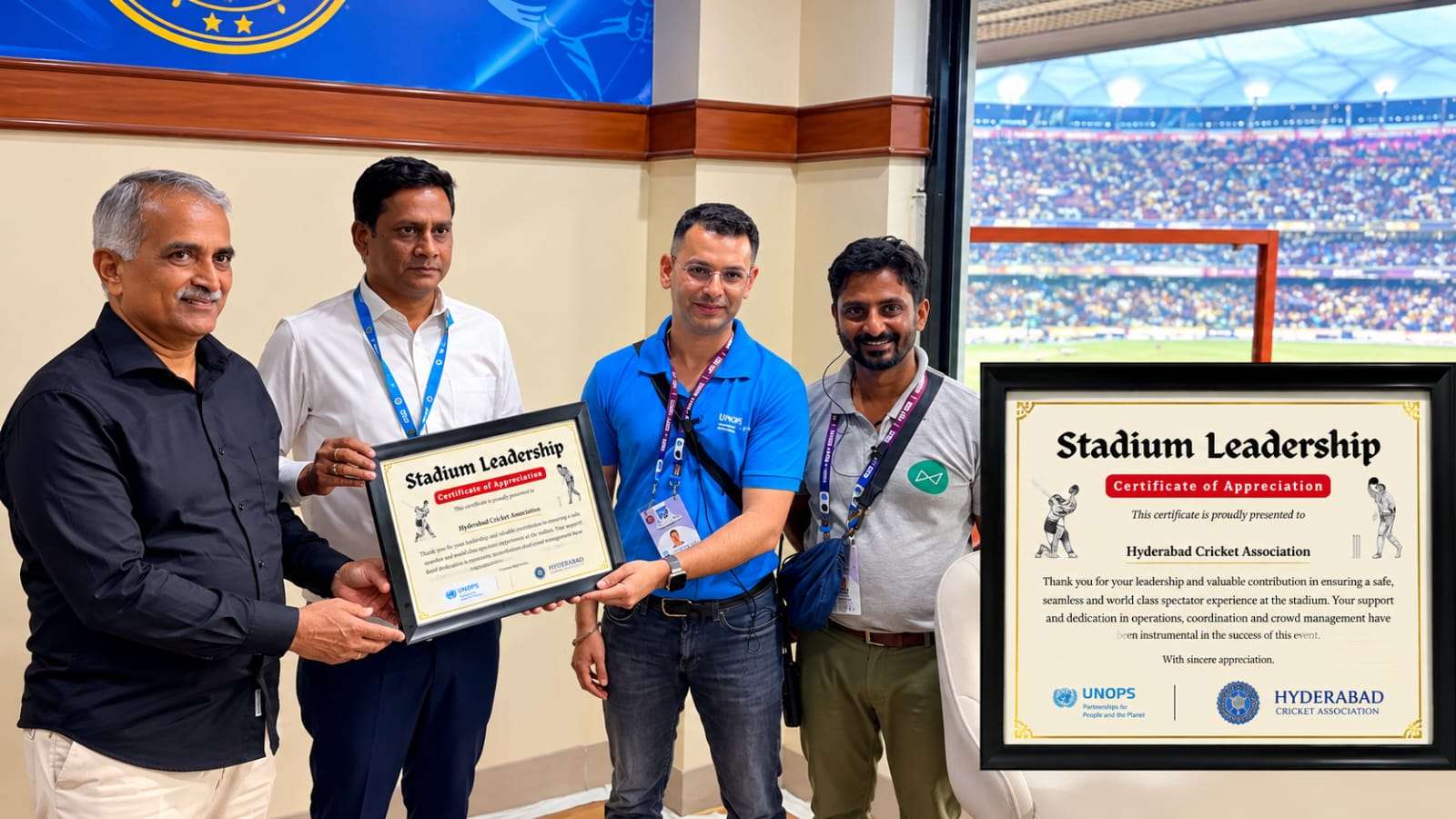
There was a second recognition. The United Nations Office for Project Services (UNOPS) presented HCA its “Stadium Leadership” Certificate of Appreciation.
HCA receives the “Stadium Leadership” Certificate of Appreciation from UNOPS at the Rajiv Gandhi International Stadium, Hyderabad.
The certificate thanks HCA for its leadership and valuable contribution in ensuring a safe, seamless and world-class spectator experience at the stadium. It says HCA’s support and dedication in operations, coordination and crowd management were instrumental in the success of the event.
Spectators rarely notice crowd management when it works; they notice it when it fails. A UN body putting its name to the first is worth recording.
The real test
Green cricket is not built in one match. UNEP’s own letter spoke of making this fixture a model for greener cricket in India, and that is the right measure for what comes next.
HCA has taken a step at Uppal. The test now is whether greener match days become routine in Hyderabad rather than the exception.