



Delhi’s Ramlila organisers seem to have stumbled upon an unusual way of celebrating Dasara.
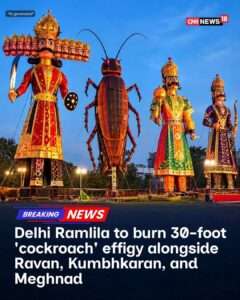
Alongside the towering effigies of Ravana, Kumbhakarna and Meghnad, they propose to burn a 30-foot cockroach, reportedly aimed at the Cockroach Janta Party (CJP).
Now, that is an interesting choice of company. But is it fair to the villains of the Ramayana?
Even demons had their virtues
Ravana, for all his notoriety, was no ordinary person. A great scholar of the Vedas, a devout worshipper of Lord Shiva and a formidable ruler of Lanka, he possessed accomplishments that even his adversaries could not simply wish away.
His fatal transgression was the abduction of Sita Mata. Like a tiny black dot on an A4 sheet of white paper, that one act overshadowed his many virtues and ultimately brought about his downfall.
His brother Kumbhakarna, despite his legendary appetite for sleep, displayed loyalty and courage. Ravana’s son Meghnad, also known as Indrajit, was a great warrior. They were flawed characters, but not cardboard cut-outs without qualities of their own.
Do cockroaches possess any virtues?
And what of our contemporary cockroaches? What virtues do they bring to the public square, apart from their apparent talent for creating a racket, provoking outrage and attracting cameras?
If Rahul Gandhi is the political patron saint of this ecosystem, Dhruv Rathee its digital storyteller, and Prakash Raj is among the voices amplifying its arguments; the question is not whether they should be allowed to criticise the government. Of course they should. Democracy would be poorer without dissent, scrutiny and inconvenient questions.
The question is what they do with that freedom. Does political criticism illuminate issues, test evidence and offer constructive alternatives?
Gen Z deserves more than slogans
The distinction matters. A young generation frustrated with unemployment, corruption or the absence of opportunities deserves serious engagement, not merely slogans and social-media spectacles.
Gen Z is entitled to question authority; it should also be encouraged to question those who claim to speak in its name.
Political mobilisation is not inherently wrong, nor is youthful rebellion. But when outrage becomes an end in itself and disruption substitutes for direction, young people risk becoming foot soldiers in somebody else’s political game.
Cockroach’s survival instinct
After all, a cockroach can survive almost anything. It can scuttle into the smallest crack, emerge when least expected and thrive in conditions that would defeat more respectable creatures. As political symbolism, it may therefore be more appropriate than its proponents realise.
Yet even a cockroach has a survival strategy. What remains to be seen is whether the political variety has a coherent vision beyond disruption and denunciation.
Triumph of good over evil
There is another irony here. Dasara symbolises the triumph of good over evil, but the burning of an effigy is not proof that evil has been defeated.
Ravana returns every year because the moral battle is never quite over. Hypocrisy, arrogance, intolerance and the abuse of power can inhabit any political camp.
So, if Delhi’s Ramlila organisers insist on adding a cockroach to the annual bonfire, let them. But perhaps they should pause before placing it alongside Ravana, Kumbhakarna and Meghnad.
The old demons, at least, had formidable qualities to accompany their fatal flaws. The new ones still have to demonstrate what, beyond making noise, they actually stand for.
Hopefully, this will be the last time this pesky insect is burnt at the stake. May the bonfire finally consign it to the ashes of political irrelevance.

