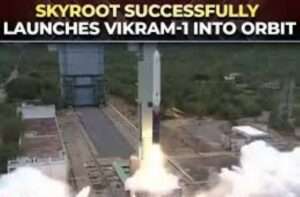
Skyroot Aerospace’s successful Vikram-1 launch is much more than a corporate milestone. It is a defining moment in Bharat’s journey from being a space-faring nation to becoming a space innovation powerhouse. For decades, Bharat’s space story was synonymous with the remarkable achievements of ISRO. Today, that story has evolved. A vibrant ecosystem of private enterprises, driven by young scientists, engineers and entrepreneurs, is adding new chapters to Bharat’s space ambitions. The Hyderabad-based Skyroot Aerospace has demonstrated that Bhartiya’s innovation can not only compete with the world’s best but can also redefine what is possible when policy support, entrepreneurial spirit and scientific excellence converge. There was a time when the idea of a privately built Bhartiya rocket reaching orbit would have sounded overly ambitious. Today, Vikram-1 has made it a reality. After creating history in 2022 with Vikram-S, Bharat’s first privately built rocket to reach space, Skyroot has now achieved yet another milestone by successfully launching its maiden orbital launch vehicle. This achievement deserves celebration not merely because a rocket took off successfully. It deserves applause because it reflects the changing face of Bharat. It is a Bharat that is increasingly confident of its capabilities and willing to empower its young minds to dream big. Prime Minister Narendra Modi’s government’s decision to open up the space sector to private participation has proved to be a transformational policy initiative. The creation of a conducive ecosystem for startups in the space sector, coupled with ISRO’s willingness to collaborate and share its decades of expertise, has created unprecedented opportunities for Indian innovators. Skyroot’s founders, Pawan Kumar Chandana and Naga Bharath Daka, represent the new generation of Bhartiya entrepreneurs who are willing to take risks and build world-class technologies within the country. Their vision of democratizing access to space is aligned with Bharat’s larger aspirations of becoming an innovation-led economy. The technical sophistication of Vikram-1 itself speaks volumes. Designed to deploy satellites weighing up to 350 kg into Low Earth Orbit, the rocket incorporates all-carbon composite structures, indigenously developed propulsion systems, and cutting-edge 3D-printed engines. More importantly, these technologies have been developed in-house by Bharatiya engineers working out of Hyderabad. The significance of this achievement extends far beyond the space sector. Space technologies have become critical enablers of modern economies. Satellite communications, navigation systems, weather forecasting, disaster management, agriculture, defence, and national security are increasingly dependent on indigenous space capabilities.
The global space economy is projected to grow exponentially over the next decade. Bharat cannot afford to remain a mere consumer of space technologies when it has the talent pool required to emerge as a major global player. Companies like Skyroot are demonstrating that Bharat startups are capable of capturing a meaningful share of this rapidly expanding market. The company’s valuation of over USD 1.1 billion and backing from leading global investors are further validation of Bharat’s growing credibility in the global innovation ecosystem. International investors are not merely investing in a startup; they are investing in Bharat’s scientific capabilities and economic potential. Equally noteworthy is Skyroot’s ambitious plan to establish a 300-acre Space City in Tirupati with an investment of ₹400 crore. Located strategically close to Sriharikota, the integrated manufacturing, assembly, and testing facility will create high-quality jobs and further strengthen Bharat’s space manufacturing capabilities. The symbolism is impossible to miss. Hyderabad has emerged as one of Bharat’s most dynamic technology hubs. Tirupati is set to become an important node in the country’s growing space ecosystem. Together, they reflect the emergence of a new Bharat where technological excellence is no longer confined to a handful of metropolitan centres. The success of Skyroot also reinforces a larger national narrative. Bharat’s strides in space exploration are becoming increasingly impressive. From historic lunar missions and solar observations to reusable launch vehicle technologies and now private orbital launches, Bharat’s space programme is expanding both in scale and ambition. The coming decade is likely to witness Indian astronauts travelling to space under indigenous programmes, Bhartiya space stations taking shape and Indian private companies becoming regular participants in the global space economy. At a time when many of our brightest young minds are tempted to seek greener pastures abroad, Skyroot offers a powerful counter-narrative. World-class opportunities are increasingly being created here at home. Indian scientists and engineers no longer need to leave the country to work on cutting-edge technologies or build globally competitive enterprises. The message from Vikram-1 is simple yet profound: the sky is no longer the limit for Bharat. It is merely the beginning. If India’s young innovators are provided the right ecosystem, policy support and opportunities, they are more than capable of shaping the nation’s future. Their talents can propel not just rockets into orbit but Bharat itself towards becoming a Viksit and Atmanirbhar nation. Skyroot Aerospace has made Bharat proud. One hopes it is only the first of many such success stories that will inspire an entire generation to build their dreams right here in Bharat.