



Shri Kalabhairavanath Temple is nestled amidst the serene countryside of Ankoli Village in Mohol Taluk, Solapur District, Maharashtra, the ancient Shri Kalabhairavanath Temple is one of the most revered shrines dedicated to Lord Kalabhairava, the fierce yet compassionate manifestation of Lord Shiva.
Kalabhairavanath is worshipped here as the divine guardian who removes obstacles, protects devotees from adversity, and fulfils sincere prayers. The temple is the Kuladaivam (family deity) of numerous families, and it is a cherished tradition for newly married couples to seek the Lord’s blessings before beginning their married life.
Although no inscriptions have been found to establish the exact date of construction, the temple is believed to be over 700 years old. This belief is based on the temple’s ancient traditions and its historic Palkhi (palanquin), which is locally believed to date back nearly seven centuries. The temple’s spacious wooden mandapa was restored by the villagers in 1971 using teak wood while preserving the sanctity of the ancient shrine.
The presiding deity is Lord Kalabhairavanath, worshipped in the form of a Swayambhu Shiva Linga. The sacred Linga is adorned with a beautifully crafted silver Mukhavata (facial mask), which is removed only during the morning Abhisheka, allowing devotees to have darshan of the original Swayambhu Linga. Lord Kalabhairava is revered here as the divine protector who grants courage, removes fear, safeguards devotees from evil influences, and blesses them with prosperity and well-being.
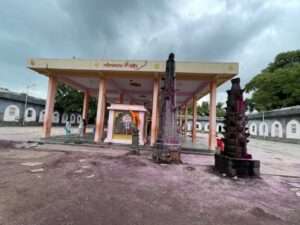
The temple is enclosed within a stone compound wall with a grand entrance leading into a spacious stone-paved courtyard surrounded by traditional Ovaris (verandahs). The courtyard houses the sacred Gorakshanath Dhuni, two Deepmalas, and a historic stone well believed by devotees to possess sanctity comparable to the Ganga at Kashi.
The temple comprises a Mandapa, Sabha Mandapa, and Garbhagriha. The sanctum enshrines the Swayambhu Kalabhairava Linga adorned with a silver Mukhavata, while the temple also features a monolithic Nandi, Kurma, sculptures of Kalabhairavanath on horseback, Jogeshwari Devi, and a beautifully carved Shikhara decorated with images of animals, deities, an Amalaka, and Kalasha.
Lord Kalabhairava occupies a unique position in the Shaiva tradition as the fierce manifestation of Lord Shiva and the eternal guardian of the sacred city of Kashi. Revered as one of the Ashta Bhairavas, He has been worshipped across India for centuries as the protector of temples, sacred kshetras, and devotees.
The exact origins of the Ankoli shrine remain unknown due to the absence of inscriptions. However, the temple has remained an important centre of worship for several centuries, with uninterrupted traditions preserved by the local community. The centuries-old Palkhi, medieval architectural features, and continuous worship indicate the antiquity of the shrine. In 1971, the villagers undertook the restoration of the spacious teak-wood mandapa while carefully preserving the original sanctum and sacred traditions. Today, the temple continues to be one of the most revered Kalabhairava shrines in southern Maharashtra.
The glory of Lord Kalabhairava is described in sacred scriptures such as the Shiva Purana and the Kalika Purana. According to the Shiva Purana, Lord Kalabhairava manifested from the divine wrath of Lord Shiva to destroy the arrogance of Lord Brahma, who had spoken disrespectfully of him. After severing Brahma’s fifth head, Kalabhairava became the bearer of the skull (Kapala). Lord Shiva later appointed him as the eternal Kshetrapala (Guardian Deity) of the sacred city of Kashi. Since then, Lord Kalabhairava has been revered as the protector of sacred kshetras, temples, and devotees, and it is believed that a pilgrimage to Kashi is incomplete without first seeking his blessings.
Another account found in the Kalika Purana narrates that Mahakala, one of Lord Shiva’s divine attendants, was born as Bhairava following a curse from Goddess Parvati. Another ancient legend states that after Bhairava subdued the pride of several celestial beings, Lord Shiva transformed him into the sacred Damanaka (Davana) plant and blessed it, declaring that worship of Shiva would be incomplete without offering this fragrant herb.
According to the local Sthalapurana of Ankoli, the Swayambhu Kalabhairava Linga has existed at this sacred site since ancient times and has been worshipped by devotees for centuries. A popular legend narrates that Jogeshwari Devi once had a disagreement with Kalabhairavanath and, leaving the temple, chose to reside about 1.5 kilometres east of Ankoli. Even today, a separate temple dedicated to Jogeshwari Devi stands at that spot, preserving this ancient tradition.
Within the Kalabhairavanath Temple, only the Panchaloha Utsava Murti of Jogeshwari Devi is housed and ceremonially brought out during festivals and the annual Palkhi procession, symbolising the eternal spiritual connection between the two shrines. Devotees believe that Lord Kalabhairavanath removes fear and obstacles, protects those who surrender with faith, fulfils sincere vows, and blesses devotees with peace, prosperity, and success in all righteous endeavours.
The temple’s principal celebration is the three-day annual Jatra, beginning on the Ashtami after Hanuman Jayanti, during which the temple remains open continuously for 72 hours. The festivities include the traditional Palkhi procession, special pujas, bhajans, and kirtans.
Other important observances include Kalabhairava Ashtami and Tripurari Pournima, when the temple is illuminated with nearly 5,000 oil lamps, attracting thousands of devotees from Maharashtra and Karnataka.


