



Shiva – Part 1
This is an article series. Please read all previous articles before reading this article. The URLs for all previous articles are located in the SPECIAL THOUGHTS section.
Now let’s move on to the next Devata in Level 5, Shiva. As mentioned earlier, Shiva is a Devata in Level 5, Position 98. Like the 4 Sana-s, the 7 Rushi-s and many others, Shiva is also a Brahma Maanasa Putra (conceived and created directly by Brahma). Shiva plays an extremely important role in our existence both in Brahmaanda (Macrocosm or this Universe) and Pindaanda (Microcosm or our body). Let’s look at each separately in a little more detail.
Shiva’s role in Brahmaanda (Macrocosm)
Popularly, Shiva is one of the “Trimoorti-s” and that Brahma is the “Creator” & Shiva is the “Destroyer”. But this is linguistic over simplification and is the outcome of the English translation with inadequate understanding. It had been mentioned earlier while we were on the topic of Vedic timeline, explaining the 4 Yuga-s, Mahaayuga-s and so on, that most people who attempt to translate the Sanskrit word “Pralaya” have used the word “destroy” or “annihilate”. I disagree with the use of such words as equivalent of “Pralaya” because destroy/annihilate is what Asura-s do, by their very nature. It doesn’t require any knowledge to destroy something. But recycling does. Therefore, I strongly disagree with expressions such as “Shiva, the Destroyer”. There cannot be anything more offensive to a Devata as venerated as Shiva. I prefer to say “Shiva, the Recycler of the Universe”.
Shiva, the Recycler
What had not been mentioned earlier is that there are 3 different levels of Pralaya. They are:
- Manvantara Pralaya – We learnt earlier, while on the topic of Devata-s in Level 16, that Brahma’s Day is divided into 14 Manvantara-s and that each Manvantara has 1 Manu, 1 Indra, 1 Upendra, and 7 Rushi-s. At the end of each Manvantara, there is a Pralaya, and this is referred to as Manvantara Pralaya. This is the shortest among the 3 Pralaya-s, and lasts somewhere between 1500 and 2000 earth years. The entire Earth gets flooded, and most things on Earth get recycled. None of the other Loka-s described earlier is affected by this.
- Brahma’s Dina Pralaya – This recycling happens at the end of each day of Brahma. Pralaya It is far longer than Manvantara Pralaya, as it lasts for one entire Dina Kalpa of Brahma, which lasts for 1000 Mahaayuga-s i.e., a total of 4,320,000,000 earth years. Except Mahaa Loka, Jana Loka, Tapo Loka, Satya Loka, Vaikuntha, and a few other spiritually elevated abodes, all Loka-s including Swarga Loka and below, are recycled during Brahma’s Dina Pralaya.
- Mahaa Pralaya – This recycling happens at the end of Brahma’s entire life of 100 Brahma Years (one entire Kalpak.a Para Kaala i.e., 311,040,000,000,000 earth years). Thus, it is the longest of all the Pralaya-s. The entire Universe, including all the Loka-s, gets recycled.
My take is that… among the above, Shiva’s involvement in Manvantara Pralaya is somewhat supervisory, because this Pralaya involves only flooding of the earth. Since all other Devata-s in lower levels are still in existence and fully functional at the time of Manvantara Pralaya. Any dissociation/recycling is carried out through the Bhoota Abhimaani Devata-s who are in lower levels of the Devata hierarchy.
However, Shiva is at the core of any/all dissociation and recycling in Brahma’s Dina Pralaya. All the Deva Loka-s and Swarga Loka (which is like a Resort area) get recycled, and the corresponding Devata-s from lower levels merge up with the Devata-s in levels immediately higher than their own level going all the way up to Shiva in the 5th level. So, it is not just Jada (insentient) that is dissociating and getting recycled. The sentient Devata-s, who are also Jeevaatma-s, too merge with the ones above them, and their time span of existence in the universe comes to an end until the beginning of Brahma’s next day.
But Mahaa Pralaya is something even beyond Brahma’s Dina Pralaya. This is when the entire universe is completely recycled. All the insentient is dissociated into the primordial insentient nature. And, like in the case of Dina Pralaya, all the Devata-s merge with the ones above them all the way up to Shiva, and Shiva further merges with the Devata-s above him (will get to this in the future) until the only one left behind is Paramaatma, his eternal consort, i.e., the sentient Chit Prakruti and the primordial insentient Jada Prakruti.
Shiva, the Creator
While it is popularly known that Shiva is instrumental in the recycling process of the universe, what is NOT popularly known is Shiva’s involvement in the creation of the Universe. Popularly, the credit for the entire process of creation is singularly attributed to Brahma. But the scriptures describe with full clarity that Shiva is Brahma’s Maanasa Putra. So, in the 2nd step of the creation of the universe, Brahma creates the Ahankaara Tatva (awareness of the self) and makes Shiva its Abhimaani. Once Shiva comes into being, Brahma’s creation process continues through Shiva.
Most commonly, people think that the equivalent word in English for Ahankaara is “Ego”. But that’s not correct. The correct word for “Ego” is Durahankaara. Wise ones have referred to Ahankaara as “Awareness of the self”. It is this “Awareness of the self” which makes us realize “I am hungry” or “I am thirsty” or “I am sleepy” and so on. And Shiva is the Abhimaani Devata for this very “Awareness of the self” in all of us. Thus, we all need to be grateful to Shiva for this very awareness that we have.
That said, there are three types of Ahankaara, namely Taamasa Ahankaara, Raajasa Ahankaara, and Saatvika Ahankaara. And the next three steps of creation happen through each one of them.
Through Taamasa Ahankaara, Shiva creates the following:
- Pancha Tanmaatra-s – Shabda, Sparsha, Roopa, Rasa, and Gandha. These are the 5 basic senses, namely hearing, touch, form, taste and smell. We’ve learnt about them earlier. All the Abhimaani Devata-s for these 5 basic senses owe their creation to Shiva.
- Pancha Bhoota-s – Aakaasha, Vaayu, Teja, Aapa, and Pruthvi. These are the 5 primordial elements (loosely translated to space, wind, fire, water, and earth). We’ve learnt about these too earlier. All the Abhimaani Devata-s for these 5 primordial elements also owe their creation to Shiva.
Next, through Raajasa Ahankaara, Shiva creates the following:
- Pancha Jnyaanendriya-s – Karna, Twag, Akshi, Jihvaa, Naasika. These are the 5 sensory organs namely ears, skin, eyes, tongue and nose. We’ve learnt about these and their respective Abhimaani Devata-s at various levels in the hierarchy of Devata-s. All of them owe their creation to Shiva.
- Pancha Karmendriya-s – Vaak, Paani, Paada, Paayu, Upastha. These are the 5 motor organs, namely the vocal organ, hands, legs, excretory organs, and organs of reproduction. We’ve learnt about each of these and their respective Abhimaani Devata-s as well. They are all at various levels in the hierarchy of Devata-s. All of them owe their creation to Shiva.
- Buddhi – This is something I find interesting because the creation of Buddhi (intellect) happens through Shiva, but the Abhimaani Devata for Buddhi is actually higher than Shiva. We’ll get to this part in the future. From our own personal experience too, we can see that Buddhi always rules over Manas, the mind, the Abhimaani Devata, for which is Shiva.
And finally, through Saatvika Ahankaara, Shiva creates Manas i.e., the mind.
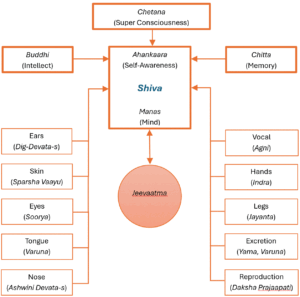
Overall, as has been mentioned many times already, the Shareera (body) is an external attachment wrapped around the Jeevatma. Manas (mind), Buddhi (intellect), Ahankaara (Awareness of the self) are all part of this external attachment called Shareera. And the Abhimaani Devata for both Manas and Ahankaara is Shiva. As depicted in the diagram below, everything connects to the “Manas” (Mind). This also means that all the Devata-s who are Abhimaani-s for various Indriya-s shown in the picture below, which are outside of us, are all connected with Manas and its Abhimaani i.e., Shiva. And, all the internal mental faculties too are connected with Manas & Shiva.
About the “Mind”
It seems as though Western psychologists do not seem to consider Manas, Buddhi, Ahankaara, and Chitta as separate mental faculties. They seem to usually refer to all of them as one integrated entity and refer to it as “Mind”. But Bhaarateeya Manas Shaastra refers to them as separate internal mental faculties called Anta:karana-s. The term “Karana” refers to “Indriya” and thus “Anta:karana” refers to internal “Indriya-s”. Bharateeya Shaastra-s also use very specific terms that pertain to the “Anta:karana-s” such as Manana, Aalochana, Smarana, Nidhi Dhyaasana, Dhyaana, Chintana, Dhaarana and so on. While I don’t claim expertise, I might use the following English terms as equivalents for the above Sanskrit terms, hoping that it may help the reader.
Manana = From what I’ve been taught, the equivalent English word is contemplation. What a Guru has taught his Shishya has to become like a “template” or like a “Spiritual Lens” for the Shishya. He/she has to view all that he/she learns through the Indriya-s using the “Spiritual Lens” and evaluate all incidents that happen around him/her using the “template” given by the Guru.
Aalochana = In my opinion, this involves Buddhi and therefore, the English equivalent term may be “Rationalizing” or simply “thinking”.
Chintana = This may be equivalent to Smarana, but the hint I got through the wise ones is that Chintana involves Chitta. Chitta is the memory shell and I’m told that it also stores all conclusions drawn from experiences in our past Janma-s. Therefore, the English equivalent word may be recalling
Dhyaana = Popularly, people use the term “Meditation” as the English equivalent of this Sanskrit term. But I am not sure if that’s appropriate. The ones I learnt from didn’t seem to prefer to use this term. Especially taking a hint from the presence of the syllable “Dhee” in the term “Dhyaana”, my take is that this too involves Buddhi. Dhyaana refers to intensely focusing the mind on one specific thing. Buddhi has to command the Manas to stay focused and not get swayed.
Nidhi Dhyaasana = My take on this term is… through the process of Manana, Aalochana, and Chintana, when the mind arrives at a conclusion that a certain good trait as an asset (Nidhi) and would be resourceful in the future, that good trait needs to be instilled in the mind. This is Nidhi Dhyaasana.
Dhaarana = This is the next step of Nidhi Dhyaasana. It refers to wearing good quality and becoming the person referred to by that good trait. Again, my take is that Buddhi has to guide Manas in this process.
Smarana = English equivalent word is perhaps “Remembering” with compassion, i.e., Bhaavanaa, which, in my opinion, is THE MOST important aspect of Manas. This has been elaborated on previously while explaining about Jaambavati.
There is plenty more information to share about Shiva who is popularly referred to by the names Gangaa Dhara, Chandra Shekhara, Trinetra, Paarvati Pati, Mruga Dhara, Nandi Vaahana, Naaga Bhooshana, Gaja Charmaambara, and so on. And there is a whole lot to learn about the topic of gender through the term Ardha Naareeshvara. We’ll learn more about Shiva next week.


very interesting