



The decision to refer the Foreign Contribution (Regulation) Amendment Bill, 2026, to a 31-member Joint Parliamentary Committee is being projected by sections of the Opposition as a retreat by the Narendra Modi government. That interpretation is politically convenient—but factually hollow.
It is not a defeat for the government. It is a demonstration of how a confident government can accommodate concerns without surrendering its legislative objective.
The Lok Sabha on Wednesday formally referred the FCRA Amendment Bill to a JPC comprising 21 members from the Lok Sabha and 10 from the Rajya Sabha. The committee has been mandated to examine the provisions in detail and submit its report by the last day of the first week of the Winter Session.
That is parliamentary democracy at work—not governmental weakness.
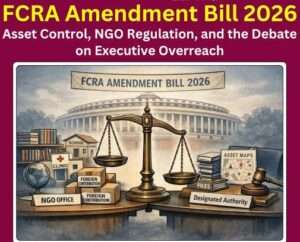
The FCRA is not an ordinary regulatory law. It governs the acceptance and utilisation of foreign contributions by individuals, associations and organisations in India. At its core is a legitimate national-security question: foreign money cannot be allowed to enter India without accountability over where it comes from, where it goes and how it is used. The government argues that the proposed amendments are intended to strengthen transparency and regulatory oversight.
At the same time, concerns have been raised about provisions dealing with the assets of organisations whose FCRA registration expires or is cancelled. Opposition parties and several Christian and minority representatives have apprehended that legitimate charitable, educational and welfare organisations could be adversely affected. The governments of Nagaland, Mizoram and Meghalaya have also raised concerns and sought closer examination of the legislation.
Those concerns deserved to be heard. And they have been heard.
That is precisely why the JPC matters.
Instead of treating every objection as anti-national or simply forcing the legislation through, the government has chosen the parliamentary route of scrutiny. The JPC allows every political party to examine the clauses, place its objections on record and suggest corrections wherever warranted.
If the government were genuinely afraid of scrutiny, it would not have sent the Bill to a committee.
The Opposition, therefore, should be careful about declaring victory. Congress MP K.C. Venugopal and Samajwadi Party leader Akhilesh Yadav have demanded withdrawal of the Bill, while other Opposition parties have also voiced objections. But demanding withdrawal is fundamentally different from demanding scrutiny. The government has provided the latter through the JPC.
The real test now is whether the Opposition will use the committee as a forum for serious legislative examination—or merely another political theatre.
Unfortunately, the broader conduct of the Opposition during the Monsoon Session has not inspired much confidence. Parliament is not a street-corner protest venue. MPs are elected to debate legislation, question ministers, raise constituency issues and hold the government accountable. Disrupting proceedings, preventing Question Hour and repeatedly forcing adjournments does not strengthen democracy; it diminishes Parliament itself.
The irony is impossible to miss. The same Opposition that accuses the government of bypassing parliamentary scrutiny has been repeatedly accused of preventing Parliament from functioning. If there are provisions in the FCRA Bill that are allegedly discriminatory, arbitrary or unconstitutional, the proper place to demonstrate that is the parliamentary record—not through slogans and disruptions.
The government has now opened that door.
The JPC must therefore be allowed to do its job without political intimidation. It should examine every contentious provision objectively, hear stakeholders—including minority and Christian organisations where relevant—and recommend changes wherever genuine safeguards are necessary. Equally, it must ensure that legitimate concerns about foreign funding, transparency, national security and misuse of charitable structures are not diluted merely because they are politically inconvenient.
That is the balance a mature democracy demands.
The Modi government should neither be embarrassed by the JPC nor apologise for it. Sending a contentious Bill to a parliamentary committee is not surrender; it is institutional confidence.
And Rahul Gandhi and the Opposition have once again been presented with an opportunity: prove that they want Parliament to function, not merely to protest.
The people are watching. The cameras are rolling. Parliament’s proceedings are increasingly visible to the public.
Ultimately, voters—not political spin—will decide who used Parliament responsibly and who merely used Parliament as a stage for disruption.
The FCRA Bill has not been defeated. It has been given a deeper parliamentary examination. If anything, that is democracy winning.


