



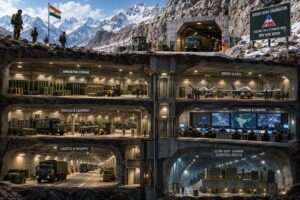
Bharat must prepare today to protect tomorrow. The true measure of national leadership is not merely how a country responds to a crisis, but how intelligently it prepares for dangers that future generations may face. Wars are no longer fought only on battlefields. Missiles can strike deep inside enemy territory, drones can penetrate defences, satellites can expose military positions, and attacks on energy infrastructure can cripple economies without occupying an inch of territory. The ongoing US-Iran war offers Bharat a compelling lesson: national security demands anticipation, technological superiority, and the ability to withstand prolonged conflict. For a rising power aspiring to become a Viksit Bharat, preparedness cannot be an afterthought. It must be an investment in the nation’s future. This is where the Narendra Modi government’s emphasis on strategic autonomy, indigenous defence manufacturing, infrastructure development and energy security assumes particular significance. Bharat is not attempting to build underground cities for its entire population, as some countries have developed extensive civil-defence shelter systems. Nor is that necessarily the immediate priority for a country of our size. What matters is developing a layered security architecture that protects our armed forces, critical installations, essential supplies and vulnerable civilian populations when danger strikes. Reports of underground and hardened military facilities along sensitive borders with China and Pakistan point towards this evolving requirement. Such infrastructure, wherever undertaken, can help protect ammunition, equipment, logistics and command facilities against missile attacks, artillery fire and drone strikes. The Border Roads Organisation, meanwhile, has played a crucial role in strengthening connectivity across difficult Himalayan terrain, helping ensure that troops, equipment and essential supplies can reach forward areas more efficiently. The strategic lesson is unmistakable. Roads must lead to the frontiers, but preparedness must extend beyond roads. Military assets need protection, communications must remain functional under attack, and supply chains must withstand disruption. A modern military cannot afford to have its operational capabilities paralysed by a single successful strike. Equally important is the protection of civilians. Community bunkers constructed in vulnerable border areas, particularly along the Pakistan frontier in Jammu and Kashmir, demonstrate the practical value of protective infrastructure for ordinary families living under the threat of cross-border shelling.
National security is not measured exclusively by the strength of our weapons; it is also measured by how effectively we safeguard the lives of citizens who live closest to danger. Energy security provides another powerful example of forward planning. Bharat’s underground strategic petroleum reserves at Visakhapatnam, Mangaluru and Padur have a combined capacity of 5.33 million metric tonnes. These reserves are designed to cushion the country against supply disruptions and international oil-market shocks. The government’s approval of an additional 6.5 million metric tonnes of storage capacity at Chandikhol and Padur represents a further step towards strengthening this vital buffer. Such investments matter enormously when conflicts threaten shipping routes, oil supplies and prices. Strategic infrastructure also extends beneath the seas. The INS Varsha project near Visakhapatnam, designed to support the Indian Navy’s nuclear-powered submarine fleet, reflects the importance of protecting critical maritime capabilities in an increasingly contested Indo-Pacific. Such projects reinforce the principle that deterrence depends not only on possessing advanced platforms, but also on sustaining and protecting them. The Modi government’s larger responsibility, therefore, is to think beyond the next election cycle. Defence modernisation, indigenous production, resilient communications, cyber security, disaster preparedness and reliable energy supplies must reinforce one another. Bharat must also invest in early-warning systems, counter-drone technology, missile defence, secure data networks and, where justified by risk assessments, additional civil shelters. None of this means that war is inevitable or that every rupee must be diverted towards military construction. Development and security are complementary, not competing, priorities. A confident Bharat must educate its children, create employment, expand healthcare and build prosperity while ensuring that hostile powers cannot easily threaten its sovereignty or hold its economy hostage. That is the larger lesson of the Iran conflict. Peace is best protected when a nation is sufficiently prepared to deter aggression, absorb a shock and recover quickly. Strategic foresight may not always produce spectacular headlines, but it can prevent catastrophic losses when circumstances turn hostile. Bharat must never wait for a crisis to discover its vulnerabilities. The responsibility of today’s leadership is to anticipate tomorrow’s threats, strengthen the nation’s defences and leave future generations a country that is not merely prosperous, but secure, resilient and sovereign. A Viksit Bharat must be built above ground through development, innovation and opportunity—and protected by the foresight, preparedness and determination that may sometimes require us to build beneath it.

