



The future of a country is determined by its youth, and the greatest centers of youth power are our schools, colleges, and universities. Therefore, if news emerges from a state that a large number of students have tested positive for HIV, forcing the government to launch a comprehensive testing campaign in higher education institutions, this is no longer a matter solely for the health department. It is a serious warning for education, society, families, policymakers, and the entire nation. This is not the time to spread fear, but to confront this challenge with a scientific approach, sensitivity, and widespread awareness.
HIV, or Human Immunodeficiency Virus, attacks the body’s immune system. If not diagnosed and treated promptly, it can lead to a serious condition called AIDS. However, advances in medical science have made it a manageable disease. With the help of antiretroviral therapy (ART), infected individuals can live long, normal lives. Therefore, early detection, regular treatment, and infection prevention are crucial.
The news of HIV infection among young people raises several serious questions. Is health and sex education adequate in our educational institutions? Are young people receiving scientific information about safe behavior, the causes of infection, and preventive measures? Are families and society willing to openly communicate on this topic? If the answer to these questions is ‘no,’ then we must acknowledge that the problem is not just about health, but also about our social mindset and education system.
Even today, Indian society doesn’t consider it comfortable to discuss sexual health openly. Parents are hesitant, teachers often avoid the topic, and students often receive incomplete or misleading information from the internet or friends. This results in myths, misconceptions, and misconceptions. Scientific information, however, is the most effective means of preventing this disease.
It’s also important to understand that HIV infection can spread not only through unprotected sex, but also through transfusions of infected blood, the use of contaminated needles, and from an infected mother to her child. However, HIV is not spread through shaking hands, sitting together, sharing food, hugging, sneezing, or mosquito bites. Unfortunately, even today, a large segment of society remains unaware of these facts. This ignorance leads to discrimination and social exclusion against infected individuals.
Young people attending higher education institutions are at a time of their lives marked by independence, curiosity, and a desire for new experiences. Guiding them in the right direction is the responsibility not only of families but also of universities and the government. Every college and university should have a health counseling center, trained counselors, confidential testing facilities, and regular awareness programs. Students should be assured that their privacy and dignity will be fully protected if they come forward with a health concern.
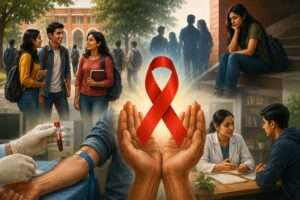
If a state decides to launch an HIV testing campaign in higher education institutions, its objective should not be solely to identify infected individuals. Counseling, mental health support, treatment, and awareness must be given equal importance. Testing will be successful only if students perceive it as a normal health safety measure rather than a source of fear or shame.
The role of the media also becomes crucial here. Sensationalizing any data or event creates fear and confusion in society. Conversely, if the media promotes dialogue based on scientific facts, expert opinion, and awareness, society can become more responsible and sensitive. It is also essential to end the tendency to associate illness with crime or character.
The growing trend of drug addiction is also a matter of concern. Drug abuse, especially the sharing of infected needles, also increases the risk of HIV infection. Therefore, de-addiction campaigns and HIV awareness programs need to be integrated. Effective infection control is achieved not only through treatment but also by reducing risky behaviors.
India has achieved remarkable success over the years through its National AIDS Control Program. New infections have declined, and millions of infected individuals have been provided treatment. However, if the number of infections among young people is a cause for concern, it signals the need to review old awareness methods and make them more effective, modern, and youth-friendly.
The role of the family is crucial in this entire matter. Confident communication, accurate information, and emotional support with children and adolescents can protect them from risky situations. If families themselves make this topic taboo, young people will be forced to seek information from inappropriate sources. Silence is never the answer; appropriate communication at the right time is the foundation of safety.
We must also remember that a person living with HIV is a normal citizen just like us. They need treatment, respect, and support, not scorn. The more sensitive society becomes, the more people will come forward without fear for testing and treatment. This is also the most effective way to prevent infection.
The need today is to transform higher education campuses not only into centers of knowledge, but also centers of health, awareness, and life skills. Scientific thinking, responsible behavior, regular health checkups, and a sensitive social environment can only address this challenge.
Ultimately, the challenge of HIV teaches us that modern education cannot be limited to degrees. Life-saving knowledge is equally essential. If we break the silence today and embrace awareness, dialogue, and a scientific approach, not only will infection prevention be possible, but we will also build a society that sees people as human beings, not diseases. This is the need of the hour and the most important step towards a healthy, safe, and compassionate India.


