Lakshmanrao Upadhyayula
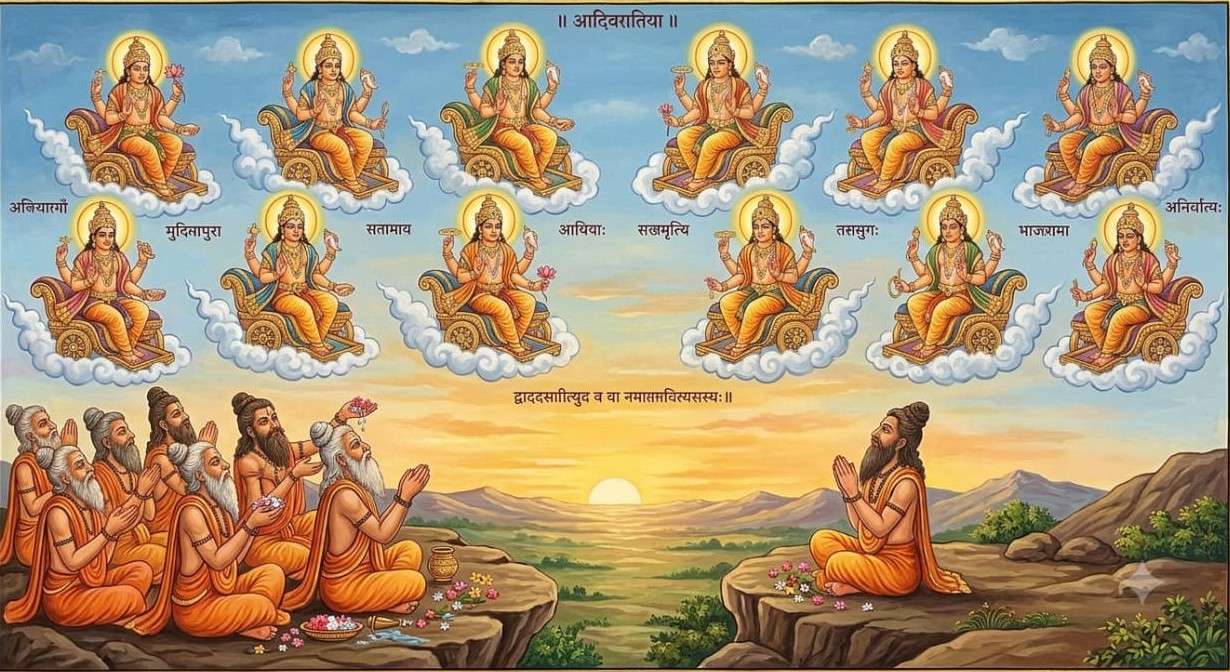
In the ancient tradition of the Rigveda, the venerable sage Śaunaka Gṛtsamada and his son Kurma raised their voices in profound devotion to the radiant Ādityas, chanting in the majestic cadence of the Triṣṭubh metre. Their hymn arose like a sacred stream of clarified butter poured into the fire of sacrifice—pure, luminous, and nourishing. With reverence they invoked Mitra, Aryaman, Bhaga, the all-encompassing Varuṇa, and Dakṣa, imploring these guardians of cosmic harmony to hear their sacred praise.
The Ādityas are celebrated in the Vedas as the eternal upholders of Ṛta, the universal order that sustains the stars in their courses, the rivers in their flow, and the moral law within the human heart. They are resplendent with light, rich in rain-bearing power, gentle yet irresistible, and unwavering in their truth. Their workings are non-violent, balanced, and precise, reflecting a cosmic intelligence that modern scientific thought may liken to the immutable laws governing nature. As gravity binds the planets and electromagnetism organizes matter, so the Ādityas govern existence through principles of order, justice, and equilibrium.
These deities are described as vast, majestic, and impossible to deceive. Swift as thought and subtle as conscience, they penetrate the hidden motives of all beings. Nothing is distant to them; what appears remote to human perception lies immediately within their awareness. In Vedic symbolism, this signifies the omnipresent intelligence that pervades the cosmos. In scientific terms, one may compare this to the interconnectedness of all systems, where every action leaves an imprint and every disturbance reverberates throughout the whole.
The Ādityas established the dwelling places of both the animate and the inanimate. They sustain the earth, the heavens, and the atmosphere, preserving every level of creation. Water, the source of life, moves under their guardianship, and through its circulation they nourish all forms of existence. Their protection extends to those who perform righteous action and live in harmony with truth. The hymn declares that they “elect debt,” meaning that they uphold moral accountability, ensuring that every deed bears its appropriate consequence.
Recognizing their dependence upon these divine powers, the sages seek refuge in the Ādityas. When fear, uncertainty, or moral confusion arise, the shelter of the gods is described as safe, spacious, and serene. The path of Mitra, Aryaman, and Varuṇa is straight, beautiful, and free from obstacles. To walk in their way is to be released from the burden of accumulated wrongdoing. It is a path of inner clarity, noble conduct, and speech that is truthful and sweet.
The hymn invokes Aditi, the infinite Mother and source of all the gods. Her name means “the Unbounded,” signifying the limitless matrix from which all existence arises. As a mother guides her children across danger, Aditi carries her devotees beyond hostility and fear to a realm of security and freedom. Under her care, humanity is called to become courageous yet gentle, strong yet non-violent, rooted in truth and compassion.
Mitra and Varuṇa bestow harmony upon the earth, heaven, and the atmospheric realm. They clothe the worlds in truth, just as the laws of nature provide consistency and reliability to the universe. The Vedic sages perceived sacrifice (yajña) not merely as ritual, but as the reciprocal exchange that sustains life. The threefold yajña—of thought, word, and action—mirrors the threefold cosmos and reminds us that every conscious offering contributes to universal balance.
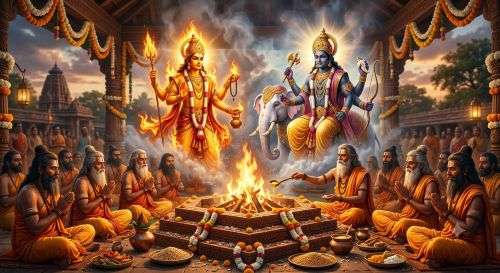
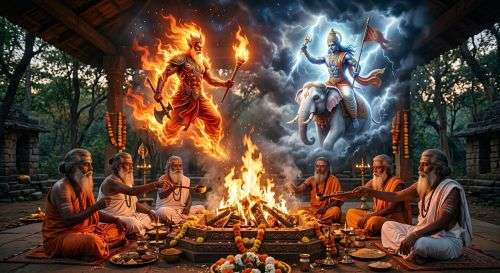
The glory of the Ādityas is revealed through yajña. Adorned with brilliance, sleepless in vigilance, and unblinking in perception, they watch over all beings. Their eyes never close because truth is eternally aware. They are free from violence and worthy of universal worship. Their presence is reflected in the luminosity of Agni, the movement of Vāyu, and the radiance of Sūrya, demonstrating the Vedic insight that all natural forces are expressions of one divine intelligence.
The seer addresses Varuṇa with humility, confessing the limits of human understanding. Whether perceived as god or as a formidable cosmic power, Varuṇa remains the sovereign of all. The prayer seeks the same blessing granted to the ancestors: a full lifespan, long enough to experience life in its completeness and to realize the truth hidden within it. In this aspiration, spiritual longing and biological vitality are united.
The sages admit their confusion: they do not know left from right, front from back. Their thoughts are immature, and courage often fails them. Yet this honest acknowledgment becomes the foundation of wisdom. They implore the Ādityas to lead them into light, the timeless symbol of knowledge and fearlessness. In both spiritual and scientific language, light dispels darkness, reveals structure, and makes understanding possible.
Those who worship the Ādityas are blessed with prosperity, good children, nourishing food, and secure dwellings near life-giving waters. They become difficult to overcome, whether by enemies near or far. Such blessings reflect not only divine favor but the practical outcomes of disciplined living, ethical conduct, and harmonious participation in the rhythms of nature.
The devotees pray that any errors committed knowingly or unknowingly toward Aditi, Mitra, and Varuṇa may be erased from memory. This is a profound request for moral renewal and psychological purification. They invoke Indra for vigor and fearlessness, asking that the darkness of ignorance never overtake them. One established in truth becomes strengthened by both earth and heaven, flourishing with abundance and conquering adversity.
The hymn further proclaims that the Ādityas set snares for traitors and those who violate cosmic law. Their justice is not arbitrary but inevitable, like a natural consequence embedded within the structure of reality. Therefore, the righteous move against obstacles with the confidence of a skilled horseman. Protected by truth, they act without hatred and dwell in the comfort of divine protection.
In its concluding prayer, the seer turns to Varuṇa, the generous king whose riches are inexhaustible. He asks never to know poverty, either material or spiritual. May he live in abundance, surrounded by children and grandchildren, and continue chanting the sacred hymns at the holy yajña. This closing vision embodies the Vedic ideal: a life of prosperity, integrity, family continuity, and ceaseless praise of the divine order.
This magnificent hymn reveals the Vedic worldview in its full grandeur. The universe is not a random assemblage of matter but a living, intelligent order governed by truth. The Ādityas are the luminous principles of moral law, ecological balance, and spiritual awakening. Their worship teaches humanity to align with cosmic harmony, to transform fear into wisdom, and to discover that the same light shining in the heavens also dwells within the human soul.