



Duryodhana cast a sharp and searching glance upon Bheeshmacharya, watching every movement of the grandsire with a calculating mind. Calmly yet with concealed anxiety, he reminded him that the vow of slaying ten thousand warriors each day had already been fulfilled. Within the restless mind of the Kuru prince, cunning thoughts moved like hidden serpents, seeking loose threads that might yet be woven into a favourable destiny. Before he could speak further, Bhishma himself addressed him with majestic composure, declaring that past deeds needed no defence, and that the world would now behold power still dwelling within aged arms and iron sinews.
Like a blazing pillar of fire rising in the midst of a tempest, Bhishma rushed upon opposing hosts. His chariot advanced with dreadful fury, scattering enemies and tormenting them with ruthless skill born of countless battles. Sanjaya then spoke to King Dhritarashtra in a grave voice, saying that the armies of the Pandavas, together with warriors of Matsya, Panchala, Yadava, Pandya, and Kekaya, surrounded Bhishma from every direction, pressing fiercely upon him. Seeing grandsire thus assailed, Duryodhana hurried forward with his divisions to defend the ancient hero. Combat grew terrible beyond measure, for warriors on both sides seemed driven by a mysterious thirst for the blood and flesh of enemies, and violence of battle rose like a storm fed by unseen winds.
At that moment, Arjuna spoke firmly to Sikhandi, who stood troubled by the terrible wrath of Bhishma. With voice steady and resolute, he said that fear had no place upon such a field, for Bhishma could not escape the ordained end. Arjuna assured him that he himself would guard him and unleash torrents of arrows, and that day would witness the closing curtain of Bhishma’s life. Words of such unwavering assurance were heard by Drishtadyumna, commander of the Pandava armies, who immediately raised a loud command that warriors should encircle Bhishma without hesitation, since Arjuna himself stood as a shield before them.
Drishtadyumna sprang forward like a wave of living fire and struck fiercely at the supporting divisions around Bhishma. Hearing the call of battle, Dharmaraja Yudhishthira, mighty Bheemasena, Nakula, and Sahadeva advanced like erupting volcanoes and poured showers of blazing shafts upon the Kaurava ranks. Abhimanyu, the sons of Draupadi, together with the kings of Kekaya and Magadha, swept into a struggle like a violent wind, strengthening the storm of the Pandava forces. On the opposing side, Krithavarma, Aswatthama, Bhurisrava, Kripacharya, Vikarna, Durmukha, Vivimsati, and Chitrasena assembled around Bhishma, forming a protective circle like a disc of warriors skilled in many arts of war.
While dreadful battle raged, even the gods watched unblinking from the heavens, unwilling to miss a single moment of such fierce encounter. Arjuna then drove his chariot swiftly toward Bhishma, placing Sikhandi before him as a shield. Yet the path was suddenly barred by Dussasana, who stood like a rocky bank resisting the furious waves of the ocean. With swift motion, he discharged a hundred arrows, wounding both Arjuna and Krishna. Arjuna responded with equal skill and calm fury, breaking the storm of shafts with a countervolley.
Though already wounded, Dussasana shot five arrows that struck Arjuna on the forehead. Arjuna instantly shattered those arrows and cut down his bow. Without delay, Dussasana seized another weapon and continued sending countless shafts in stubborn defiance. Arjuna, maintaining unbroken concentration, released a deadly arrow that pierced the chest of Dhritarashtra’s son. Dussasana collapsed senseless upon the chariot, and the charioteer swiftly carried him away to safer ground. Yet after a short recovery, he returned to the field, displaying boldness though fate itself seemed to oppose him.
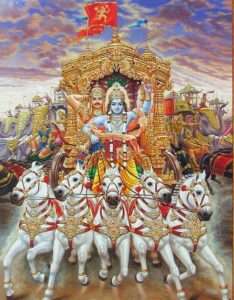
Across a vast field, many warriors met worthy rivals. Satyaki confronted Alambusha and Bhagadatta; Abhimanyu engaged Sudakshina; Virata and Drupada battled Aswatthama; Kripa clashed with Sahadeva; Nakula fought Vikarna; Ghatotkacha struggled against Durmukha; Bhima stood opposed to Bhurisrava; Chekitana encountered Chitrasena; and Dharmaraja himself faced Dronacharya. Each pair fought with admirable skill, striving with utmost mastery of weapons and discipline of warriors.
In every quarter of the battlefield, standards were shattered, banners torn away, horses slain, charioteers struck down, bows broken, arrows whistling in deadly flight. Terrifying twang of bowstrings echoed through the air while swords clashed like thunder without rain. Blood flowed in streams and fell like crimson drizzle, driven by violent winds raised by the movement of countless warriors. Limbs were severed, heads rolled upon the ground, blood flooded the earth, and confusion grew so great that no man could tell whose arrows struck whom. Such was a dreadful scene unfolding at Kurukshetra as Sanjaya narrated with sorrowful gravity to the blind king.
Battlefield soon appeared drenched in blood and flesh, as though clouds of war had poured ghastly rain upon earth. Even the sun seemed ashamed to witness such a spectacle. Its fierce rays glared upon the plain of carnage, forcing weary soldiers to narrow their eyes while mud of bones and shattered limbs lay exposed beneath blazing light.
Meanwhile, Arjuna again shattered the bow of Dussasana and filled his body with deep wounds until the prince appeared like a crimson pillar. Horses of his chariot, terrified by relentless assault, turned away and carried him from the place of danger. Dussasana offered little resistance, for a hidden wish to preserve life overcame the courage of the moment. Arjuna then advanced through hostile ranks like lord of death himself, striking down warriors who guarded Bhishma.
Seeing such development, Dronacharya raised his bow and drew the string with mighty force. The sound of its vibration thundered across the earth and trembled in the vault of the sky. Yet Dharmaraja placed himself before Drona and restrained both him and the surrounding troops, thereby clearing the path for Arjuna to advance toward Bhishma. At that moment, Drona felt a strange heaviness within his heart. Tears like sparks of fire filled his eyes as he spoke to his son, Aswatthama, in a troubled voice.
He confessed that his hands trembled, his mind faltered in recalling the sacred science of celestial weapons, and the bow itself seemed ready to fall from his grasp. Thoughts wandered without direction, and the strength of the body weakened. He declared that the events of that day clearly pointed toward the fulfilment of Arjuna’s oath. Horses stumbled and fell, elephants slipped and crashed upon the ground, chariots shattered into fragments, and countless strange occurrences appeared as heralds of approaching catastrophe.
Drona further observed many dreadful omens. Eagles circled above the Kaurava ranks as if awaiting a feast of death. A rain of burning coal seemed to descend, though no fire was visible. Wild foxes howled loudly across the field. All these portents, he said, proclaimed the inevitable fall of Bhishma and ruin that could no longer be averted. Thus, the distress of the great preceptor and the shadow of impending grief were conveyed by Sanjaya to King Dhritarashtra, while terrible destiny moved steadily across the blood-soaked plains of Kurukshetra.

