



Sanjaya said: “O King, with incomparable courage and unconquerable strength, the mighty Satyaki assailed Karna upon the battlefield. His arrows burst forth like torrents of flame and caused streams of blood to flow from Karna’s body, till the son of Radha appeared like a flowering tree reddened by crimson blossoms. Satyaki shattered his standard, tore down his banner, slew his steeds and charioteer, and before the eyes of Duryodhana and his brothers smashed the royal umbrella that crowned his splendour. At the command of Duryodhana, the princes of the Kuru race, filled anew with zeal, surrounded Satyaki from every side. Yet that illustrious warrior, endowed with astonishing skill and irresistible vigour, moved with wondrous mastery amidst the circling chariots and coursing steeds, scattering showers of arrows in every direction. The gathered princes, unable to withstand his assault, were broken and driven away like clouds dispersed by a tempest.”
Dhritarashtra said: “Indeed, the horses of Krishna, the excellence of his chariot, and the skill of its divine guide transformed Satyaki into a warrior beyond compare. The swift movements of Daruka, while bringing forth that celestial chariot, though unknown to him, fulfilled the secret design of Krishna himself. Mounted upon that splendid car, furnished with every weapon and ornament of war, Satyaki displayed immeasurable prowess and faultless precision in action. Meanwhile your sons provided Karna with another chariot, upon which he mounted once more. Tell me then, O Sanjaya, what did Bhima do after he had reached Arjuna?”
Sanjaya replied: “Bhimasena, though scorched inwardly by humiliation and burning with wrath after the insults hurled by Karna, restrained his fury in silence. Yet soon, unable to bear the arrogance and boastful pride of the suta’s son, he spoke before Arjuna with blazing indignation: ‘Karna proclaims again and again that he shall confront and destroy us by many means in this war. Whenever I hear his haughty words, I regard them as arrows aimed directly at my heart. But let him not delight in empty speech. I shall answer him not with words, but with deeds upon the field of battle.’”
Then Arjuna, advancing in his resplendent chariot, addressed Karna in stern reproach: “O Karna, why do you delight in vain arrogance? Why do you mock Bhimasena, before whom you fled in shame when he drove against you in battle? Is defeat unknown among warriors? Victory and loss alike attend all who enter the field of war. Yet, blinded by conceit, you revile those who are your equals in strength and valour. Even common men now know the measure of your conduct and the stain upon your lineage. Hear then my solemn vow. In my absence, by unrighteous means, you shattered the bow of Abhimanyu and took part in his cruel slaughter. Therefore, before your very eyes, and by lawful combat, I shall sever the head of Vrishasena. Thus shall I repay the injustice committed by you and your companions.”
Having spoken thus, Arjuna launched a terrible assault, driving the Kaurava army before him like frightened cattle. Princes and mighty warriors assembled together and encircled him, and there arose a dreadful battle filled with tumult and carnage. The sun meanwhile descended slowly toward the western horizon, and seeing the danger, Duryodhana spoke anxiously to Karna: “Arjuna, aided by Bhima and Satyaki, presses swiftly toward Jayadratha. If only we can restrain him for a short while longer, the sun shall set and his vow will fail. You, supported by Shalya, Ashwatthama, Kripacharya, Dushasana, and myself, can surely halt his advance. His reckless vow has arisen because the hour of his destruction draws near. When he and his brothers perish, we shall rule the kingdom free from resistance.”
Karna replied: “Bhima’s arrows have deeply pierced my body, yet even so Arjuna shall not surpass me in battle. I remain ever the most loyal servant of the king, and it is righteous that I strive with all my might to fulfil your desire. I shall blaze forth like a raging wildfire amidst the Pandava host. Beyond all effort, however, stands the will of destiny and the ordinance of God.” Hearing these resolute words, Duryodhana rejoiced greatly.
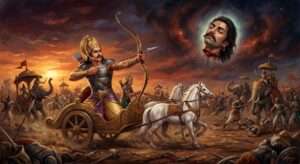
Then Arjuna, accompanied by Bhima and Satyaki, advanced like blazing fire fanned by mighty winds. He loosed relentless showers of arrows that shattered royal umbrellas, broke standards, tore banners into fragments, and splintered weapons into dust. Amid streams of blood mingled with flesh and mud, Duryodhana, Karna, Vrishasena, Shalya, Kripa, and Ashwatthama formed a mighty circle around Saindhava for his protection. United together, they discharged fierce volleys of arrows against Arjuna. Yet the son of Pandu reduced their shafts into fragments of wood and iron before they could reach him. Though all of them pierced Krishna and Arjuna repeatedly with keen arrows, Dhananjaya, undisturbed and immovable in resolve, struck them down with irresistible force, causing many warriors to faint beneath the fury of Arjuna, Bhima, and Satyaki.
Sanjaya continued: “Like a maddened elephant rushing through the forest, Arjuna surged toward Saindhava. Karna, swelling with pride and fierce determination, leapt forth to obstruct him, shaking the earth beneath his wheels. For a brief moment he succeeded in halting Arjuna’s advance. Arjuna struck Karna with seventeen arrows, while Bhima and Satyaki pierced him with three each. In return Karna discharged sixty arrows against those heroes. The astonishing swiftness with which he released his shafts filled all warriors with wonder. Torn between the desperate need to restrain Arjuna and the near impossibility of that task before sunset, Karna fought with unyielding resolve. Arjuna then drenched him with a hundred arrows, staining him with blood, but Karna answered with a storm of five hundred shafts. Dhananjaya shattered Karna’s bow and pierced his broad chest with nine deadly arrows speeding like messengers of death. Ashwatthama, however, cut down those arrows in flight. Karna seized another golden bow and again assailed Arjuna. Then Arjuna cried aloud, ‘Karna, stand and behold the power of Partha!’ and covered him with countless shafts. Karna too answered proudly, ‘Arjuna, wait and witness the might of Karna!’”
Their conflict then rose to fearful intensity, as though two gods disguised in mortal form contended for mastery of the worlds. Duryodhana shouted aloud, commanding his warriors to support Karna. Arjuna slew Karna’s steeds and charioteer and struck the son of Radha with such force that he stood paralysed for a moment. Thereupon Ashwatthama, aided by Shalya, advanced fiercely against Arjuna, while Kripacharya and Vrishasena joined them in surrounding him with deadly arrows. Hidden behind those mighty protectors, Saindhava too discharged shafts against Arjuna. Yet the son of Kunti restrained them all with swift and terrible arrows. Whenever he directed his attack against Saindhava, Duryodhana signalled his vast army to fall upon Arjuna. Armed with swords, spears, maces, and many dreadful weapons, they sought to overwhelm him from every side.
Undisturbed amid that uproar, Arjuna drew the string of the Gandiva with tremendous force, and its thunderous twang reverberated across the heavens. His arrows swept through elephants and horses like a devastating tempest, and the entire army was shaken and scattered in confusion. Then Arjuna shone like the blazing midday sun itself, terrible as the Lord of Death striding amidst destruction, filling both men and celestial beings with awe and terror. The warriors who pursued him were driven back by his fierce shafts, while blazing arrows sped unceasingly toward Saindhava.
Yet Saindhava, though confronted by impending doom, did not flee. With remarkable courage he wounded Arjuna, struck his steeds, tore down his banner, and pierced even the Gandiva itself with sharp arrows. The celestials, beholding such fearless valour, praised Saindhava’s heroism and steadfastness. But suddenly, in a dazzling stroke beyond mortal comprehension, Arjuna severed Saindhava’s head together with the banner bearing its divine boar-emblem in one simultaneous act. At that sight the Kaurava army trembled violently, like lotus leaves shaken beneath a storm of wind and torrential rain.
Thus did Sanjaya continue to narrate to Dhritarashtra the dreadful and wondrous events of the great war at Kurukshetra.

