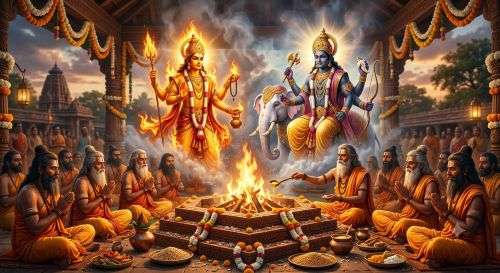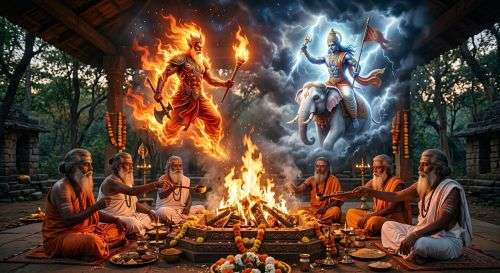
The sage Deerghatama, endowed with luminous insight, stands immersed in the rhythmic cadence of Jagathi chandas, invoking Agni with profound reverence. The Rugvedic priest, disciplined in knowledge and unwavering in his sacred vow, moves in circumambulation with folded hands, his voice resonating with the eternal hymns of the Veda. In his grasp rests the wooden ladle, the humble yet powerful instrument through which offerings are conveyed to the divine fire. This act is not merely ritualistic; it is a conscious alignment of human intention with cosmic order, where sound, gesture, and substance converge into a unified act of devotion.
In the vast vision of Vedic thought, the Sun is perceived as the primal स्रोत, the origin of waters, from which all streams emerge and circulate through the cosmos. These waters, encircling the solar radiance, are themselves participants in the sacred act, as though they too bow in silent adoration to Agni. The fire, paradoxically residing in the depths of the waters, reveals a subtle scientific intuition—the coexistence of opposing elements and the transformative energy latent in matter. As these waters descend to the earth infused with the presence of Agni, they become a life-giving elixir, symbolizing the conversion of cosmic energy into nourishment and vitality.
The priest of the Yajurveda stands equal in capability and devotion, complementing the Rugvedic chanter in a harmonious collaboration. Their coordinated recitations and ritual actions represent a sophisticated system where sound frequencies, precise movements, and material offerings create an energetic field. Through this cooperation, the ritual fire evolves into the Avahaneeya Agni, the inviting flame that becomes the central axis of the yajna. This fire is not merely physical; it is the binding force, the bridle that holds together the entire sacrificial process and extends its influence across the seen and unseen realms.
The Hota and the Adhvaryu, equal in merit and mastery, perform their roles like inseparable companions, akin to day and night in their continuity and balance. The yajna becomes a field of equilibrium where neither is superior, and both contribute indispensably to the unfolding of the sacred act. Agni responds dynamically to their care; when fuel is absent, the flame wanes, and when nourished with dry wood, it flourishes brilliantly. This observation reflects an early scientific awareness of cause and effect, energy input and output, demonstrating how the ancients perceived natural laws through ritual practice.
Agni consumes the oblations offered by the Adhvaryu and the Hota, yet this consumption is not destruction but transformation. The offerings are transmuted into prana, the vital life-breath that sustains existence. The generation of Agni through the friction of Aranis, requiring the coordinated effort of ten fingers, symbolizes both physical action and metaphysical awakening. When the fingers release, Agni emerges free and radiant, embodying the principle that energy is liberated through disciplined effort and harmonious release.
As mortals bound by limitations, the seekers turn to Agni as protector and guide. Just as arrows released from a bow strike their intended target, the sparks that leap from the fire travel outward with purpose and शक्ति, growing into a blazing force that strengthens the presence of Agni. These sparks mirror the spread of knowledge and energy, illustrating how small beginnings can expand into transformative power.
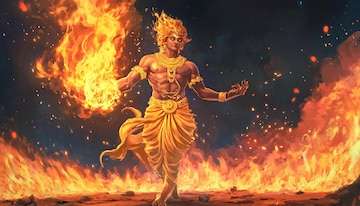
Agni is hailed as the sovereign of all that exists in the vast expanse of space, moving freely like an independent shepherd, unbound by constraints. At the same time, he is the lord of all that is born upon the earth, the custodian of wealth, the well-wisher of beings, and the radiant source of prosperity. Within him reside both the celestial and terrestrial realms, unified in a single principle of energy and consciousness.
He is the bearer of offerings, the one born for yajna, whose presence is marked by auspicious action and vibrant resonance. His sound is not mere noise but a pulsation of life itself, echoing through the fabric of existence. The people, recognizing his presence within and around them, worship him as one of their own, intimate yet transcendent. With devotion and humility, they invite him to partake in their offerings, to listen to the cherished hymns of the Rugveda, and to dwell among them as the eternal mediator between humanity and the divine.
Thus, the narrative unfolds as both a spiritual revelation and a scientific contemplation, where ritual becomes a language of energy, and devotion becomes a pathway to understanding the intricate harmony of the universe.