
Hardly anyone outside India’s deep-tech ecosystem may have heard of NoPo Nanotechnologies. Yet, in a modest facility in Bengaluru’s Electronic City, a company born from an improbable dream is attempting to solve one of the most consequential problems in advanced manufacturing — producing carbon nanotubes at industrial scale.
And it all began with Mars.
Gadhadar Reddy, a quantum physicist and the founder of NoPo, wanted to go to Mars — literally, not metaphorically. His pursuit soon led him to a fundamental problem confronting large-scale space exploration: spacecraft need materials that are extraordinarily strong but exceptionally light.
That search brought him to carbon nanotubes — microscopic cylindrical structures of carbon that are more than 100,000 times thinner than a human hair. Their remarkable properties have long made them one of the most promising materials for next-generation technologies. But there was a catch: producing high-quality nanotubes consistently and economically at scale remained an enormous scientific challenge.
When Reddy returned to India in 2011 determined to build the technology, he was repeatedly told that it was “not possible”, particularly in India.
He turned that scepticism into a company name: NoPo — short for ‘not possible’.
What followed was not a conventional startup story. Reddy and co-founder Robert Kelley Bradley spent nearly six-and-a-half years working largely as an unfunded science project, trying to solve a problem that had eluded researchers globally.
Bradley had written his PhD thesis under Nobel Laureate Dr Richard Smalley, one of the pioneers of the carbon-nanotube production process. Following Smalley’s death in 2005, scaling the process consistently remained a formidable challenge.
NoPo claims to have cracked that problem through its proprietary HiPCO process, enabling industrially consistent production of single-walled carbon nanotubes.
The potential is enormous. Carbon nanotubes can offer electrical conductivity far beyond conventional materials, exceptional thermal conductivity, high tensile strength and extremely low weight. These characteristics make them potentially valuable in EV batteries, semiconductors, advanced polymers, water filtration and a range of other emerging technologies.
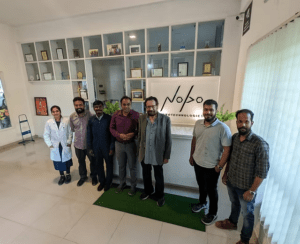
The company is now building what it describes as the world’s second-largest carbon nanotube production facility — and, significantly, one designed specifically to supply battery manufacturing lines directly. If successful, it could place an Indian company at a critical upstream point in the global battery and advanced-materials supply chain.
What makes the story even more striking is the scale of capital involved. NoPo reportedly raised only around $3 million in pre-seed funding two years ago from Mission10X, Inflexor and family offices. For a company attempting to establish one of the world’s largest production facilities for a highly sophisticated material, that is remarkably modest funding.
The company says it reinvests about 98 per cent of its income into research and development — an extraordinary commitment for a technology startup. Its nanotubes are also reportedly attracting interest from institutions including the Indian Navy and Tesla.
For Bharat, the significance goes beyond one company.
India’s ambitious EV, battery, semiconductor and advanced-manufacturing programmes will ultimately depend on sophisticated materials and components that are still heavily dependent on global supply chains. Building domestic capability in such upstream technologies is therefore just as important as assembling the finished products.
That is where NoPo’s journey could become important.
A world-scale Indian source of carbon nanotubes could potentially strengthen everything built above it — from batteries and electric vehicles to semiconductors and advanced composites — while reducing dependence on imported advanced materials.
There is no flashy consumer product here. No spectacular launch. No billion-dollar valuation story.
Just 15 years of persistence, much of it in a relatively small Bengaluru facility, pursuing a material that many believed could not be manufactured in India at scale.
Sometimes, technological revolutions do not begin with a finished product.
They begin with someone refusing to accept that something is “not possible.”