



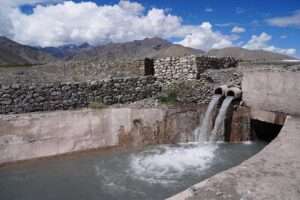
There are some development stories that do not make the headlines, yet they tell us more about a nation’s transformation than a hundred political speeches. What is happening in the cold, barren and unforgiving terrain of Ladakh is one such story. It is a reminder that under Prime Minister Narendra Modi’s leadership, the idea of development is no longer confined to Bharat’s metropolitan cities or fertile plains. It is reaching the most difficult corners of Bharat—and often producing remarkably simple miracles. Consider the latest example from Ladakh. The Irrigation and Flood Control Department has reportedly created two simple earth trenches using a JCB to divert excess glacial runoff before it disappeared unused into the Indus. Around 26 cusecs of water—roughly 90 million litres every 24 hours—is now being redirected to agricultural fields. The intervention is expected to improve irrigation for more than 1,000 acres of farmland across 12 villages. No giant dam. No expensive pumping station. No elaborate concrete infrastructure. Just an intelligent understanding of terrain, gravity and water—and the political will to put that understanding to work. This is precisely where the real significance of the Ladakh experiment lies. Ladakh is among the most challenging environments in Bharat. It receives less than four inches of rainfall annually. Agriculture survives largely on seasonal snow and glacier melt. Water that is abundant for a brief period can otherwise rush away into rivers, leaving communities to struggle through long, harsh winters and dry seasons. The answer, therefore, is not necessarily to impose an expensive engineering solution on nature. It is to understand nature and work with it. Gravity does the heavy lifting. Engineers identify the natural elevation difference between glacial streams and agricultural valleys. Earthen channels, traditionally known as guls, are created along carefully calculated gradients. Small barriers made from earth or boulders divert a portion of the flowing water, which then moves naturally towards farms.
https://x.com/lg_ladakh/status/2090375793218327020/video/1
There are no power bills, no sophisticated machinery and virtually no dependence on complex maintenance systems. In an age obsessed with mega-projects, there is something refreshingly powerful about such a solution. It is also a tribute to the indigenous wisdom of Ladakh’s communities. For generations, people living in this high-altitude desert have devised ingenious ways of conserving and storing precious water. Traditional methods of freezing and storing water during winter are another example of how local knowledge can complement modern engineering. The Modi era has repeatedly demonstrated that development need not mean blindly replacing traditional wisdom with expensive technology. The real achievement is combining technology, scientific thinking, local knowledge and administrative determination to solve problems that were once accepted as inevitable. This is the larger story of a changing Bharat. From highways and tunnels carved through mountains to railway lines reaching remote regions, from border infrastructure to digital connectivity, the country is steadily refusing to accept geography as destiny. Ladakh represents perhaps the most dramatic test of that philosophy. The message is simple: even in a cold desert at some of the highest inhabited elevations on earth, water can be brought to farms, villages can prosper and barren land can become productive. That is not merely an irrigation intervention. It is a metaphor for New Bharat. The miracle is not that Bharat has conquered nature. It is that Bharat is increasingly learning to understand nature, respect its constraints and use science and indigenous wisdom to turn those constraints into opportunities. And sometimes, the most powerful miracle does not require a spectacular inauguration. Sometimes, all it takes is a trench, gravity, a JCB—and a government determined to make every drop count.



Excellent work Modi ji & his team
Using Nature to human advantage