



Kidneys can lose 90% of their function without any warning. You can indeed lose a significant part of your kidney function and still wake up feeling completely normal the next morning. You may be eating normally. Sleeping normally. Passing urine normally. There may be no pain, no fever, and no obvious swelling.
And yet, quietly, the kidneys may be losing their ability to do one of the body’s most important jobs: filtering the blood. This is what makes chronic kidney disease so dangerous. By the time symptoms become obvious, considerable kidney damage may already have occurred. The World Health Organization (WHO) notes that kidney disease is often asymptomatic until the later stages, making early testing particularly important.
India cannot afford to ignore this
The problem is not small. A 2025 systematic review and meta-analysis of community-based studies from India, covering research conducted between 2011 and 2023, estimated the pooled prevalence of chronic kidney disease at 13.24% among the populations studied. The researchers also found substantial variation between studies and regions, highlighting the need for better population-level data. This means kidney disease is not something that concerns only dialysis centres. It is a public-health problem that begins much earlier—often in people who have no symptoms at all.
The kidneys work silently
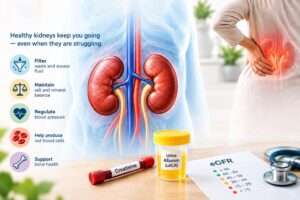
Most of us think of the kidneys simply as organs that produce urine. In reality, they are sophisticated filtration and regulation systems. They remove waste products and excess fluid from the blood, maintain the body’s salt and mineral balance, help regulate blood pressure, contribute to red blood cell production and play an important role in maintaining bone health. We have two kidneys, and the body has considerable functional reserve. This is one reason kidney disease can progress quietly. A person does not necessarily feel sick when kidney function begins to decline. That is why waiting for symptoms before checking the kidneys can be a serious mistake.
Diabetes and blood pressure: The two big culprits
Diabetes and high blood pressure are among the most important causes and risk factors for chronic kidney disease. Persistently high blood sugar can damage the tiny blood vessels and filtering units of the kidneys. Similarly, uncontrolled high blood pressure can damage the delicate blood vessels within the kidneys. And the relationship works both ways. Kidney disease can itself contribute to high blood pressure, creating a vicious cycle: Diabetes or hypertension → kidney damage → worsening kidney function → further health complications. Other causes include glomerular diseases, autoimmune and genetic conditions, infections, cardiovascular disease, kidney stones and certain medications or toxins.
Creatinine: The number everyone should know
When people receive a blood test report, they often look for the word creatinine. Creatinine is a waste product produced mainly through normal muscle metabolism. Healthy kidneys remove it from the blood and excrete it in urine. When kidney filtration declines, blood creatinine generally rises. But there is an important catch. Creatinine alone does not tell us exactly how well the kidneys are functioning. A person’s muscle mass, age, diet and several other factors can influence creatinine. This is why doctors use the creatinine result along with other information to calculate the estimated glomerular filtration rate (eGFR). The National Kidney Foundation (NKF) explains that eGFR provides an estimate of how well the kidneys are filtering waste from the blood. So instead of asking only, “What is my creatinine?” we should also ask, “What is my eGFR?”
What does eGFR actually mean?
Think of eGFR as an approximate measure of the kidney’s filtering capacity. In general:
* eGFR 90 or above: normal or high, although kidney damage may still be present
* 60–89: mildly reduced; may represent chronic kidney disease (CKD) if other evidence of kidney damage is present
* 45–59: moderate reduction
* 30–44: moderate to severe reduction
* 15–29: severe reduction
* Below 15: kidney failure range. These numbers should not be interpreted in isolation. Chronic kidney disease is defined by abnormalities that persist for at least three months, and the overall assessment also includes urine findings and the underlying cause. This is why a single abnormal creatinine or eGFR result should not automatically be labelled as chronic kidney disease. Acute kidney injury can temporarily reduce kidney function and requires a different approach.
Don’t forget the urine test
There is another simple test that is often neglected: urine albumin. Healthy kidneys generally prevent significant amounts of albumin—a protein in the blood—from leaking into the urine. When the kidney’s filtering barrier is damaged, albumin can begin appearing in the urine. The urine albumin-to-creatinine ratio (uACR) is a simple urine test used to detect and quantify this leakage.
The 2024 Kidney Disease: Improving Global Outcomes (KDIGO) guideline recommends urine albumin-to-creatinine ratio as the preferred initial test for albuminuria.
Therefore, two simple numbers can tell us a great deal:
Blood: eGFR Urine: uACR
You can have significant kidney damage even before your eGFR falls substantially, particularly when albumin is leaking into the urine.
Why does someone with kidney disease feel perfectly well?
Because the body compensates remarkably well. As kidney function gradually declines, the remaining functioning kidney tissue can increase its workload. The person may therefore have few or no symptoms for a long time.
But as kidney function becomes severely impaired, waste products and excess fluid begin accumulating, and the body’s internal balance becomes increasingly difficult to maintain. Only then may symptoms such as fatigue, swelling of the legs, breathlessness, nausea, vomiting, itching, muscle cramps, poor appetite or changes in mental alertness become apparent.By that stage, the disease may already be advanced. That is why the absence of symptoms is not proof of healthy kidneys.
Who should get their kidneys checked?
Not everyone needs frequent kidney testing. But people at higher risk should not wait for symptoms. This includes people with:
* Diabetes
* High blood pressure
* Cardiovascular disease
* Obesity
* A family history of kidney disease
* Previous kidney injury
* Recurrent kidney stones
* Certain autoimmune or genetic diseases
* Prolonged exposure to medicines that can damage the kidneys People who regularly use painkillers, particularly non-steroidal anti-inflammatory drugs (NSAIDs), should also discuss their kidney risk with their doctor rather than taking them repeatedly without supervision.
For people with diabetes or hypertension, kidney assessment should become part of routine medical care rather than something done only when symptoms appear.
Can kidney disease be prevented?
Not every kidney disease can be prevented. But many cases of kidney damage can be delayed, or their progression slowed. The most important steps are surprisingly ordinary: Control blood pressure. Control blood sugar. Maintain a healthy weight. Exercise regularly. Avoid smoking. Avoid unnecessary or prolonged use of potentially kidney-toxic medicines. Drink adequate fluids according to your medical needs. Reduce excessive salt intake. And most importantly, treat diabetes and hypertension consistently rather than only when you feel unwell. Once kidney disease is detected, treatment is not simply about “saving the kidneys.” It is also about reducing cardiovascular risk and preventing complications.
Does everyone with low kidney function need dialysis?
Absolutely not. This is another common fear. Dialysis is a treatment used when the kidneys can no longer adequately perform their essential functions. It removes waste and excess fluid from the blood when the kidneys are unable to do so sufficiently. But a person with early or moderate chronic kidney disease does not automatically need dialysis. The objective of detecting kidney disease early is precisely to slow progression and, whenever possible, prevent or delay kidney failure. When kidney function reaches the kidney-failure stage, dialysis or kidney transplantation may become necessary, depending on the person’s symptoms, laboratory abnormalities and overall health and clinical circumstances. The WHO describes dialysis and kidney transplantation as kidney-replacement therapies used to sustain life in kidney failure.
Don’t wait for swelling
One of the biggest misconceptions is that kidney disease will announce itself through swollen feet or reduced urine output.It may—but not necessarily early. A person can have substantial kidney disease while passing what appears to be a normal amount of urine. That is why the simplest approach is not to wait for the kidneys to complain. Check them before they do. A blood test for creatinine with calculation of eGFR and a urine test for albumin can provide important information about kidney health. The WHO specifically highlights simple blood and urine testing as tools that can detect chronic kidney disease in primary care.
Without warning, kidneys may fail
Kidney disease is frightening not because it always progresses rapidly, but because it can progress silently. The person may feel healthy while the kidneys are gradually losing their filtering capacity. By the time fatigue, swelling, nausea or breathlessness appear, there may be far less kidney function left to protect.
So, the question should not be: “Do I have symptoms of kidney disease?” It should be: “Am I at risk, and have I checked my kidneys?” A simple blood test, a simple urine test and timely medical attention can sometimes make the difference between quietly progressing kidney disease and years of preserved kidney function.

