



A casual discussion with friends on electric cars and its impact on the transportation industry triggered me to pen this article.
On 12 August 2026, Heart Aerospace, a US-based company, flew its 11-tonne X1 electric aircraft for 27 minutes over New York. It reached 1100 feet high, marking a huge technological leap since the first battery-powered plane, the Militky MB-E1, flew for 9 minutes in Austria on 21 October 1973.
Battery-powered aviation is gaining traction in flight training, private flying, and prototyping, but commercial electric airliners remain a distant reality. To bridge this gap, initiatives like NASA’s X-57 Electric Research Plane and other startup projects are in the race to develop more cost-effective, quiet, and eco-friendly aircraft.
Electric-operated commercial aeroplanes: While breakthrough battery technology might make short-haul, 30-seat electric flights viable in the coming decades, operating larger aircraft like the Airbus A320, Boeing 737, or long-haul widebodies like the A350 and B777, on pure electric power remains highly unlikely or probably impossible. Why is it so?
The basic problem with making electric planes is one of energy density and the weight of batteries. People can break human laws, but you can never break the laws of physics. Let me explain with an example. Jet fuel holds over forty times more energy per kilogram than the best modern lithium-ion batteries, like a Tesla Model 3, which has an energy density of ~1 megajoule per kilogram (MJ/kg), against the jet fuel with 43 MJ/kg. A megajoule is a standard metric unit of energy, work or heat. Since the energy density in a modern battery is approximately forty times less, you need to have large batteries to compensate for the energy deficit, thereby increasing the weight of the batteries.
So, if you have to fly from Hyderabad to London in an electric-powered Boeing 777 to cover a distance of approximately 7800 km you need to have a battery pack that would weigh several times the aircraft weight. Such a plane would never take off with additional battery weight, as the Maximum Take-Off Weight (MTOW) for a B777 is 351 tonnes, which includes 167-tonne empty aircraft weight, fuel, and 300 to 400 passengers and luggage. The same is true for an electric-powered A320 or B737 aircraft to fly from Hyderabad to Delhi, a distance of ~1500 km, where the weight of the batteries, empty aircraft weight, fuel, passengers, and luggage will be several times higher than the MTOW.
Compounding to this is the weight penalty of an electric flight. In a conventional aeroplane, fuel is burned and exhausted during travel, making the aircraft progressively lighter and more efficient, meaning less lift and thrust are required to stay airborne. On the contrary, a battery-powered aircraft must carry its entire energy weight from take-off to touchdown. The battery will weigh the same, whether it is fully charged or empty. Because of this inescapable math, electric-powered wide-body airliners will not be crossing oceans to reach global destinations, ever. This single physical constraint dictates the entire future of electric aviation.
Can advancements in battery technology solve this problem? Unlikely. While digital electronics and computing have advanced at a spectacular pace, battery development operates under rigid chemical and physical constraints. Over the next few decades, we may see a modest 30% to 40% improvement in battery technology, but scaling energy density fortyfold remains a physical impossibility. Furthermore, even achieving that improbable metric would fall short of solving the issue. A brief look at the average energy densities of three primary power sources clarifies this reality: jet fuel provides approximately 43 megajoules per kilogram (MJ/kg), coal offers ~24 MJ/kg, and a Tesla Model 3 battery delivers a mere ~0.94 MJ/kg. So, even coal is statistically over 20 times more energy dense than a battery!!!
Future of electric aviation: In my opinion, the future of electric aviation is strictly short haul, say around 200 km or less distance and at a small scale, say with 25-30 passengers. Electric propulsion is good in flight training, where aircraft only need to stay aloft for an hour or less at a time. The two-seater Pipistrel Velis Electro, the world’s first fully certified electric airplane, designed and produced in Ajdovščina, Slovenia, is already being used to teach pilots without the noise or emissions of a combustion engine.
Parallel innovation is happening in urban air mobility, where numerous startups are currently developing electric Vertical Take-off and Landing (eVTOL) aircraft to serve as urban air taxis and ambulances for quick city trips and medical emergencies. Simultaneously, the aerospace sector is focusing on regional travel by designing electric commuter planes for 9 to 19 passengers on routes under 200 kilometres. At this range, battery weight remains manageable. Furthermore, the lower maintenance and operating costs of electric motors offer airlines a significant financial benefit.
A few prominent eVTOL developers are: i) Joby Aviation and Archer Aviation in the USA, ii) An Indian startup, The ePlane Company is incubated at IIT Madras, building local prototypes and air ambulance solutions, iii) Pivotal – Already producing personal ultralight models like the Helix, and iv) Wisk Aero: A joint venture between Boeing and Kitty Hawk focusing on autonomous flight.
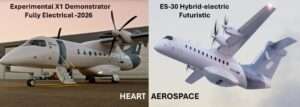
Hybrid option: Heart Aerospace’s battery-operated X1 aircraft that completed its maiden test flight on 12 August 2026 paved the way for the company’s planned ES-30, a futuristic 30-passenger commercial airliner featuring hybrid-electric architecture. Weighing 11 tonnes, this experimental battery-powered aircraft closely matches the scale of a traditional and actively flown jet-fuel-powered ATR 42 regional plane, except for its lengthier and massive 32-meter wingspan, which is uniquely designed to carry 5 tonnes of batteries. For comparison, an empty ATR 42 weighs roughly 11.7 tonnes with an 18-tonne maximum take-off load, carrying up to 50 passengers across 1,500 km. In contrast, the X1 is optimized for short routes under 200 km with 9 to 19 passengers. At these shorter ranges, the immense battery weight becomes highly manageable, allowing airlines to leverage the massive economic advantages of electric motors, including drastically lower mechanical maintenance and operating costs.
A basic calculation indicates that 5 tonnes of batteries yield roughly 800 kWh to 1 MWh of capacity. Due to the high energy demands of an ATR-42, an all-electric flight would last a mere 30 to 40 minutes, covering just 200 km excluding taxiing. Consequently, extending the ES-30 hybrid aircraft’s range beyond this 200 km limit requires relying on aviation fuel. Furthermore, regional airports would need to install 1 MW chargers to maintain a standard 30-minute turnaround time.
I conclude with a message that this technology is still in an embryonic stage, and it would be some significant amount of time before these aircraft make a meaningful contribution to aviation. True innovation is measured not by how it alters our world, but by how it betters it, reminding us that Technology remains a helpful servant yet a dangerous master.


Nice and interesting article packed with scientific facts and data.let us hope for scientific breakthrough that will make electric aviation possible during our lifetime. 🙂
Yes, physically it appears to be impossible. However, if we consider other than Lithium batteries some of which are a little beyond the laboratory stage, we can still hope to expect a breakthrough. BESS cost is required to crash for energy security anyway, so one spinoff of that affordability will reflect on longer haul flights…. As far as timelines are concerned, I have always been an optimist. We will see it within a decade from now.
wonderful article in simple terms enriching us with so much of information about the road how the world is moving..
Dr. Chadha Garu, very insightful and thought-provoking article. One question that came to mind while reading it: why isn’t the aviation industry looking more aggressively at hybrid propulsion, similar in principle to hybrid cars?
Instead of depending entirely on heavy batteries, could aircraft combine conventional aviation fuel with electric motors and batteries—using electric power during take-off/climb or shorter phases and fuel for cruising and longer distances?
Would such a hybrid approach offer a practical middle path until battery technology improves, or would the additional weight and complexity of carrying both propulsion systems outweigh the benefits?
Would love to hear your perspective on this.
Yet another super article on the current developments across the globe. The author rightly said you can never break the laws of physics or nature. Worth reading to check and update our knowledge in this subject. Let us watch developments. Hats off.