



There is growing concern that excessive reliance on LLM-based AI assistants such as ChatGPT, Gemini, Claude and others in knowledge-based professions may reduce active engagement in critical thinking, independent analysis, creativity, and learning. As the language component of the broader AI ecosystem, these models are rapidly transforming the way we work and learn by personalising education and democratising access to knowledge. However, their overuse may have cognitive consequences, potentially affecting how our brains think, learn, and process information.
In a first-of-its-kind experiment, scientists at the Massachusetts Institute of Technology, USA, examined the cognitive effects of using ChatGPT for essay writing by three groups comprising 54 participants aged 18 to 39 years; one group used ChatGPT and the two others, a search engine and the brain-only (no tools). The scientists used EEG (electroencephalography) to monitor brain activity, conducted natural language processing analysis of the essays, and interviewed participants afterwards.
The results were startling and revealed the evidence of “cognitive debt”. A cognitive debt is not a medical diagnosis but a metaphor for a possible long-term cost of letting AI do thinking for us. When AI writes, summarises, or solves a problem for you, the task gets done quickly and the benefit is immediate but with long-term effects. Think of it like financial debt, which is easy to accumulate and may remain invisible initially. But the repayment comes later, when you have to do the same work without AI and realise you never truly learned it. The salient features of the experiment results are summarised below.
ChatGPT Group: Participants who relied on ChatGPT showed notable deficits in memory and essay ownership. Notably, 83% were unable to quote accurately from essays they had written only moments earlier. Their essays were also more homogeneous, showing significantly less variation than those of the other groups, an indication of reduced originality and more standardised, “run-of-the-mill” output. In terms of brain activity, neural connectivity declined systematically as the level of external support increased. When asked to write without AI assistance, participants in this group showed approximately 55% lower neural connectivity than the brain-only group.
Brain-Only Group: Participants who wrote without AI assistance produced essays with greater variation, suggesting more original and individualised thought. They were also able to recall and quote much of what they had written, reflecting the highest sense of ownership. Their neural connectivity was the strongest and most widespread. Moreover, when these participants later used AI tools to refine their brain-only essays, the resulting work showed substantial value addition.
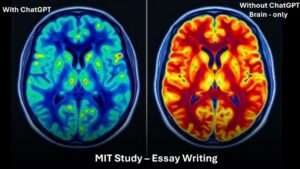
The group that used a search engine performed better than the ChatGPT group participants. The studies clearly demonstrate that LLMs may help a user in the short term but will diminish critical thinking, reduce creativity and independent thinking, increase vulnerability to bias and manipulation, and lead to shallow information processing. The study concluded that AI assistance fundamentally restructures our cognitive architecture and experimentally demonstrated how our brains process and retain information.
To me the results are not surprising. Common wisdom tells us that an unused brain may lose its sharpness and possibly atrophy over a period of time, if not used properly. Atrophy means the gradual shrinking or weakening of a tissue or organ, often due to disuse, ageing, poor nutrition, or disease. The MIT research suggests that excessive long-term dependence on LLMs may similarly weaken cognitive engagement, changing how we process and retain information, though it does not establish any permanent brain damage.
The brain is not a muscle, but it weakens with disuse. When we stop challenging it, unused neural pathways may be pruned to conserve energy, potentially contributing to cognitive decline, a gradual loss of memory, attention, language, reasoning, and planning ability. So, use your brain or risk losing its edge.
Caution: As of today, LLMs are prone to hallucination that is generating information that may sound convincing but maybe inaccurate on which you cannot rely on completely. LLMs are designed and trained to mimic how people use language, which is not the same as genuinely understanding the world. In simple terms, LLMs are trained on vast amounts of text and are scored on their ability to predict the next word in a sequence. As a result, they are highly skilled at generating text that resembles their training data. The fact that such text often aligns with reality is useful, but it is essentially a by-product of language prediction and not a guarantee of factual accuracy.
LLMs cannot reliably recognise situations in which the answer to a question lies outside their training data. Instead, they are designed to generate a plausible sequence of words that could serve as an answer. In other words, they produce text that sounds like an answer, whether or not it is factually correct. Considerable research is underway to combine the linguistic capabilities of LLMs with rigorously verified facts encoded in symbolic systems. I expect these efforts to bear fruit, and hallucinations may become less frequent over time. At present, however, I remain cautious about any output generated by an LLM assistant. Until these issues are fully resolved, always cross-verify important information.
Final word: In today’s world, and increasingly in the times to come, I see LLM-based AI assistants as a permanent fixture in knowledge-based professions, especially software development, writing and content creation, research, education, customer service, finance, healthcare administration, law, and marketing. Despite their pitfalls, their true value lies not in acting as a surrogate teacher that explains every concept from scratch, but in serving as a collaborative tool for brainstorming, summarising complex reading material, and providing immediate grammar feedback.
So, do not resist these new tools or insist on doing things the “old way.” That would be like performing long division by hand while your competitor uses a calculator. Although traditional skills may still be valuable, they are unlikely to earn much appreciation in a world where everyone else is using technology to work faster and stay ahead. You can certainly remain a purist and prefer traditional methods of working, problem-solving, or creating, while making effective use of new technology. My advice is to ride the wave of technology-driven innovation with little or no fear. Humans are highly adaptable, and the world has always evolved through periods of rapid change and always will.
The takeaway: Use LLM-based AI assistants thoughtfully, while remaining cautious about optimising ourselves into a soulless, machine-driven oblivion. Do not outsource your writing entirely to AI. Instead, flex your mental muscles in a landscape increasingly dominated by “autopilot.” While writing articles, research papers, or any other document, “think first, then use a search engine or AI to organise your ideas without falling into a bias trap”. Without that first step, the result may be generic and will be a uniform output that lacks the texture of independent thought and may have errors. Used this way, LLMs can become a force multiplier. Remember, AI is meant to help you execute, not to replace your ability to think.

