



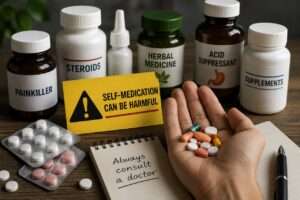
“I had this pain before, so I took the same tablet.” “My friend takes this steroid whenever she has a bad allergy.”
“It is herbal, so it cannot harm me.” “I take this acidity tablet every day. It is harmless.”
“My vitamin supplement is good for everyone.”
These statements sound ordinary. In fact, they represent one of the most overlooked problems in modern healthcare: medicines being treated as everyday commodities rather than pharmacologically active substances.
A 2025 systematic review and meta-analysis of 66 studies involving nearly 30,000 participants found that self-medication was highly prevalent in India, with a pooled prevalence of 64.4%. Analgesics, antipyretics, antibiotics and cough remedies were among the commonly self-medicated medicines.
The reasons included the perception that an illness was minor, lack of time and financial constraints, fear of a bunch of blood tests, X-ray scans, etc. But self-medication is not limited to antibiotics. Some of the greatest risks may come from medicines people consider completely routine.
Painkillers are the Plain killers
Painkillers are probably among the most commonly self-medicated medicines. A headache, backache, dental pain, muscle pain or fever appears, and a tablet is taken without much thought. Non-steroidal anti-inflammatory drugs (NSAIDs), such as ibuprofen, diclofenac, naproxen and several others, can be extremely useful medicines when used appropriately. But they can also affect the kidneys, stomach, blood pressure and cardiovascular system.
A 2024 systematic review and meta-analysis involving more than 1.75 million participants found a significant association between chronic NSAID use and the occurrence or progression of chronic kidney disease. The risk becomes particularly important when kidney blood flow is already compromised. Dehydration, older age, pre-existing kidney disease and certain combinations of medicines can make the kidneys more vulnerable.
The so-called “triple whammy”—an NSAID taken together with a diuretic and a renin-angiotensin system blocker such as an angiotensin-converting enzyme inhibitor (ACE inhibitor) or angiotensin receptor blocker (ARB)—has been associated with a 1significantly higher risk of acute kidney injury.
A recent systematic review and meta-analysis found approximately twice the odds of acute kidney injury with this combination, although the certainty of the evidence was low. The problem is not that every person who takes a painkiller will damage their kidneys. The problem is taking it repeatedly without knowing whether one is among the people at higher risk.
And there is another danger: different cold, fever and pain preparations may contain the same or related active ingredients. Taking several products for the same symptoms can unintentionally increase the total dose.
The United States Food and Drug Administration (FDA) also warns that taking more than the recommended dose of common over-the-counter pain and fever medicines can cause serious injury.
Steroids: The quick relief that can come at a cost
Steroids are powerful medicines. They can be life-saving when properly prescribed for conditions such as asthma exacerbations, severe allergic reactions, autoimmune diseases and many inflammatory disorders. The problem begins when steroids become a shortcut. A person develops a rash, body pain, cough or allergy and takes a steroid because “it works quickly.” And it often does. That rapid improvement can create the false impression that the medicine is harmless. It is not. Glucocorticoids can affect blood sugar, blood pressure, immunity, bones, eyes, skin and the hormonal system.
A 2024 review on glucocorticoid-induced osteoporosis describes the relationship between glucocorticoid exposure, bone loss and fracture risk, with risk influenced by dose and duration. Even short courses are not automatically risk-free. A large population-based study published in The BMJ found increased rates of sepsis, venous thromboembolism and fractures following short-term oral corticosteroid use, although observational studies such as this need to be interpreted with attention to confounding by the underlying illness.
There is another particularly visible problem in India: unsupervised topical steroid use. Steroid-containing creams are sometimes used for fungal infections, itching, pigmentation and facial problems because they produce rapid symptomatic improvement. But inappropriate use can alter the appearance and course of infections and cause significant skin damage.
The lesson is simple: A steroid should never become a medicine that one keeps at home “just in case.”
“Herbal” does not automatically mean safe
Perhaps the most persistent misconception is that something natural cannot be harmful. That is simply not true. Plants contain biologically active chemicals. Some are medicines. Some can interact with other medicines. Some can affect the liver or kidneys. And products containing multiple ingredients can make it difficult to determine exactly what caused an adverse reaction. A 2024 review in Clinical Liver Disease highlighted the continuing problem of liver injury associated with herbal and dietary supplements.
A 2024 analysis in Liver International also identified several herbal and dietary supplement products associated with liver injury, including products containing green tea extract, Garcinia cambogia, turmeric, ashwagandha and multi-ingredient formulations. The authors also highlighted the difficulty of identifying the responsible ingredient because many products contain several compounds. This does not mean that all herbal medicines are dangerous.
It means that the word “natural” should never be used as a substitute for evidence and safety assessment. The doctor should know about herbal medicines too. If one is taking a prescription medicine, a supplement and a herbal product simultaneously, the combination is what matters—not whether one of them came from a plant.
The acidity tablet that never leaves the kitchen
Acid-suppressing medicines have transformed the treatment of acid-related diseases. Proton pump inhibitors (PPIs), such as omeprazole, pantoprazole and related medicines, are highly effective and appropriate for many patients. But a medicine that is appropriate for four weeks is not necessarily appropriate indefinitely. People frequently start an acid-suppressing tablet for acidity, reflux or indigestion and then continue taking it for months or years without reassessing whether it is still required.
A 2025 expert review on PPI prescription and deprescription emphasized appropriate indication, duration, recognition of adverse events and deprescribing when clinically appropriate. The evidence around many alleged long-term complications of PPIs is complicated. Observational associations do not automatically prove that the medicine caused the problem. That distinction matters. But prolonged unnecessary use still deserves review because PPIs can affect nutrient absorption and interact with other medicines, and certain patients may have increased risks of complications. 3The answer is therefore not to fear PPIs. It is to stop treating them as harmless daily supplements.
Vitamins and supplements are not always better
The supplement industry has created another misconception: if a small amount of something is beneficial, a large amount must be even better. It doesn’t work that way. The National Institutes of Health Office of Dietary Supplements notes that supplements can have strong effects in the body, cause adverse reactions, interact with medicines, and create problems when taken at high doses or in combinations. Excessive supplementation can sometimes produce toxicity rather than health. For example, excessive vitamin
A can cause liver damage and weaken bones, while excessive iron can damage the liver and other organs. Certain supplements can also increase bleeding risk or interfere with medicines. Another problem is duplication. A person may take a multivitamin, a separate vitamin D preparation, a calcium tablet, an immunity supplement and a “wellness” powder without realizing that several products contain overlapping nutrients.
The body does not reward us simply because something is labelled “vitamin.” A deficiency should be corrected when present. A supplement should have a reason.
The biggest problem is not the medicine
The real problem is the belief that medicines are interchangeable. A tablet that helped a neighbour may not be appropriate for another person. A medicine prescribed two years ago may not be appropriate for the problem one has today.
A drug that is safe for a healthy young person may be risky in someone with kidney disease, liver disease, hypertension, diabetes, pregnancy or multiple other medicines. And the dose is only one part of the equation. The indication, dose, duration, interactions and individual patient factors all matter. That is why a prescription cannot simply be remembered as a recipe.
When should one stop self-medicating?
Self-care has a legitimate place in healthcare. Not every headache requires a hospital visit, and not every episode of acidity requires extensive investigation. But self-medication becomes dangerous when symptoms are persistent, recurrent, severe or unexplained.
Medical advice becomes particularly important when: Pain keeps returning or requires frequent painkillers; acidity requires daily medication for a prolonged period; steroids are being used repeatedly; several medicines or supplements are being taken together; there is known kidney, liver or heart disease
A person is pregnant or elderly. Symptoms are worsening despite treatment. Unexplained weight loss, bleeding, persistent vomiting or difficulty swallowing occurs. A medicine is being continued simply because it was prescribed in the past. And perhaps most importantly, the doctor should be told everything one takes—including over-the-counter medicines, herbal products, vitamins, protein or bodybuilding supplements and medicines purchased on someone’s recommendation.
The medicine should have a reason
Medicines have transformed human health. The answer is not to distrust medicines. The answer is to respect them. A painkiller can relieve suffering. A steroid can prevent a life-threatening inflammatory reaction. An acid suppressant can heal disease. A vitamin can correct a genuine deficiency. An herbal product may have legitimate therapeutic value. But each can also cause harm when used in the wrong person, at the wrong dose, for the wrong duration, or without understanding interactions.
A recent systematic review of self-medication in India found that the practice is widespread. That makes the message especially important: Do not ask only, “Will this medicine make this person feel better?”
The questions to consider are: “Is this medicine actually needed?”
“How much should be taken?” “For how long?” “Could it interact with something else being taken?” These are the questions one should consider before indulging in self-medication. Self-medication should be discouraged in the interest of one’s own health and to protect the health of future generations.

