Lakshmanrao Upadhyayula
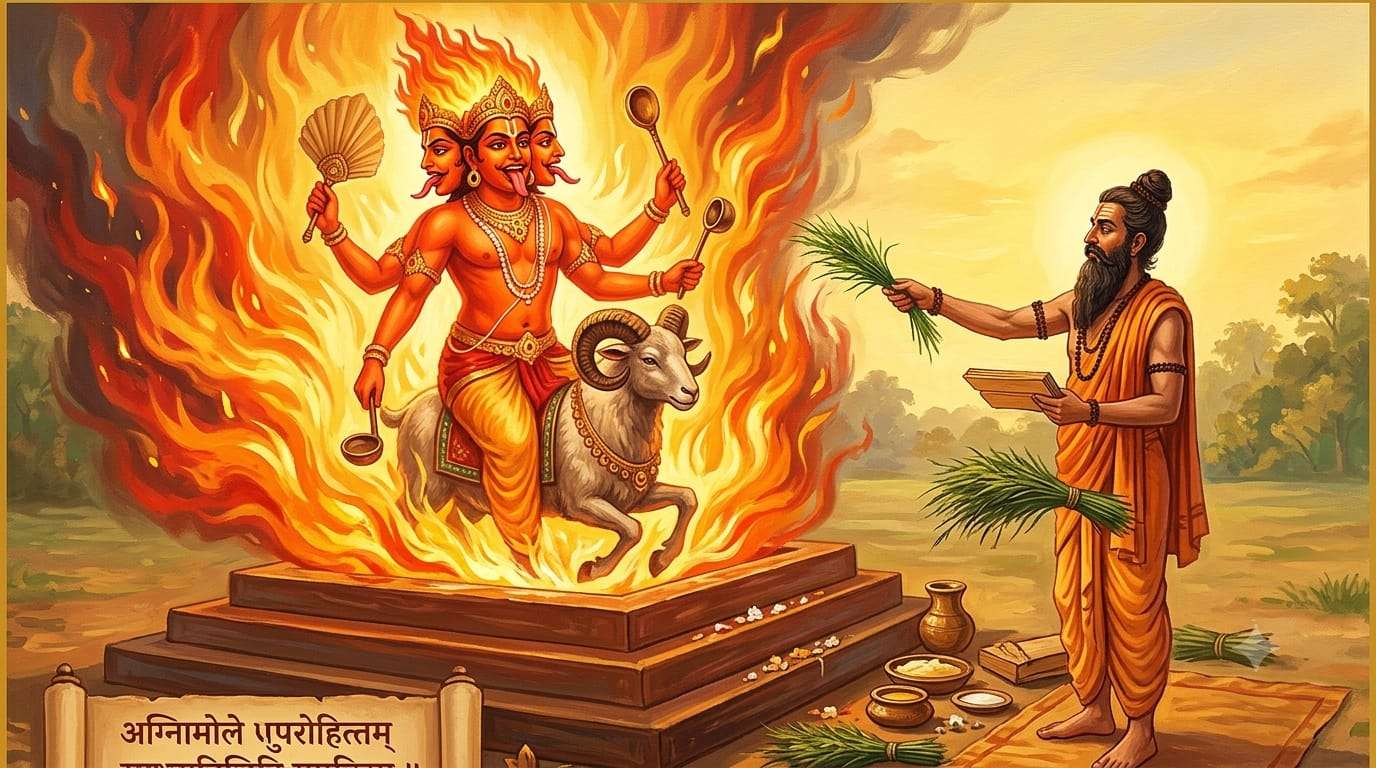
The seer Vishvamitra invokes Agni in the majestic cadence of Trishtubh metre, addressing him as the divine priest who carries the offerings of humanity to the celestial realms. Agni declares, “You have appointed me as the bearer of Soma and the conductor of sacrifice; therefore strengthen me, that I may shine resplendent in this sacred duty.” The worshipper, holding the purifying ladle in his hand, prays that Agni protects both body and mind, sanctifying the sacrificer as well as the rite itself. In the Vedic vision, Agni is not merely physical fire but the conscious intelligence that transforms earthly substances into spiritual energy and conveys human aspiration to the gods.
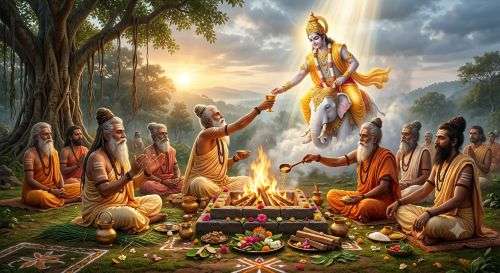
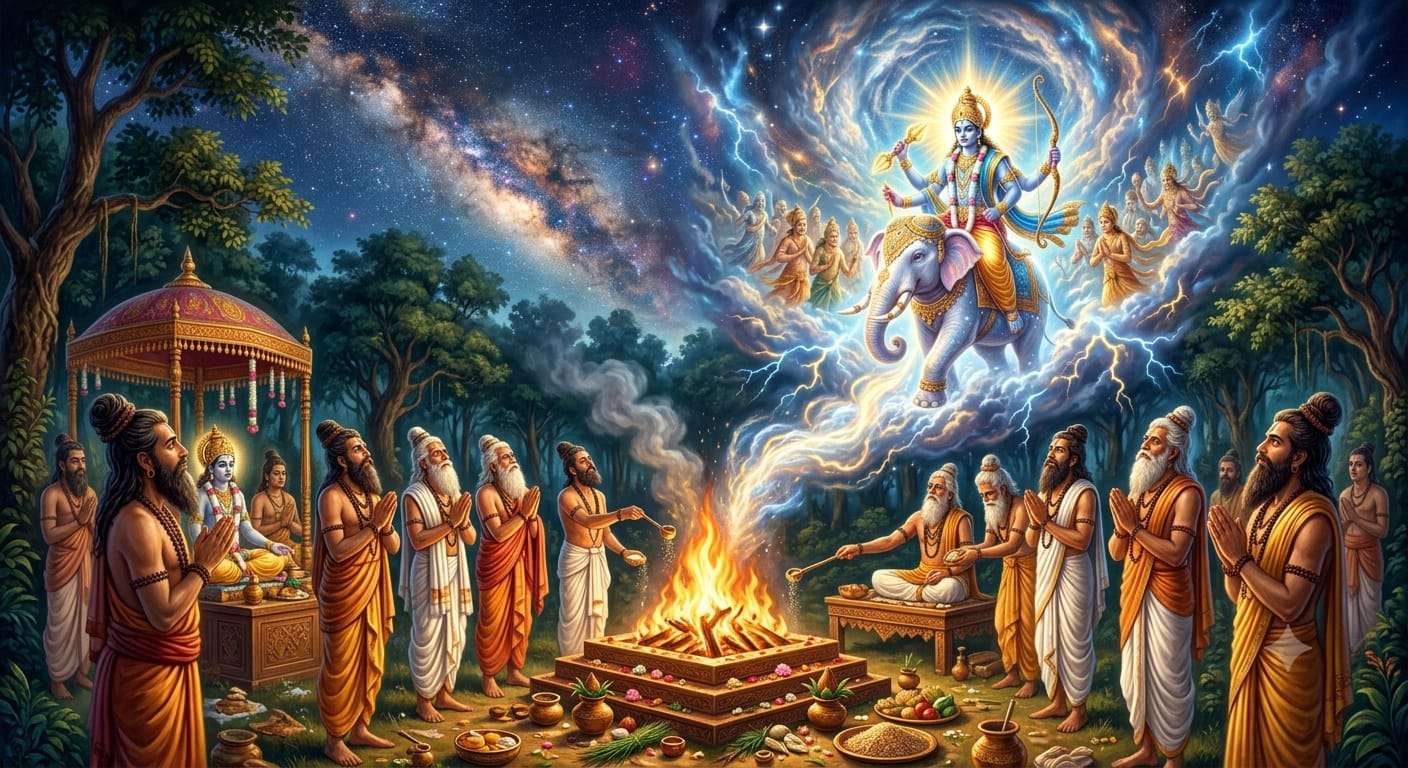
The sages proclaim that the sacrifice has been performed with due reverence. Sacred grass has been spread, fuel sticks arranged, and clarified butter offered into the blazing altar. Drawn by the fragrance of devotion, the gods descend from heaven and inspire the priests with revealed hymns. These venerable priests recognize Agni as the progressive force within creation, the pure and mighty power that advances both the cosmos and human civilization. Born with innate majesty and wisdom, Agni knows the hidden felicities of the heavenly worlds and reveals them to those who approach him with disciplined understanding.
The gods, seeking a mediator between heaven and earth, discovered Agni concealed in the depths of the cosmic waters. Though hidden, he was rich in potential, immaculate in essence, and radiant with self-born splendor. At his birth, the seven sacred rivers—known as the Sapta Sindhu—nurtured him as tender mares gather around a newborn foal. The image expresses a profound natural insight: energy lies latent within water, atmosphere, and matter, awaiting the conditions for manifestation. The gods caused Agni to blaze forth, and by his variegated colors the whole expanse of space was illumined.
Agni envelops the patron of sacrifice in a mantle of divine light. He bestows food, expanding prosperity, and complete abundance. His radiance elevates the worshipper, rendering him worthy to utter the Vedic hymns with clarity and power. As the visible principle of transformation, Agni converts offerings into nourishment and devotion into illumination. Spiritually, this signifies the awakening of inner brilliance; scientifically, it reflects the universal law that energy transforms one state of existence into another while preserving its essential nature.
Agni moves mysteriously through the waters in all four directions, yet the waters cannot extinguish him. This paradox points to the hidden fire present in lightning, in the sun, in living organisms, and even in the molecular energies latent within water itself. Born in the mid-space, Agni is unclothed and yet fully adorned, for his vesture is light. Ancient and ever-renewing, he remains the embryo of creation—garbha-svarupa—carried in the womb of the seven rivers and sustained by the dynamic processes of nature.
When rain descends, Agni multiplies his rays, and these rays are cherished by all beings. Heaven and Earth, the eternal parents, nurture him as father and mother. His strength becomes evident to all who observe his workings: he shines from beginning to end, swift and blazing, pervading every region. Through the hymns of the patron he flourishes, and in response the sweet streams of water are released. This union of fire and rain reveals the Vedic understanding of ecological balance, in which atmospheric heat, evaporation, clouds, and precipitation sustain life in an interconnected cycle.
At the moment of his birth, Agni comprehended the reservoirs of water upheld by the father in the upper regions. He understood the dynamics of the atmosphere and, like Indra wielding the thunderbolt, released the life-giving rains. Together with Vayu and the celestial powers, Agni dwells in hidden caverns, inaccessible to ordinary perception. He stores the waters of space within himself, just as heat is stored within clouds and stars. Thus the Vedic seers discerned that fire and water, seemingly opposed, are in truth complementary expressions of one cosmic process.
Agni alone consumes countless herbs and plants, converting them into light, warmth, and fragrance. The Earth and Heaven, benevolent toward humanity, are his cherished companions. Though space itself is immeasurable, Agni thrives within its vastness, for he is the indwelling energy of the universe. The birthplace of water is the heavens, and Agni is the luminous resident of that expanse. He dwells peacefully among his sisters, the rivers, and becomes the father of all worlds, sustaining life while protecting humanity and overcoming hostile forces.
Visible to all, Agni manifests in many forms. He contains within himself the waters and the healing virtues of herbs. He is brought forth by the auspicious Arani sticks, symbolizing that latent energy emerges through disciplined effort and friction. Ancient yet eternally youthful, self-luminous and worthy of praise, Agni is served by all the gods. The hosts of the Sun, currents of immortal brilliance, take refuge in him, flourishing in the hidden chambers of the cosmic ocean. This imagery evokes both the stellar furnace that powers life and the immortal consciousness that sustains spiritual realization.
The sacrifice prays, “I seek wisdom in the realm of righteousness. Grant me kinship with you. Come with the gods, and by your gracious radiance protect us, our cattle, our birds, and all living beings.” Agni is the commanding leader under whose shelter humanity seeks security and prosperity. Through offerings and disciplined action, the worshippers gain strength to overcome adversity and those who oppose harmony and truth.
Agni is revered by gods and priests alike. He created dwelling places for humankind and resides in every home as the domestic fire. He is the chariot of divine action, carrying the intentions of the gods and fulfilling righteous desires. Daily worship causes his body to shine more brilliantly with clarified butter. Vast, majestic, and ever-moving, he is the king of light whose friendship brings protection, peace, and enduring abundance.
The sage Vishvamitra extols Agni as gentle, non-injurious, beautiful, and graceful, overflowing with sacred hymns and inexhaustible riches. Agni is the ancient and universal head of the sacrificial order. To please him, the seers composed these metrical prayers and chanted them in the rhythms of the Veda. He belongs to all the elements and dwells among human beings as the benefactor of all. His power is immeasurable, and his function is to carry the subtle essence of every offering to the gods.
Agni is the cause and consummation of sacrifice. Through his grace, cows, food, wealth, and noble offspring are bestowed upon the patron. He sustains lineage, prosperity, and spiritual continuity. Therefore the hymn concludes with a prayer of humility: “O Agni, show us your mercy. Lead our offerings to the gods. Nourish us with food, bless us with great wealth, and grant children who will uphold our heritage.”
In the deepest sense, Agni is the flame of consciousness within every being. He is the digestive fire that transforms food into vitality, the intellectual fire that converts knowledge into wisdom, and the spiritual fire that burns ignorance into illumination. The Vedic seers perceived in Agni both a scientific principle of universal energy and a sacred symbol of divine presence. Wherever transformation occurs—within stars, storms, living cells, or awakened hearts—there Agni shines, eternal priest of the cosmos and luminous bridge between humanity and the Infinite.