



Ego is an assertive thought, just as the mind is an impulsive thought and intellect is a rational thought. You can appreciate a higher cause to the extent that you have diluted your ego. This ego thought is generated by one; it does not come on its own. We have mobilised it, and so we have to immobilise it. An egoistic person attributes his entire actions and success to himself. When we understand that the fruit of success we experience is the culmination of the team’s collective effort, the ego gets diluted. Even if one member of a team is a thorn in your flesh, you may not be successful. If success is coming your way, you have to bow down to every individual who has played their role to the larger cause you have conceived. If you can keep the common interest above yourself, even if your subordinate or manager’s idea is going to benefit the organisation, why not accept it and not look at it egoistically?
When one is consumed by arrogance, they revel in their own self-inflated ego. We have to consciously liquidate the ego. The pivotal point for liquidating the ego is to identify a higher cause or goal. Thereafter, you become a mere instrument in serving the cause. You become a part of the totality and not the totality itself. When the goal is loftier, your individuality becomes smaller. Without any goal, the individual’s centre is on himself, and he arrogates himself as the cause of everything. When one has a high ego, his friction with the world is greater. Ego ends up in creating disruption and conflict. So to reduce friction, we have to reduce our ego.
A child has no ego, and so everyone loves the child. As you evolve spiritually, you are like a child. People are drawn to a spiritual person because of his non-egoistic nature. As the child starts growing up, he exhibits the attitude of ‘I’ and ‘mine’. Ego starts manifesting it.
In the Bhagavad Gita, while the Lord is explaining the divine qualities, He has mentioned ‘no much pride’ because individuality itself is ego. The fact that we are born and carry a name and identity implies we have ego. The moment you have created individuality, you have separated yourself from totality. The ego exists till we attain Self-realisation.
Above the individual ego, we have other egos for our success, position, fame… We can strive and reduce this additional ego before we reach the state to nullify the individual ego.
When you stand up for what is right and the truth vis-à-vis to prove somebody wrong is self-respect. One has to live up to their Conscience. Self-respect is not to pat your ego, but to stand up for the truth, Satyam. When you are assertive and stand up for self-respect, it does not agitate you. The moment you have an egoistic relationship it unsettles you and brings about a lot of discomfort within you. Dealing with ego is like walking on a slippery surface. When ego reduces, you become humble and modest, and the noble qualities start surfacing.
If you have a Guru and if you allow the Guru to play an active role in your life, the Guru crushes your ego. He does not pamper your ego and keep complimenting you. In the space of devotion and surrender to the Guru, you accept the demolition of your ego. The symbolic representation of crushing the ego is the offering of a coconut in a temple. A coconut is offered through the pujari, who removes the tuft, breaks the coconut, and offers to the Lord.
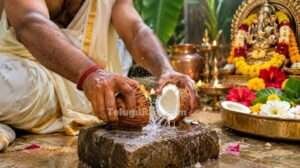
Pujari is the Guru and the coconut is the individual ego.
When the coconut is broken, the white kernel is exposed. The white kernel is the Atman. When you offer your ego to the Guru, the Atman is revealed.
Atman being shown at the altar symbolises the individuality merging into totality. The true Self in you has realized the Brahman.
We present the coconut by removing the coir and leaving only the tuft. Coir is the desires; we have to approach the Guru with most of the desires removed, except the tuft, which is a few desires.
Pujari removing the tuft is compared to Guru breaking the ego. A student has to do the sadhana before he approaches the Guru. The job of the Guru is to break the ego.
When you go with the attitude of surrender, you know the Guru is bringing the best out of you. You do not get into antagonizing or challenging him.
Leaving footwear outside the temple or meeting a Guru is to leave your fame, success, and ego to enter the temple or approach the Guru.
In the Mahabharata war, Sanjaya describes how Arjuna and King Duryodhana approached Lord Krishna. Sanjaya brought out the arrogance of Duryodhana by addressing him as King. He did not address Arjuna otherwise, as Arjuna was humble when he approached Lord Krishna.

