


The recent shooting incident between two rival coaching centres in Patna exposes the ugly face of Bharat’s booming “dream-selling industry”. Many of these centres prey on innocent and aspiring students, masquerading as providers of affordable education while exploiting them for profit. These centres portray themselves as “revolutionary,” but exploit through deceptive advertisements and star-faculty bait to lure students. They sell false dreams of guaranteed success, often using inflated results and photographs of top rankers. But this is all a hoax.
Today, coaching centres in Bharat have become a high-profit-making industry where aggressive marketing, one-size-fits-all pitches, zero personal attention unless you are a top-ranker take precedence over education. The stress is only on cracking the competitive exams by scoring high ranks to get admission into elite educational institutions in the country. These centres have turned into coaching factories where students are products and results are a part of branding. They have standardized mass production of “rank chasers” rather than fostering genuine learning, treating students as units to manufacture success stories. If you ever have a chance to talk to a tutor running a coaching centre, you will come out with a feeling that he is more a salesperson than an educator.
Coaching Centres: The primary reasons for coaching centres to boom in Bharat are, i) Highly competitive entrance tests like IIT-JEE, for engineering, NEET, for medicine, and UPSC for elite government administrative services, ii) The mainstream schooling system has not evolved to meet the demands of a hyper-competitive and exam-driven selection process into elite institutions. There is a mismatch in curriculum and teaching techniques, iii) Demand-supply imbalance because of high demand (lakhs of aspirants due to a massive youth population) and limited supply (few seats in top institutions), iv) Parents’ high ambitions, anxieties and social pressures, iv) Craze to become doctors, engineers, IAS, IPS or other high ranking positions in civil services, a status symbol and upward mobility in the society.
Realising the potential of the unregulated coaching industry with huge profit margins due to the unending availability of vulnerable consumers, these centres are mushrooming in several parts of the country. As the competition grows, there is a race to attract new aspirants to their centres by luring them with promises that are never kept. On the contrary, several unethical practices are adopted to fool people to maximise their profits.
Unethical practices: A few of the unethical practices are listed, though the list could be long. i) Misleading advertisements using names and photos of top-rankers without permission, ii) Multiple institutes claiming the same toppers as their student even if he or she took one single mock test at their centre, iii) Assuring 100% success guarantees, iv) Toppers buyoff by paying huge sums of money to top scorers and use them exclusively on promotional posters, v) Batch segregation based on initial entry scores where top faculties and resources are funnelled exclusively to the elite “star batches” to secure ranks, while average batches receive less experienced tutors despite paying the same high fees. I would recommend readers to watch Kota Factory, a web series on Netflix, which is in its third season now, to know about segregation of batches and (vi) Unsafe, unhygienic, poorly ventilated, and crammed classrooms resembling ghettos. The 2024 incident of students losing their lives in the basement of a coaching centre in Old Rajender Nagar, New Delhi, is still fresh in people’s memories.
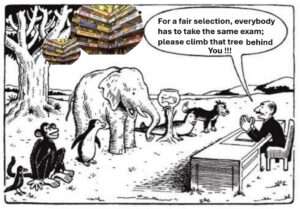
What needs to be done? We are all aware that every child possesses certain inherent capabilities; restricting them all to conventional pathways like engineering, medicine, or civil services could be counterproductive, overlooking the vast spectrum of human potential. It would be unfair to them if they were asked to take a common test that does not fit their natural abilities. The cartoon below depicts today’s reality.
Parents and teachers play a major role in shaping a child’s destiny. Brains are not wired the same way in every child who are born a learner and just need a supportive environment to bring out their natural talents. Parents should be more communicative with their children and ask them about their interests rather than imposing their expectations. Very early, while growing up, children show their inclination towards certain activities that need to be picked up to guide them to their matching careers. Children excel when profession aligns with natural strengths.
For example, some children show their preference in sports, some in arts, music, painting, photography, linguistics, writing, reading, environment, handling money, and many other traits that will lead to several pathways, other than engineering, medicine or administrative professions. Typical childhood preferences towards engineering are, curiosity about how things work, problem-solving skills, interest in math, physics, and logic, dismantling and reassembling, coming up with solutions, etc. And for doctors – interest in the human body, loves biology, empathetic towards people, helping nature, study long hours, etc.
To reduce the dependence on caching centres, both the government and parents must take coordinated action. The government should realise that just policing coaching centres and levying heavy penalties are not enough; it needs to adopt a holistic approach combining curriculum reform, stronger regulation, career awareness, and exam system overhaul. On the part of parents, they need to change their mindset and realise that children’s happiness and unique talents matter more than forcing them into narrow medicine, engineering or UPSC tracks. Look at the recent UPSC results, the government data indicates that over 64% to 70% of selected candidates have engineering or medical backgrounds in an administrative profession! It explains that children will anyway choose the profession of their liking even after going through the grilling in coaching centres for NEET or JEE examinations.
A healthy society needs diversity of talents, not only doctors, engineers, or administrators, and a lot of alternative paths are available for children to pursue a career of their liking. Forcing them into a uniform competition will waste human potential and create mental health crises. I conclude with advice. “Let children chase their dreams because, if they choose a job they love, they will never have to work a day in their lives”.


no true kids are over burdened by Parents expectations tend to do what they don’t want to do and in return they are always. …lost not enjoying the work ….not their choice give them freedom to choose their carrier and d hope for the best
Very well thought of one of the current affairs. Worth reading and noted by all, institutions, parents, students, etc. Excellent information.
Good piece of advice to children and parents. However, it may not have much effect in this competitive world.
Our system of education itself is not competition oriented except for a few institutions. It is simply a subject orientation. TF students r forced to attend the coaching classes that is where the business starts. Frequent leakages of question papers even at national level exams is also jeopardising the ambitions
of both the students n parents as well.
In some cases financial constrains would be there for aspirants if one want to choose their subject of interest.
The author always brings out a timely topic either to educate r awaken the concerned system. A good article.